
AI Automation Agency vs Freelancing: Which Business Model Is Better in 2026?
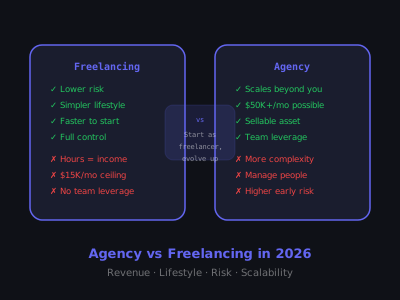
When people decide to monetize AI automation skills, they face an immediate fork in the road: freelance as an individual, or build an agency? Both paths are viable in 2026, but they lead to very different businesses, lifestyles, and income ceilings. This guide gives you a direct, honest comparison so you can make the right choice for your situation, including the specific numbers, processes, and decision points most guides skip over.
Two people with identical automation skills approach the same dental practice client. The freelancer says: "I charge $150 per hour to build automations." The agency owner says: "We build a full patient follow-up and reactivation system for $4,500 with a $1,200 per month retainer to maintain it." Same underlying work. The agency owner wins the deal at three times the revenue per client and positions the engagement around an outcome the dentist actually cares about, more booked appointments, rather than hours of technical labor. That difference in positioning is the core of the agency vs. freelancing choice.
Revenue Potential: Agency Wins at Scale, Freelancing Wins Early
In months one through three, freelancers often earn more. Lower overhead, faster to close deals, simpler offer. A skilled freelancer can hit $3,000 to $6,000 per month within 60 to 90 days. In months four through twelve, revenue converges. Freelancers hit a ceiling around $8,000 to $12,000 per month (limited by hours). Agency owners who have hired or systematized can surpass this. By year two and beyond, the agency wins decisively. Agencies with two to four contractors regularly hit $20,000 to $50,000 per month. Freelancers almost never exceed $15,000 to $18,000 per month sustainably without burning out.
Why does the freelancer ceiling exist? A skilled automation freelancer working 40 hours per week, billing 25 of those at $150 per hour, generates roughly $3,750 per week, about $15,000 per month before taxes at full utilization. Raise your rate to $200 per hour and you hit $20,000 per month maximum, with no room for vacations, sick days, or business development. That math does not change no matter how good you get.
Agency math works differently. If you charge $3,500 for a build project and your contractor costs $800 to complete it, your gross margin is $2,700. Bring that contractor to ten builds per month at a mix of project and retainer work and your revenue is $35,000 with $18,000 to $22,000 in gross profit, while you focus on selling and client relationships rather than building. Your personal hours are no longer the bottleneck.
12-Month Revenue Trajectory, Agency vs. Freelancing (Same Starting Skills)
Lifestyle: Freelancing Is Simpler, Agency Is Scalable
Freelancing offers a cleaner lifestyle in most respects: no payroll, no managing contractors, no team drama. You work exactly when and where you want. Finances are simpler with one income source and minimal overhead. The downside: your income is directly tied to your time. When you take a vacation, revenue pauses. When you get sick, revenue pauses.
There is also a subtler lifestyle cost to freelancing that most guides do not mention: context-switching overhead. When you have eight active clients, each week requires you to context-switch between eight different tools, industries, and communication styles. That cognitive load adds up. Agency owners who have a delivery person handling the builds only need to manage client relationships and strategy, a significantly lower cognitive load per client.
Agency ownership introduces complexity: managing people adds overhead and stress, client delivery depends on others so quality control becomes a constant concern, and cash flow is less predictable early on. However, a well-built agency can eventually run without you in the day-to-day. Freelancing structurally cannot. If you want to take a six-week sabbatical in year three, the agency path makes that possible. The freelancer path does not.
Risk Profile: Freelancing Is Lower Risk
Freelancing has a lower risk floor and lower risk ceiling. The worst case is earning nothing for two to three months with no employees to pay, so the financial damage is limited. Agency risk is higher in both directions. The upside is scaling to $30,000 or more per month and building a sellable business asset. The downside is hiring before you have stable revenue and having contractor costs you cannot cover.
The most common agency failure mode is hiring too early. The rule: do not bring on contractors until you have more work than you can handle and at least three months of retained revenue locked in. Retainer revenue covers your contractor's base cost even in a slow month. Project revenue alone will not, one dry month and you are paying someone with no incoming work.
Scalability: Agency Wins Clearly
Scalability is the only dimension where the agency model has a clear, unambiguous advantage. Freelancing scales linearly at best, you can raise your rates, but you cannot serve 20 clients simultaneously as a solo operator. Agencies scale through leverage: systems, people, and productized services.
An agency does not need to be large to be leveraged. Even a two-person operation, you as the sales and strategy lead, one contractor doing technical builds, can service eight to twelve clients simultaneously and generate $15,000 to $25,000 per month. There is also a third type of scalability most people overlook: productization. Instead of custom-building every automation from scratch, agency owners can develop templated workflow packages for specific verticals that can be deployed in a fraction of the original build time, dramatically improving margins.
Scalability also applies to exit value. A freelance practice is not sellable, when you stop working, there is nothing to sell. An agency with documented processes, recurring revenue, and a team that delivers without the owner is a sellable asset. Service businesses in the AI space have sold for two to four times annual recurring revenue. A $300,000 per year agency is worth $600,000 to $1,200,000 at exit. That exit option simply does not exist in the freelance model.
Which Model Fits Which Personality Type
Choose freelancing if you are highly technical and love doing the actual work, dislike managing people or find it draining, value lifestyle flexibility over income maximization, are risk-averse and prefer stability over growth, or are in an early learning phase and need to build skills before scaling.
Choose the agency model if you are energized by selling and business development, want to build something that runs without you eventually, are comfortable with more complexity and higher variance, want to build a sellable asset rather than just income, and have leadership instincts and enjoy developing other people.
Agency vs. Freelancing, Head-to-Head Comparison
The Hybrid Path: Start as a Freelancer, Evolve Into an Agency
The pragmatic approach for most people is to start as a freelancer, explicitly with the intention of building an agency. This means pricing your work at agency rates from day one (not freelancer rates), documenting every process you build as if someone else will execute it later, building your LinkedIn presence and outreach system from the start, and bringing in your first contractor when you consistently hit $8,000 to $10,000 per month.
The documentation habit is worth emphasizing. From your very first client project, maintain a simple build log: what the client needed, what tools you used, the key workflow logic, and any challenges you hit. Over six months this becomes a library of reusable templates and a training document for your first hire. Without it, you are starting from scratch every time you onboard someone new. With it, a new contractor can ramp up in one to two projects instead of five to six.
Regardless of which model you choose, the client acquisition strategy is identical in the early stages. For the outreach system that works for both freelancers and agency owners, see our guide on LinkedIn outreach sequences for AI agencies. For the complete launch roadmap, see our guide on how to start an AI automation agency in 2026.
Program · 90 days
Client Accelerator bundles the demo software with live coaching.
A one-time $1,499 purchase, or 4 interest-free payments of $374.75. Includes Ciela AI with 150 personalized demos each month throughout the program, the 90-Day AI Client System, two live group coaching calls every week, sales and outreach templates, 200+ n8n workflow templates, and private Build With Adhiraj resources.
See what is includedCiela AI is the demo platform for AI agencies and AI consultants. It turns any prospect's website into a live, personalized AI demo (chat, voice, or missed-call text-back) you can send before the first call.
Start Client AcceleratorCiela AI pricingAgent builds by nicheAll articles
Community · Training
Join Build With Adhiraj free.
Build With Adhiraj is the free community for people building and growing AI service businesses. Learn alongside other operators as you package, demonstrate, sell, and deliver practical AI systems.
Join Build With Adhiraj free