
The Best AI Automations to Sell to Ecommerce Store Owners in 2026
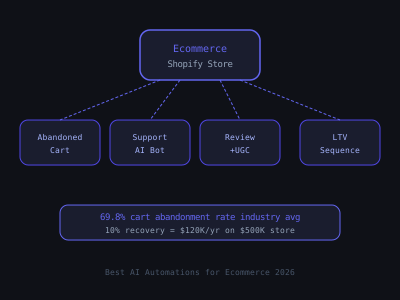
Ecommerce store owners are a uniquely receptive audience for AI automation. They already think in systems, conversion rates, customer lifetime value, cart abandonment rates. They understand that every 1% improvement in a key metric translates directly to revenue. For AI automation agency owners, ecommerce offers some of the highest-value and most measurable automation opportunities available. You can point to specific metrics before and after, the ROI is undeniable, and unlike service businesses, ecommerce owners are already comfortable with technology. The average Shopify store has a 69.8% cart abandonment rate, meaning for every dollar it earns, it is losing nearly $2.30 to abandoned carts alone, and that is just one of six high-value automation opportunities.
Qualifying the Right Ecommerce Clients
Not every ecommerce store is worth pursuing. Target stores doing $15,000 to $200,000 per month in revenue. Below $15,000 per month the ROI math barely works for your pricing. Above $200,000 per month they often have an in-house team or agency already. The sweet spot is $30,000 to $100,000 per month, big enough to have a real problem, small enough to not have a solution yet. Shopify is the gold standard for automation integrations, with Klaviyo, Gorgias, Postscript, and Okendo all having native apps. Identify automation gaps before outreach: add a product to cart, abandon it, and wait an hour. If you get nothing, they have no recovery flow at all, that is your opener. The verticals with strongest repeat purchase potential are apparel, supplements, pet products, home goods, and beauty.
Ecommerce Automation ROI: Six Core Opportunities
The Six Highest-Value Ecommerce Automations
1. Abandoned Cart Recovery Sequence ($497–$797/month)
A standard single abandoned cart email recovers about 3 to 5% of abandoned carts. A 3-touch AI-optimized sequence recovers 8 to 15%. The structure: one hour after abandonment, an email with cart items and no discount yet, a simple reminder with product images and a direct link back to cart. At 24 hours, an email with a light incentive: a 10% off offer to help them decide. At 72 hours, a final email with urgency referencing limited stock. Add SMS to the sequence for a significant lift, SMS cart recovery messages see 3 to 5x higher click rates than email. The ROI calculation is compelling: a store doing $500,000 per year with a 70% abandonment rate is abandoning roughly $1.2 million in cart value annually. A 10% recovery rate adds $120,000 in revenue against a $9,564 annual service fee, a 12x ROI. Use Klaviyo's “Checkout Started” flow with 1-hour, 24-hour, and 72-hour delays. Add a conditional split so purchased contacts exit the flow.
2. AI Customer Support Bot ($597–$997/month)
Train an AI on the store's FAQ, shipping policy, return policy, and product catalog, then deploy it on the website, SMS channel, and email. The AI handles the five question categories that make up 70% of support volume: order tracking via Shopify API, return and exchange requests, product comparison questions, stock checks, and order modification requests. Complex or negative sentiment tickets escalate to a human with full conversation context. Most stores using this system reduce support ticket volume by 40 to 60%, saving 20 to 40 hours of human support time per week. The fastest path for Shopify stores is Gorgias with its built-in AI features augmented by a custom GPT knowledge base for product-specific questions. Build a sentiment detection layer so messages with negative intent language go straight to a human flag, never let AI be the only touchpoint for an angry customer threatening a chargeback.
3. Post-Purchase Review and UGC Generation ($297–$497/month)
Build a timed post-purchase review request sequence. For physical products trigger 7 to 14 days after delivery, allowing time for use. For 5-star raters, ask for a photo or video with a small incentive. For 3-star or below ratings, route to direct support for service recovery before the review goes public, this converts dissatisfied customers into satisfied ones and is a feature most small ecommerce stores have never thought of. Stores with more reviews and higher ratings see 15 to 30% increases in conversion rate. This automation compounds over time as reviews accumulate and drive organic traffic.
4. Post-Purchase LTV Maximization Sequence ($397–$697/month)
The average ecommerce store has a 27% repeat purchase rate. Stores with strong post-purchase sequences average 40 to 50%. Build a 90-day sequence: a product upsell recommendation on day 14 based on purchase history, an education email on day 30, a cross-sell on day 45, a loyalty offer on day 60, and a win-back with discount on day 90 if no second purchase has occurred. For consumable products, supplements, coffee, skincare, pet food, add a replenishment reminder at 80% of the expected usage cycle. If a bottle lasts 30 days, send the reminder on day 24. These replenishment emails typically see 20 to 35% click rates because the timing is genuinely useful. If your sequence lifts repeat purchase rate from 25% to 35% for a store acquiring 500 new customers per month, that is 50 additional repeat buyers per month, $3,750 in additional monthly revenue at $75 average order value.
5. Inventory Reorder Alert System ($197–$397/month)
Build an automated monitoring system that alerts the owner when a best-selling SKU drops below a set threshold, generates a reorder suggestion with quantity based on historical sales velocity, and flags slow-moving inventory for promotion campaigns. Stockouts cost ecommerce stores an average of 4.1% of annual revenue, for a $500,000 store that is $20,500 per year. Build this in n8n with a scheduled trigger running every morning, pulling inventory from Shopify's Inventory API, comparing each SKU against a threshold sheet, and sending a formatted alert with the SKU, current stock, recommended reorder quantity, and a link to the supplier's order page.
6. Winback Campaign for Lapsed Customers ($397–$597/month)
Segment customers who have not purchased in 90, 180, or 365 days and run targeted win-back campaigns with escalating offers and personalization. After the win-back sequence, move still-unresponsive contacts to a monthly newsletter only to preserve deliverability, this is something most store owners do not know and it genuinely impresses them because protecting deliverability directly impacts revenue from every future campaign they send. Use AI via n8n or Make.com to generate personalized subject lines for each contact based on purchase history. A customer who bought a coffee grinder gets: “Still grinding? We think you'd love what we just added.” This level of personalization consistently outperforms generic subject lines by 20 to 40% in open rates.
Ecommerce Automation Pricing Tiers
How to Pitch Ecommerce Store Owners
Lead with their specific metrics. Before the pitch, research the store: check their review volume and rating, look for a chat widget (absent means manual support), and test their abandoned cart email by adding to cart and abandoning it. The opener: “I went to add [product] to my cart on your site and then abandoned it. I never heard from you. That is 70% of your visitors. I help stores like yours recover 10 to 15% of those abandoned carts automatically, want to see how?” On the discovery call, ask four questions before pitching: what percentage of revenue comes from repeat customers, how are they currently handling customer support, are they running any email sequences post-purchase, and what is their biggest operational bottleneck. Their answers tell you exactly which automations to lead with. For finding ecommerce clients, BuiltWith identifies Shopify stores using basic email tools, Instagram and TikTok reveal brands with strong content but slow engagement, Shopify App Store negative reviews surface frustrated store owners, and ecommerce Facebook groups connect you with owners actively seeking solutions. For more on the full outreach and closing process, see our guide to how to close AI automation clients.
Program · 90 days
Client Accelerator bundles the demo software with live coaching.
A one-time $1,499 purchase, or 4 interest-free payments of $374.75. Includes Ciela AI with 150 personalized demos each month throughout the program, the 90-Day AI Client System, two live group coaching calls every week, sales and outreach templates, 200+ n8n workflow templates, and private Build With Adhiraj resources.
See what is includedCiela AI is the demo platform for AI agencies and AI consultants. It turns any prospect's website into a live, personalized AI demo (chat, voice, or missed-call text-back) you can send before the first call.
Start Client AcceleratorCiela AI pricingAgent builds by nicheAll articles
Community · Training
Join Build With Adhiraj free.
Build With Adhiraj is the free community for people building and growing AI service businesses. Learn alongside other operators as you package, demonstrate, sell, and deliver practical AI systems.
Join Build With Adhiraj free