
Cold Email Open Rate Benchmarks by Industry in 2026 (Real Data)
"Is a 40% open rate good?" depends entirely on which industry you are targeting, which tool you are using to measure it, and whether your tracking is even accurate. Cold email benchmarks are widely misunderstood, partly because vendors publish numbers from their best-performing users, and partly because open rate tracking itself has become less reliable since Apple Mail Privacy Protection launched.
This guide breaks down the real benchmarks for cold email open rates, reply rates, and meeting conversion rates across the major B2B industries. It also covers a diagnostic framework for understanding exactly where in your funnel you are losing prospects, and what actually moves these numbers with specific examples and subject line patterns for each vertical. For the infrastructure side of this equation, see our email domain warm-up guide.
Why Open Rate Benchmarks Are Tricky in 2026
Before getting into the numbers, two critical caveats about open rate data. Apple Mail Privacy Protection pre-loads email content for all Apple Mail users, which fires tracking pixels even when the email is not opened. This inflates open rates for any list with significant Apple Mail usage, often by 15 to 25 percentage points.
Many enterprise email clients also block tracking pixels entirely. Outlook Web App and some corporate Microsoft 365 configurations strip tracking pixels, meaning your actual open rate could be higher than reported for enterprise-heavy lists. The practical implication: reply rate is a more reliable metric than open rate for cold email in 2026. Focus on reply rate benchmarks. Use open rate as a relative indicator, has it changed?, rather than an absolute one.
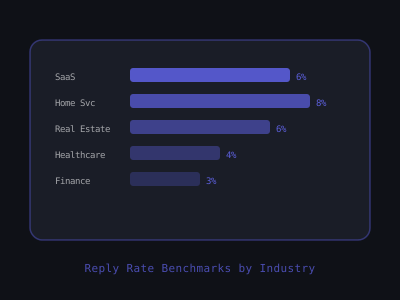
Cold Email Reply Rate Benchmarks by Industry (2026)
The Funnel Metrics That Actually Matter
Cold email performance should be measured at five stages, in this specific order of reliability. Deliverability rate is the percentage of emails that reach the inbox rather than spam, target 90% or higher. Open rate is the percentage of delivered emails that get opened, but treat this with caution due to Apple MPP inflation. Reply rate is your primary performance metric, targeting 2 to 8% depending on industry. Positive reply rate is the percentage of replies that express genuine interest, targeting 50 to 70% of total replies. Meeting rate is the percentage of positive replies that convert to a booked meeting, targeting 40 to 60%.
Most operators only track open rate and reply rate. The positive reply rate and meeting conversion rate are where the real leverage is, and where most campaigns quietly leak revenue. To see how a given reply rate translates into meetings and revenue, run the numbers through our free outreach ROI calculator.
Cold Email Benchmarks by Industry
These benchmarks represent realistic performance from well-configured campaigns with proper deliverability setup, warmed domains, correct DNS records, clean lists, and relevant personalization. Under-optimized campaigns will underperform these numbers significantly.
Home Services (HVAC, Plumbing, Electrical, Roofing)
Open rate: 50 to 70%. Reply rate: 5 to 10%. Positive reply rate: 60 to 75%. Meeting conversion: 55 to 70%. Home services operators receive far less cold email volume than enterprise buyers, making well-crafted sequences stand out considerably more. This is the highest-performing vertical for AI automation outreach because the pain points are concrete and universal: missed calls, slow follow-up, unbooked estimates.
Subject lines referencing their specific trade perform well. Examples: "HVAC companies missing after-hours calls," "quick question about your plumbing estimates," "how [competitor name] is booking more jobs automatically." Home services owners are often in the field during business hours, emails sent Tuesday through Thursday between 7 and 9am or 6 and 8pm local time typically see higher engagement.
SaaS and Technology
Open rate: 45 to 60%. Reply rate: 4 to 8%. Positive reply rate: 55 to 65%. Meeting conversion: 45 to 55%. Tech buyers are sophisticated cold email consumers who can spot a template from the first sentence. High personalization and a specific technical insight in Email 1 significantly outperforms generic value propositions. Your CTA should be low-commitment, "Is this on your radar?" outperforms "Can we schedule a 30-minute demo?" consistently.
Professional Services (Consulting, Accounting, Legal)
Open rate: 40 to 55%. Reply rate: 3 to 6%. Positive reply rate: 45 to 60%. Meeting conversion: 50 to 65%. Professional services buyers respond well to peer comparisons and outcome-specific messaging. Trust signals matter more than in tech, name-dropping a recognizable client or result in the first email increases reply rates meaningfully. This vertical is highly relationship-driven, so the goal of your first email should be to start a conversation, not close a deal.
Real Estate
Open rate: 45 to 65%. Reply rate: 4 to 8%. Positive reply rate: 50 to 65%. Meeting conversion: 45 to 60%. Segmentation matters in this vertical. Individual agents have different pain points than team leads, who differ from brokerage owners. An agent cares about converting more of their existing leads. A brokerage owner cares about agent productivity. Property managers care about tenant communication at scale. Same service, completely different emails for each segment.
Healthcare and Dental
Open rate: 35 to 50%. Reply rate: 2 to 5%. Positive reply rate: 40 to 55%. Meeting conversion: 40 to 55%. Healthcare is a lower-response vertical due to compliance concerns and gatekeeping. Emphasize HIPAA considerations upfront rather than hoping the prospect does not ask. Dental practices are a particularly strong sub-vertical, the problems are universal (no-shows, missed appointment reminders) and the practice owner typically makes fast decisions without committee approval.
Financial Services
Open rate: 30 to 45%. Reply rate: 2 to 4%. Positive reply rate: 40 to 55%. Meeting conversion: 45 to 60%. Financial services has the most compliance-sensitive buying environment of any B2B vertical. Lower open and reply rates are expected and should not be treated as a deliverability failure. The higher meeting conversion rate relative to reply rate reflects that financial services prospects who do respond are typically serious buyers, fewer replies, but better quality.
Quality vs. Volume: Reply Rate Impact
How to Diagnose Underperformance
If your numbers are below these benchmarks, use this diagnostic framework to identify the problem. The mistake most operators make is assuming copy is the issue when deliverability is actually the bottleneck, or vice versa.
Step 1: Check Deliverability First
Before changing a word of your copy, verify that your emails are reaching the inbox. Run your sending domain through MXToolbox to check blacklist status, and confirm your SPF, DKIM, and DMARC are passing with our free email domain checker. Send a test email to Mail-tester.com and check your spam score, anything below 8 out of 10 needs attention before you send volume. Use GlockApps to run an inbox placement test across major providers. Common deliverability failures: missing or misconfigured DMARC record, sending domain less than four weeks old, and no warm-up period completed.
Low Open Rate (Under 25%)
A sub-25% open rate almost always means deliverability failure, not a subject line problem. Your emails are landing in spam. Check domain blacklist status, SPF/DKIM/DMARC configuration, and warm-up status. If deliverability checks out but open rate is still low, test shorter, lowercase subject lines with no punctuation, they consistently outperform polished marketing-style subject lines in cold outreach.
Good Open Rate, Low Reply Rate (Under 1%)
The email is reaching the inbox and getting opened but not generating replies. Check these common causes: is it over 100 words (cut it to 50 to 80), does the first sentence establish relevance to this specific person, is there at least one specific detail that could not have been sent to anyone else on your list, and are you asking for too much in your CTA? "Schedule a 30-minute demo" is a high-commitment ask. "Worth a quick call?" generates more replies in nearly every vertical.
Good Reply Rate, Low Positive Reply Rate
Many replies but mostly negative responses. This is a targeting problem. You are reaching people who are not a good fit, either wrong company size, wrong role, wrong industry sub-segment, or the timing is off systematically. Revisit your ICP with specificity. The more tightly you define the who and the when, the higher your positive reply rate.
How AI Personalization Changes These Benchmarks
Properly implemented AI personalization, using tools like Clay to pull company data and then generating custom first lines with GPT-4 or Claude, consistently produces reply rates two to four times above baseline for the same list. This is the single highest-leverage improvement available to cold email operators in 2026.
A practical example: a real estate campaign sending 200 emails per day with a generic template might produce a 3% reply rate. The same list with AI-generated custom first lines referencing each agent's recent listings typically produces 7 to 10% reply rate on half the volume, more than double the output. The mechanics involve Clay pulling LinkedIn and website data, a custom GPT prompt generating a 15 to 20 word first line referencing something specific, and the rest of the email being templated.
Before deploying at scale, manually review 50 to 100 generated first lines for accuracy and naturalness. Tune your prompt until the output consistently passes the "would I send this to a friend?" test. For the infrastructure required to run personalized cold email at scale, see our cold email infrastructure guide.
Program · 90 days
Client Accelerator bundles the demo software with live coaching.
A one-time $1,499 purchase, or 4 interest-free payments of $374.75. Includes Ciela AI with 150 personalized demos each month throughout the program, the 90-Day AI Client System, two live group coaching calls every week, sales and outreach templates, 200+ n8n workflow templates, and private Build With Adhiraj resources.
See what is includedCiela AI is the demo platform for AI agencies and AI consultants. It turns any prospect's website into a live, personalized AI demo (chat, voice, or missed-call text-back) you can send before the first call.
Start Client AcceleratorCiela AI pricingAgent builds by nicheAll articles
Community · Training
Join Build With Adhiraj free.
Build With Adhiraj is the free community for people building and growing AI service businesses. Learn alongside other operators as you package, demonstrate, sell, and deliver practical AI systems.
Join Build With Adhiraj free