
How to Build a Waitlist for Your AI Automation Services (That Creates Urgency)
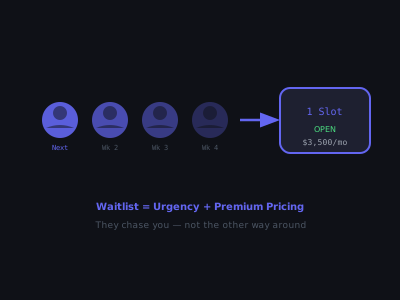
A waitlist is one of the most powerful positioning tools an AI automation agency can have. When a prospect hears "we're currently full and have a 3-week waitlist," two things happen: they immediately perceive more value in your services, and the decision to sign becomes urgent instead of optional. This guide covers how to build a genuine waitlist, not a fake scarcity tactic, and how to leverage it for premium pricing and better clients.
Most agency owners approach sales from a position of neediness. They have open slots, they need revenue, and every discovery call carries the weight of desperation. The prospect can feel it. They sense they have leverage, and they use it, asking for discounts, dragging out decisions, ghosting after proposals. A waitlist eliminates all of that. It flips the power dynamic so that you are the one being pursued, and the prospect is the one who needs to act fast. What follows is a step-by-step system for building that waitlist from scratch, even if you are just starting out.
Waitlist Impact on Sales Metrics
Why a Waitlist Changes Your Sales Conversations
When you have no waitlist and unlimited availability, prospects take their time. They say "let me think about it" and you follow up three times over six weeks. When you have a waitlist, the dynamic inverts. Now the prospect is the one following up. They're asking "are you available yet?" instead of you chasing them.
This shift in dynamic also changes how prospects perceive your pricing. A service with a waitlist clearly has demand exceeding supply, which is exactly how premium products and services justify their prices. You can charge 20–40% more for the same work when you have a waitlist because scarcity signals value.
There's also a quality filter effect. When prospects have to wait and apply, the ones who follow through are more serious, more committed, and more likely to be good long-term clients. The tire-kickers and price-shoppers self-select out because they don't want to wait. This means higher close rates, better client relationships, and lower churn.
Consider the difference in two real conversations. Without a waitlist, the close call sounds like: "We can start whenever you're ready. How does next week look?" The prospect responds with "Let me check with my partner" and you never hear from them again. With a waitlist, the close call sounds like: "We have one spot opening up on April 14th. I'm speaking with one other business about this slot. If you want it, I need a signed agreement by Friday." The prospect signs Friday morning. Same service, same price, completely different outcome, because the framing changed.
There is also a compounding psychological effect at play. Once a prospect has invested the time to fill out an application, wait 2–3 weeks, engage with your nurture emails, and finally get on a call, they have significant sunk cost in the relationship. Walking away from that investment feels like a loss. This is not manipulation; it is the natural byproduct of building a process where people have to earn access to your time.
Phase 1: Create Genuine Capacity Constraints
A waitlist only works if it's real. Fake scarcity is transparent and damages trust. The goal is to actually limit your onboarding capacity so the waitlist is genuine.
Cap Your Monthly New Client Intake
Decide on a maximum number of new clients you onboard per month. For most solo or small-team agencies, that's 2–3 new clients. Communicate this openly: "We take on a maximum of 3 new clients per month to ensure every engagement gets the attention it needs." This is a real constraint and a legitimate reason to have a waitlist.
How do you arrive at the right number? Start with your delivery hours. A typical AI automation build, say a missed-call-text-back system with CRM integration and a chatbot, takes 15–25 hours over 2 weeks for initial setup, plus 3–5 hours per week for ongoing management and optimization. If you work 40 billable hours a week, and you have 6 existing retainer clients consuming 20 hours a week in maintenance, you have 20 hours left for new builds. That supports 1–2 new project builds per month, comfortably. Trying to squeeze in a fourth means cutting corners, missing deadlines, and delivering mediocre work. Your cap should be based on this math, not an arbitrary number.
Fill Your Current Capacity First
You can't have a waitlist if you have open slots. The first step is reaching full capacity, typically 5–8 retainer clients for a solo operator. Use outbound outreach, referrals, and content to reach that point. Once you're full, the waitlist starts naturally.
If you are not yet at capacity, your entire focus should be on getting there. Run 50–100 personalized cold emails per day targeting your niche. Post 3–5 times per week on LinkedIn with results-driven content. Ask every satisfied client for 2 referrals. Attend local business networking events in your target vertical. The waitlist phase comes after you have proven demand, not before. Trying to manufacture a waitlist when you have 2 clients and plenty of free time will come across as inauthentic, and prospects will see through it.
Define What "Full" Means
Be specific about your capacity. A solo agency owner with 6 retainer clients and 3 active project builds is legitimately at capacity. A team of 2 might handle 10-12 retainer clients before being full. Know your number, and when you hit it, stop accepting new clients immediately and redirect to the waitlist.
Write this number down. Put it in your operating document. Tell your team (if you have one). The temptation when a high-value prospect appears will be to squeeze them in. Resist this. The moment you start making exceptions, the waitlist loses its integrity. If a prospect is truly exceptional, say, a $5,000/month retainer in your exact niche, you can bump them to the top of the waitlist and accelerate the timeline, but they still go through the waitlist process. The process is the brand. Skipping it devalues everything you have built.
Phase 2: Build the Waitlist Infrastructure
The Waitlist Landing Page
Create a dedicated page for waitlist signups. Include: a clear statement of what you do and who you serve, 2–3 specific results you've achieved for clients (with numbers), your current availability status ("Currently full, accepting waitlist applications for [Month]"), and a short application form. The form should ask qualifying questions: company size, current monthly revenue, what they want to automate, and timeline. This filters prospects and signals that you're selective.
The application form is doing two jobs simultaneously. First, it qualifies prospects so you do not waste a slot on someone who is a poor fit. Second, it communicates exclusivity. When someone sees a form asking about their revenue, team size, and specific automation goals, the implicit message is: "Not everyone gets in." That perception of selectivity is as valuable as the actual filtering.
Here is what a strong waitlist application form looks like in practice. Keep it to 5–7 fields maximum. Required fields: full name, business name, email, monthly revenue range (dropdown with ranges like $10K–$25K, $25K–$50K, $50K–$100K, $100K+), and a short text field asking "What process do you most want to automate and why?" Optional fields: website URL and how they heard about you. Anything longer than this and completion rates drop significantly. You want the form short enough that serious prospects fill it out in under 90 seconds, but detailed enough that you can prioritize intelligently.
For the page itself, keep it simple and direct. A strong headline like "We Build AI Automation Systems for [Niche]. Currently Accepting Waitlist Applications for [Month]." Below that, 2–3 short client result bullets: "Helped [Business Type] increase booked appointments by 340% in 60 days" or "Reduced manual lead follow-up time by 12 hours/week for [Client Type]." Then the form. No navigation menu, no footer links, no distractions. This page has one job: collect qualified applications.
The Waitlist Email Sequence
Everyone who joins your waitlist should enter a 4-email nurture sequence delivered over 3 weeks:
- Email 1 (Day 0): Confirmation + what to expect. Share a case study showing results for a client similar to them.
- Email 2 (Day 5): Educational content, "3 AI automations that 10x our clients' outreach." Build belief in your approach.
- Email 3 (Day 12): Social proof, a client testimonial or short video walkthrough of a system you built.
- Email 4 (Day 21): Slot opening notification, "We have one spot opening up next week. I'd like to offer it to you first. Here's how we can get started."
By the time Email 4 arrives, the prospect has been warmed up for 3 weeks. The close rate on these conversations is dramatically higher than cold outreach.
Let's break down what makes each email effective. Email 1 should be short, 150 words max, and set clear expectations. Tell them their position on the list, roughly when you expect to have availability, and share one compelling case study. The case study should match their industry or problem as closely as possible. If a dentist signed up, send a case study about a dental practice. If a roofing company signed up, send roofing results. This personalization takes 30 seconds per application but massively increases engagement.
Email 2 is where you establish authority. Write it as a mini-guide: "3 AI Automations That Consistently Generate $10K+/Month in Revenue for Our Clients." Break down each automation, what it does, how it works at a high level, and what results it produces. You are teaching and selling simultaneously. The prospect finishes this email thinking "I need this in my business yesterday."
Email 3 should feature a real client testimonial. A video testimonial is best if you have one, but a text testimonial with the client's name, business, and specific results works well too. Alternatively, send a 2-minute Loom walkthrough of a system you built, show the automation in action, the dashboard, the notifications firing. Prospects who can see the system working become far more confident in paying for it.
Email 4 is the money email. It should feel personal, not automated. Reference their application: "Hi Sarah, I see you mentioned wanting to automate your lead follow-up process for your landscaping company. We just wrapped a similar build for another service business and the results have been incredible, 47 more booked estimates in the first month. I have one slot opening next week and I think your business would be a great fit. Here is my calendar link, grab a 30-minute call and let's map it out." This email converts at 35–50% to a booked call, and those calls close at 60–70% because the prospect has been nurtured for three weeks and is ready to buy.
Phase 3: Driving Waitlist Signups
A waitlist only has leverage if it has volume. Here's how to drive signups:
LinkedIn Content
Post regularly about your results and process on LinkedIn. End every post with: "We're currently full, but you can join our waitlist at [link]." People who see your results and want to work with you will sign up. Even 10–15 waitlist signups per month is a pipeline worth managing.
The types of LinkedIn content that drive the most waitlist signups are: client result breakdowns (specific numbers, before/after), behind-the-scenes build walkthroughs, contrarian takes on industry trends, and "lessons learned" posts from recent engagements. Each post should subtly reinforce that you're at capacity and in demand.
Here is a content framework that consistently drives waitlist signups. Use it 2–3 times per week. Start with a hook that leads with a result: "Our client booked 47 new estimates last month without hiring a single new person." Then explain the problem they had before, slow follow-up, leads falling through the cracks, manual processes eating up 15 hours a week. Describe the solution at a high level, you built an AI-powered lead response system that qualifies incoming leads, sends personalized follow-ups within 60 seconds, and books appointments directly into their calendar. Share the specific outcome with numbers. Close with: "We're currently at capacity, but if you want something similar for your business, join our waitlist [link]." This formula works because it demonstrates competence, creates desire, and then makes access feel limited.
Referral Traffic
Ask existing clients to send people to your waitlist instead of directly to a sales call. "If you know anyone who'd be a fit, send them to our waitlist page, we'll prioritize people referred by existing clients." This makes referring feel lower-friction because they're not sending someone to a hard sales pitch.
To systematize referrals, build them into your delivery process. At the 30-day mark after onboarding a new client, when they have seen initial results and are excited about the system, send a short message: "Hey [Name], glad to hear the follow-up automation is already generating results. Quick question, do you know 1–2 other business owners who are losing leads because they can't follow up fast enough? We have a waitlist for new clients and I always prioritize referrals from people we are already working with." Then again at the 90-day mark when results are even stronger. Two touchpoints per client, each producing 0.5–1 referral on average, means that 8 active clients generate 8–16 referrals per year, all of which land on your waitlist pre-warmed.
Cold Outreach With a Waitlist CTA
Change your cold outreach call-to-action from "book a call" to "join our waitlist." This lowers the commitment barrier, prospects who aren't ready to book a call will often join a waitlist. Once they're in your sequence, you can qualify and close them on your timeline.
The psychology here is important. A cold email asking someone to book a 30-minute call requires a significant time commitment from a stranger. A cold email asking someone to fill out a 90-second application to get on a waitlist feels much lighter. The waitlist framing also implies exclusivity, which makes the prospect curious rather than defensive. A strong cold email for this approach looks like: "Hi [Name], we help [niche] businesses automate their lead follow-up so they stop losing customers to slow response times. We are currently booked out through [month], but I am accepting waitlist applications for [next month]. If this is relevant, you can apply here: [link]. Takes about 60 seconds." Short, direct, low-commitment, and subtly communicating high demand.
Blog and SEO Traffic
Every blog post on your site should include a waitlist CTA for readers who want to work with you. Organic traffic converts at lower rates than outbound, but it's passive, once the content ranks, waitlist signups arrive without any effort on your part.
Place the waitlist CTA in two locations within each blog post: once in the middle (after delivering substantial value) and once at the end. The mid-article CTA catches readers who are already convinced and ready to act. The end-of-article CTA catches everyone else. Use contextual copy that ties to the article topic, if the post is about AI chatbots for dental practices, the CTA should say "Want us to build this for your practice? Join our waitlist" rather than a generic "work with us" message.
Waitlist Email Nurture Sequence Performance
Managing the Waitlist Conversation
When a slot opens, don't just send a generic "you're next" email. Send a personalized note referencing their application: "Hi [Name], I have a spot opening up in [week]. Based on your application, I think we could [specific outcome]. I'd love to jump on a 30-minute call to see if it's a fit, here's my calendar link."
Offer the slot to 2 people simultaneously when possible. The mild competition ("I'm speaking with one other person for this slot") adds urgency without being manipulative, it's simply true.
Timing matters here. Send the slot-opening email on a Tuesday or Wednesday morning. Give prospects a 72-hour window to book the call. If they do not respond within 72 hours, move to the next person on the list and send the first prospect a brief note: "Hi [Name], the slot I mentioned has been taken. I will reach out again when the next one opens up." This creates a real consequence for inaction and teaches waitlist members to respond quickly when you reach out. Over time, your response rates to slot-opening emails will climb because word gets around that your slots actually fill.
Waitlist Priority Tiers
Not all waitlist members are equal. Create an internal priority system based on:
- Referral source: Referred by an existing client? They go to the top of the list.
- Revenue potential: Higher-revenue clients get priority because they represent more value per slot.
- Engagement level: Prospects who reply to your nurture emails, engage with your content, or proactively follow up are signaling high intent.
- Fit with your niche: Prospects in your core niche are easier to serve and more likely to get strong results, which generates better case studies.
In practice, keep a simple spreadsheet or CRM tag system to manage this. Each waitlist member gets a priority score from 1–4 based on these criteria. When a slot opens, you start at the top and work down. A referred prospect from your core niche with high revenue who replied to your nurture emails is a 4 out of 4, they get first call. A cold-outreach signup from outside your niche who never opened an email is a 1, they stay at the bottom. This system ensures that every slot goes to the prospect most likely to become a high-value, long-term client.
The Pricing Premium
Once your waitlist is established and you have 5+ people in it consistently, raise your prices for new clients by 15–25%. Communicate it transparently: "Due to demand, our new client rate is now $X. Existing clients are grandfathered at their current rate." Waitlist members who have been nurturing for 2–3 weeks almost always accept the new pricing without objection, they've already invested time in the relationship.
The pricing premium is one of the most powerful benefits of a waitlist. An agency charging $2,500/month without a waitlist that moves to $3,000/month with a waitlist has just increased revenue by 20% per client with no additional work. Over 10 clients, that's an extra $5,000/month, $60,000/year, from nothing but better positioning.
Here is how to implement the price increase without friction. When you reach 5 consistent waitlist members, set your new rate for the next slot that opens. Do not retroactively change pricing for anyone already on the waitlist, honor whatever rate they saw when they applied. For the next cohort of waitlist applicants, the new rate is on the landing page and in Email 1 of the nurture sequence. When you get on the close call, state the price confidently and without justification: "Our monthly retainer is $3,000. That includes the initial build, ongoing optimization, and priority support." If the prospect pushes back on price, your response is simple: "I understand. We do have 6 other people on the waitlist at this rate, so this is where we are priced right now. If the budget does not work, I completely understand, no hard feelings." Most will not push back. The ones who do were probably not great fits anyway.
You can also use the waitlist to introduce tiered pricing. Offer a standard tier at your base rate and a priority tier at a 30–50% premium that comes with faster onboarding, a dedicated Slack channel, and weekly optimization calls. Waitlist members who are impatient to get started will often self-select into the priority tier, further increasing your revenue per client.
Maintaining the Waitlist Long-Term
A waitlist is not a one-time tactic, it's an ongoing system that requires consistent attention. Here's how to keep it healthy:
- Keep driving traffic: Continue posting on LinkedIn, asking for referrals, and running outbound with waitlist CTAs. A waitlist with zero new signups per month loses its utility.
- Clean the list quarterly: Remove prospects who haven't engaged with your emails in 90+ days. A stale waitlist is worse than no waitlist.
- Update availability regularly: Post on LinkedIn and update your landing page when slots open. This keeps the waitlist feeling current and active.
- Track conversion metrics: Monitor signups per month, nurture email open rates, slot offer acceptance rates, and close rates from waitlist conversations. Optimize each stage.
The metrics worth tracking weekly are: total active waitlist members (target 8–15 for a solo agency), new signups this week, nurture sequence email open rates (target 50%+), reply rate to slot-opening emails (target 40%+), and close rate from waitlist calls (target 60%+). If any of these numbers drop below target, you know exactly where the bottleneck is. Low signups means your top-of-funnel content and outreach need attention. Low open rates mean your subject lines or sender reputation need work. Low close rates mean your nurture sequence is not building enough desire or your pricing is misaligned.
Quarterly, do a full audit. Remove anyone who has not opened an email in 90 days. Refresh your case studies with newer, stronger results. Update the landing page copy to reflect your current niche focus and client count. Adjust your intake cap if your team has grown, if you hired a second builder, you might move from 2 new clients per month to 4. The waitlist is a living system, not a set-it-and-forget-it page. The agencies that treat it as a core business process, reviewing it weekly, optimizing it monthly, auditing it quarterly, are the ones that sustain premium pricing and never have to chase clients again.
For more on how pricing and positioning work together, read our AI agency pricing guide. And for strategies on getting referrals that fill your waitlist, see our guide on getting referrals from AI automation clients. If you are still building your LinkedIn content engine to drive waitlist signups, our LinkedIn profile optimization guide covers how to turn your profile into a lead generation asset.
Want to learn how to build and sell AI automations? Kingstone AI Operators is our free community for AI automation agency builders. Join Kingstone AI Operators, free.
FAQ
Frequently Asked Questions
How do I build a waitlist for my AI automation services?
Cap your monthly new client intake at 2-3, fill your current capacity through outreach and referrals, then create a waitlist landing page with an application form. Drive signups through LinkedIn content, referral traffic, and cold outreach with a waitlist CTA. Nurture waitlist members with a 4-email sequence over 3 weeks.
Does having a waitlist actually help sell AI automation services?
Yes. A genuine waitlist shifts the sales dynamic entirely. Prospects follow up with you instead of you chasing them. Services with waitlists are perceived as more valuable and justify 20-40% higher pricing. The urgency of limited availability compresses decision timelines and reduces objections.
How many clients should I take on per month for my AI agency?
For solo or small-team AI automation agencies, cap new client intake at 2-3 per month. This ensures quality delivery and creates genuine capacity constraints that support a waitlist. At 5-8 existing retainer clients, onboarding more than 3 new clients per month risks delivery quality.
What should I include on a waitlist landing page for AI automation?
Include a clear statement of what you do and who you serve, 2-3 client results with numbers, your current availability status, and a short application form. The form should ask qualifying questions: company size, monthly revenue, what they want to automate, and timeline. This filters prospects and signals selectivity.
How do I create urgency without fake scarcity for AI services?
Real urgency comes from real constraints. Cap your monthly intake, communicate it openly, and fill your pipeline so the waitlist is genuine. When a slot opens, offer it to 2 prospects simultaneously and be transparent about it. Authentic scarcity builds trust; fake scarcity destroys it.
How much more can I charge with a waitlist for AI automation?
Agencies with established waitlists of 5+ people consistently charge 15-25% more than their previous rates. Waitlist members who have been nurtured for 2-3 weeks almost always accept the premium pricing because they have already invested time in the relationship and perceive the service as high-demand.
What email sequence should I send to AI automation waitlist subscribers?
A 4-email nurture sequence over 3 weeks: Day 0 confirmation plus case study, Day 5 educational content building belief in your approach, Day 12 social proof with client testimonial, Day 21 slot opening notification with a personalized offer. Close rates from this sequence are dramatically higher than cold outreach.
Program · 90 days
Client Accelerator bundles the demo software with live coaching.
A one-time $1,499 purchase, or 4 interest-free payments of $374.75. Includes Ciela AI with 150 personalized demos each month throughout the program, the 90-Day AI Client System, two live group coaching calls every week, sales and outreach templates, 200+ n8n workflow templates, and private Build With Adhiraj resources.
See what is includedCiela AI is the demo platform for AI agencies and AI consultants. It turns any prospect's website into a live, personalized AI demo (chat, voice, or missed-call text-back) you can send before the first call.
Start Client AcceleratorCiela AI pricingAgent builds by nicheAll articles
Community · Training
Join Build With Adhiraj free.
Build With Adhiraj is the free community for people building and growing AI service businesses. Learn alongside other operators as you package, demonstrate, sell, and deliver practical AI systems.
Join Build With Adhiraj free