
How to Close High-Ticket AI Automation Deals on Zoom Calls
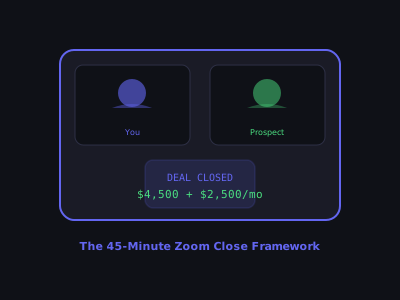
Most AI automation agency owners lose deals not because of their skills or their pricing but because their sales call structure is broken. They spend forty minutes explaining services and then awkwardly mention a price at the end. The prospect says "let me think about it" and never replies. The difference between a 15 percent close rate and a 40 percent close rate almost never comes down to what you sell. It comes down to how you run the call.
This guide covers the exact call structure, verbal frameworks, and close techniques that consistently convert high-ticket prospects on Zoom. The framework is built from hundreds of real AI automation sales calls and works across deal sizes from $3,000 to $50,000 or more.
The Pre-Call Setup That Wins Deals Before You Speak
High-ticket deals are won before the call starts. Send a brief pre-call questionnaire when the prospect books: their biggest bottleneck right now, what they've tried before, their monthly revenue range, and their decision timeline. Reviewing these answers lets you walk in knowing their pain, their budget range, and their urgency.
Also send a brief agenda the morning of the call: "Looking forward to our call at the scheduled time. Here's what we'll cover: understand your current situation, walk through what the right solution looks like, and see if we're a fit. The call is 45 minutes and I'll make sure we end on time." This sets professional expectations and reduces no-show rates by roughly 25 to 30 percent.
Pre-Call Research Checklist
Before every sales call, spend ten minutes reviewing their questionnaire answers, checking their website for lead capture gaps and response time issues, reviewing their LinkedIn profile for role and company context, preparing one relevant case study from a similar industry, and writing down three specific questions tailored to their situation. Walking in prepared transforms your opening from a generic "tell me about your business" into a specific observation that immediately builds credibility.
Sales Call Time Allocation (45-Minute Framework)
The 45-Minute Call Framework
Minutes 0 to 5: Rapport and Framing
Open with brief rapport, then set the frame immediately: "I want to make sure this call is genuinely useful for you, so I'm going to ask some direct questions to understand your situation. At the end, I'll tell you honestly whether I think we can help, and if so, what that looks like. Sound good?" This positions you as an advisor rather than a salesperson, creates permission to ask direct questions, and sets up a binary outcome that reduces the dreaded "let me think about it."
Do not spend more than 90 seconds on small talk. Business owners with real problems want to get to the point. Match their energy.
Minutes 5 to 20: Deep Discovery
This is the most important part of the call. The more deeply a prospect feels understood, the more likely they are to buy. Ask these key questions: "Walk me through your current process — what does it look like today?" Then "What's the biggest friction point?" Then "What have you tried to fix it and what happened?" Then "If we could solve this completely, what would that be worth in time saved or revenue generated?" And finally "What's your timeline — do you need this solved in 30 days or is it more of a next-quarter initiative?"
Go deeper than most people are comfortable with. When the prospect says they lose a lot of leads, push for specifics: how many leads come in per month and roughly how many fall through the cracks. "We get about 200 leads per month and probably 40 to 50 never get a follow-up call" is something you can build your entire pitch around. That number becomes the anchor for your ROI calculation later.
Also ask about the cost of inaction: "What happens if nothing changes? If you are still running this same process six months from now, what does that look like?" This forces the prospect to visualize staying stuck, which increases urgency without you having to manufacture it.
Minutes 20 to 35: The Solution Walkthrough
Present your solution framed entirely in terms of their specific situation, not a generic service description. Structure the walkthrough in three layers. First, the trigger — what kicks off the automation. Second, the logic — what happens behind the scenes. Third, the outcome — what the prospect actually sees. For example: "When a new lead fills out the form or calls your office and no one picks up, the system activates instantly. The AI qualifies the lead and sends a personalized text within 10 seconds. You wake up with three new appointments on your calendar that were booked at 11 PM last night."
Show a relevant case study here with specific numbers and timeline. Avoid the temptation to show your screen and demo a workflow builder. Non-technical buyers do not care about the tool. Showing n8n or Make on screen actively hurts your close rate for high-ticket deals because it makes the solution feel like software, not a done-for-you service.
Minutes 35 to 42: Pricing Presentation
State the price clearly and confidently, then immediately connect it to their stated value: "The investment is $4,500 setup plus $2,500 per month. Based on what you told me earlier about the leads being lost and the hours being wasted, the ROI is clear within 60 days." Then stop talking. Silence after the price is one of the most powerful sales tools available.
If you offer tiered pricing, present no more than two options. Lead with the package you actually want them to buy, then offer one higher tier. This gives the prospect a choice between two yeses rather than a choice between yes and no.
Close Rate by Sales Call Structure
The Close and Handling Objections
After presenting the price and handling any initial reaction, ask a direct closing question: "Does this feel like the right direction for you?" If they say yes, move immediately to logistics — send the proposal and contract within two hours, lock in the next step before the call ends. If they hesitate, ask: "What would need to be true for you to feel confident moving forward?"
Handling "I Need to Think About It"
This almost always means an unspoken objection. Respond: "Of course. What specifically is giving you pause? Is it the investment, the timeline, or something about the approach?" Name the three most likely objections to pull the real one to the surface. If they still will not name the real objection, try: "If the investment was not a factor, would you move forward today?" If yes, the objection is price and you can address it directly with ROI math or a phased approach.
Handling "That's More Than I Expected"
Acknowledge it, then reanchor to value: "If this system saves you 15 hours a week for the next 12 months, what is that worth to your business?" Let them do the math out loud. If the gap is genuinely too large, do not discount. Instead, offer a smaller scope: start with just the lead follow-up automation at a lower price point and add the scheduling and review systems once they see ROI from the first phase.
Post-Call Follow-Up
Send the proposal within two hours of the call, not the next day. Include a personalized summary at the top. Follow up at 48 hours with value — attach a short Loom video walking through one specific part of the proposal or share a quick case study result. At day five, use a soft close: "Are you still interested in moving forward, or has the timing shifted? Either way is completely fine." This gives the prospect an easy out, which paradoxically makes them more likely to respond. After that, move to monthly nurture.
A 30 to 40 percent close rate on qualified discovery calls is strong for AI automation agencies. Below 20 percent usually indicates weak discovery or misaligned prospects. Above 50 percent often means you are underpriced. Track every call and review the patterns after 20 to 30 conversations to identify exactly where to focus your improvement effort.
Close Rate Benchmarks by Lead Source
Program · 90 days
Client Accelerator bundles the demo software with live coaching.
A one-time $1,499 purchase, or 4 interest-free payments of $374.75. Includes Ciela AI with 150 personalized demos each month throughout the program, the 90-Day AI Client System, two live group coaching calls every week, sales and outreach templates, 200+ n8n workflow templates, and private Build With Adhiraj resources.
See what is includedCiela AI is the demo platform for AI agencies and AI consultants. It turns any prospect's website into a live, personalized AI demo (chat, voice, or missed-call text-back) you can send before the first call.
Start Client AcceleratorCiela AI pricingAgent builds by nicheAll articles
Community · Training
Join Build With Adhiraj free.
Build With Adhiraj is the free community for people building and growing AI service businesses. Learn alongside other operators as you package, demonstrate, sell, and deliver practical AI systems.
Join Build With Adhiraj free