
How to Demo Chat Booking Before You Have Built It
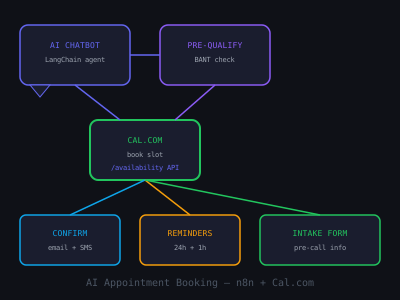
You can demo a chat booking agent before you have built the calendar integration, because the thing the prospect is evaluating is the conversation, not the API call. A demo chat can run the entire booking dialogue on the prospect's own services, ask the questions their front desk asks, offer times, and capture the contact details. All of that happens inside the demo. None of it touches their real calendar, and that is fine, as long as you say so.
This matters because the sequencing most agencies use is backwards. They win a conversation, promise a booking agent, then spend a week wiring a calendar API for a prospect who has not committed, using guesses about which booking system the business runs. Half the time the guess is wrong, and the week is gone. Meanwhile the deal cooled, because nothing was in front of the prospect during the week you spent building.
The better order is: demo the experience, win the conversation, then build the integration against a system you have confirmed. This post covers how to do that without misleading anyone, which is the entire risk of the approach and worth being precise about.
Split the product into the part that persuades and the part that connects
A chat booking agent is really two products stacked. The first is conversational: understanding what a visitor wants, mapping it to a service, asking the right qualifying question, handling hesitation, and arriving at a specific time. The second is integrative: writing that appointment into Calendly, Acuity, Jane, Housecall Pro, a practice management system, or whatever else the business already runs.
Prospects buy the first one. Almost nobody has ever been sold by watching a row appear in a calendar. They are sold by watching a machine handle a customer well. The integration is table stakes they assume is possible, and they are right to assume it, because it usually is.
Once you separate the two, the sequencing argument makes itself. The persuasive half can be built in minutes from the prospect's public website. The integrative half requires credentials, an account, a decision maker, and often a phone call with their office manager. Doing the second before the first is spending your scarcest resource on your least persuasive asset.
What the demo half can genuinely do
- Answer questions about the prospect's actual services, pulled from their real site.
- Qualify a visitor toward the right service and the right urgency.
- Offer appointment times and let the visitor choose one.
- Collect a name, phone, email, and reason for the visit.
- Confirm the booking back to the visitor inside the conversation.
What it deliberately does not do
It does not write into the prospect's real calendar, booking software, or CRM. It does not send a text or email to a real customer. It does not create a record anywhere outside the demo. This is not a gap you are hiding, it is the correct behavior for a demonstration: a demo that could write to a stranger's production calendar would be a liability, not a feature.
Say the quiet part in the demo itself
The way this goes wrong is not the demo being simulated. It is the prospect discovering it was simulated at a moment you did not choose. If an owner walks away believing you connected to their system and finds out on the kickoff call, you have spent trust you cannot re-earn, and it does not matter that you never technically claimed it.
So place the disclosure where they will see it without being deflated by it. One line, in the demo, in plain language:
This is a working demo of your booking agent. It runs on your real services and captures bookings inside this demo. Connecting it to your actual calendar is a setup step we do together.
Notice the framing. Nothing is apologized for. "Captures inside this demo" is stated as a property, not a confession, and it is immediately followed by the thing that resolves it. Prospects have bought software before. They know systems get connected during onboarding. What they punish is finding the gap themselves.
Use the same sentence in your outreach
Repeat it in the message that carries the link. Something like: "built you a working version of the booking chat, it runs on your real service list and books inside the demo, connecting it to your calendar is a setup step". That sentence makes the demo more credible, not less, because a claim with a stated boundary reads as honest while an unbounded claim reads as marketing.
Build the demo on their business, not a template
The entire persuasive weight of a pre-build demo comes from specificity. A generic booking bot proves nothing, because the prospect has already dismissed six of those in their inbox. A booking chat that lists their services, in their words, with their pricing tiers and their intake question, is a different object entirely.
The practical difference: the prospect stops evaluating whether chat booking works in general and starts evaluating whether this specific flow is right for their business. That is a much better conversation, and it is a conversation where their corrections are buying signals. When an owner says "actually we would never book a new patient without asking about insurance", they have started designing the build with you.
This inversion is the point. Product tour tools like Storylane and Supademo are built for a SaaS team recording its own interface once and reusing that recording. An AI agency has no interface to record, and the demo needs to be of the prospect's business rather than your own. Different problem, different object. The demo platform Ciela AI works this way on purpose: you give it the prospect's website, it builds a live chat agent grounded in that site, and you paste the resulting link into whatever outreach tool you already run.
The five beats a chat booking demo needs
Keep the flow tight. A booking conversation that wanders is a booking conversation that proves the agent is not ready.
- Recognition. The opening line names the business and offers their real service categories.
- Qualification. One question their office genuinely asks, not a generic "how can I help".
- Offer. Concrete times, phrased the way a person would phrase them.
- Capture. Name, contact, reason. Shown clearly, so the owner sees the output.
- Confirmation. A closing message that reads like the one their customer would receive.
Five beats, under two minutes of reading. If your demo needs more than that to make its case, the problem is usually that the agent is not grounded well enough in the business, not that the flow is too short.
Design the confirmation carefully
The confirmation message is where honest framing and persuasive framing meet. Write it as the message the customer would receive once deployed, and let the demo state that it is a preview of that message. You get the full emotional payoff of the completed booking without a sentence that implies something was written somewhere it was not.
What to build only after they say yes
Once the prospect is in, the build order changes and integration becomes the first job. Ask which booking system they use before you write anything. The answer determines whether this is an afternoon or a week, and the answer is often a niche vertical tool rather than the calendar you assumed.
- Confirm the booking system, who administrates it, and whether you get access or a staff member does the clicks.
- Confirm what happens on a double-book, because that is the first failure the office will notice.
- Confirm where the lead goes if booking fails, since a captured lead with no calendar row still has value.
- Confirm the escalation path to a human, which every local business asks about eventually.
None of those questions can be answered before the prospect is engaged, which is the structural reason demoing first is not laziness. It is the only order in which you have the information you need. The chat booking build pages exist for exactly this handoff: demo the experience, then deliver against a confirmed stack.
The objection you will hear, and the answer
Sooner or later a sharp prospect asks: "so this did not actually book anything?" The wrong answer is defensive. The right answer is flat and unbothered.
Correct. It captured the booking inside the demo. I would not connect anything to your live calendar before you hired me, and you would not want me to. What you just saw is the conversation, which is the part that decides whether this works for your customers.
That answer does two jobs. It closes the honesty question completely, and it reframes the connection step as evidence of professionalism rather than an omission. Agencies who lead with this find it almost never becomes a real objection, because the only thing that makes it one is the sense that it was being avoided.
For the wider method behind demoing before the build rather than after it, start with demo software for AI agencies, or see how the same sequencing plays out with no portfolio at all. Pricing covers what ships inside Client Accelerator.
FAQ
Frequently Asked Questions
Can you demo a chat booking agent before building the integration?
Yes, because the part a prospect evaluates is the conversation, not the calendar write. A demo chat can run the full booking dialogue, ask the qualifying questions, offer times, and capture the details, all inside the demo itself. The calendar and CRM connections are implementation work that belongs after the deal, not before it.
Does a demo chat booking agent write to the prospect's real calendar?
No. A demo chat books and captures inside the demo. It does not write to the prospect's real calendar, booking system, or CRM, because it is a demonstration of what a deployed agent would do rather than a live deployment on their business. Say that in the demo and in your message, not only when asked.
Is demoing before you have built it a bait and switch?
Only if you let the prospect believe something untrue. A demo that shows real conversational behavior and states plainly that bookings are captured inside the demo is an honest preview, the same way an architectural model is an honest preview of a building. The bait and switch happens when you imply a live connection you have not built.
How do you tell a prospect the booking is not real without killing the demo?
Frame it as scope rather than limitation: this is your booking flow running on your services, and connecting it to your actual calendar is a setup step we do together in week one. Prospects understand that software gets connected to their systems during onboarding. What they punish is discovering the gap themselves after they assumed otherwise.
What should a chat booking demo show?
The prospect's real services in the menu, a qualifying question their front desk would actually ask, a time offer, a captured contact, and a confirmation message. Those five beats cover everything an owner needs to judge whether the agent would work on their site. Everything else is detail that belongs in the build, not the demo.
Should the chat demo be embedded on their site or on a separate page?
A separate branded page you control is safer and faster, since you cannot install a widget on a site you do not have access to. A demo page that visually resembles their site gets most of the recognition benefit without touching their hosting or asking permission you have not earned yet.
When should you actually build the calendar integration?
After the prospect has agreed to move forward and told you which system they use. Building against a guess wastes days, because the answer is frequently a booking tool you did not anticipate. The demo gets you the conversation where you learn the real answer.
Program · 90 days
Client Accelerator bundles the demo software with live coaching.
A one-time $1,499 purchase, or 4 interest-free payments of $374.75. Includes Ciela AI with 150 personalized demos each month throughout the program, the 90-Day AI Client System, two live group coaching calls every week, sales and outreach templates, 200+ n8n workflow templates, and private Build With Adhiraj resources.
See what is includedCiela AI is the demo platform for AI agencies and AI consultants. It turns any prospect's website into a live, personalized AI demo (chat, voice, or missed-call text-back) you can send before the first call.
Start Client AcceleratorCiela AI pricingAgent builds by nicheAll articles
Community · Training
Join Build With Adhiraj free.
Build With Adhiraj is the free community for people building and growing AI service businesses. Learn alongside other operators as you package, demonstrate, sell, and deliver practical AI systems.
Join Build With Adhiraj free