
How to Fire a Bad Client From Your AI Automation Agency Without Drama
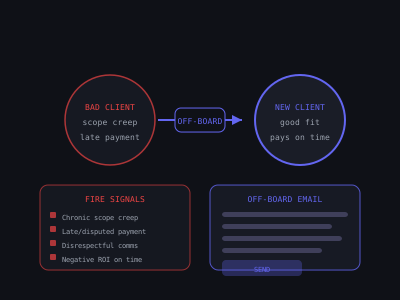
Every agency owner has a client who drains 40% of their energy for 10% of their revenue. You know exactly who I'm talking about. They message after midnight. They dispute scope constantly. They make your team dread Monday mornings. You open their Slack channel with a knot in your stomach, and you close it 45 minutes later having accomplished nothing except emotional damage control.
The instinct is to keep them because revenue is revenue. But the math doesn't work. A difficult client who pays $1,500/month but consumes 25 hours of your time is costing you the opportunity to land two new clients who pay the same and take 4 hours each. That is not a hypothetical, run the numbers on your own roster right now. Take your worst client's monthly payment and divide it by the total hours you and your team spend on their account, including Slack messages, calls, rework, scope discussions, and the 20 minutes you spend venting about them after every interaction. The effective hourly rate is almost always below minimum wage.
Firing a bad client isn't a failure, it's a strategic decision. It is one of the highest-leverage moves you can make as an agency owner because it simultaneously removes a drain on your capacity, protects your team's morale, and opens space for a client who actually fits your business model. This guide gives you the framework to do it professionally, cleanly, and without drama.
Step 1: Confirm It's a Fire, Not a Fix
Before you fire anyone, make sure you've genuinely tried to fix the relationship. A difficult client who can be reset with clear boundaries isn't a client you should fire, they're a client you should manage differently. The distinction matters because some clients are difficult only because expectations were never clearly set. That is a process failure on your end, not a character flaw on theirs.
Ask yourself these three diagnostic questions:
- Have I clearly communicated the communication protocol in writing?
- Have I had a direct conversation about the specific behavior that's the problem?
- Have I offered a solution (revised scope, different pricing, adjusted deliverables) that might resolve the tension?
If yes to all three and the behavior persists, it's time to fire.
Here is a concrete example of a fixable situation: a client sends you messages at 11pm expecting responses. You have never explicitly told them your response window is 9am-6pm on weekdays. Before firing, send a written communication policy: "Messages received after 6pm will be addressed the following business day." If they respect it, problem solved. If they continue sending midnight messages and then get upset when you don't reply until morning, that is a pattern that won't change.
Another fixable situation: the client keeps asking for work outside the original scope. Before firing, send a formal change order for the next out-of-scope request. Outline the additional cost and timeline. If they pay for it, your scope problem was actually a pricing problem. If they refuse to pay but still expect the work, that is the confirmation you need.
Bad Client Impact: Revenue vs Time Consumed
The 7 Signs It's Time to Fire a Client
Sign 1: Chronic Scope Creep Despite Clear Boundaries
Every month they request work that falls outside the contract, and they respond poorly when you say it requires a change order. This isn't a misunderstanding, it's a values mismatch. Some clients fundamentally believe that saying "that's outside scope" is you being difficult, not you enforcing an agreement.
You will see this pattern escalate over time. Month one, they ask for a small tweak that takes 30 minutes, and you do it as a courtesy. Month two, the requests are bigger. By month four, they are sending weekly lists of new features they expect included in their existing retainer. Each time you push back, they reference the free work you did in month one as proof that this is how the relationship works. The precedent compounds. The only way to stop it is to either enforce a hard boundary with change orders or exit the relationship entirely.
Sign 2: Constant Payment Issues
Late payments, disputed invoices, and "I thought that was included" conversations are a pattern, not a one-off. Chasing payment consumes time and energy better spent elsewhere. A client who doesn't pay reliably isn't worth the revenue.
Track this quantitatively. If a client has been late on 3 or more payments in a 6-month period, that is a pattern. If they dispute line items on invoices more than once, that is a pattern. The time you spend drafting follow-up emails, re-explaining what was included, and managing the anxiety of unpaid invoices has a real cost. For a $2,000/month client, two hours per month chasing payment at a $150/hour opportunity cost means you are effectively giving them a 15% discount every single month, except the discount goes to waste rather than to goodwill.
Sign 3: Disrespectful Communication
Messages that are rude, dismissive, or threatening, especially after hours. A client who makes your team feel bad about coming to work is costing you more than their retainer in morale and team retention.
This is the one sign where you should have the lowest tolerance. A client who is rude to you is one thing. A client who is rude to your team, your VA, your automation builder, your project manager, is someone you fire quickly. Good team members are harder to replace than clients. If you lose a $2,500/month client, you can find another one in 30 days with a solid outreach campaign. If you lose a skilled automation builder because you allowed a client to berate them, that replacement takes months and costs thousands in lost productivity during the transition.
Sign 4: Unrealistic Expectations That Don't Shift
You built the system they agreed to. It's working as designed. But they're not satisfied and the goalposts keep moving. These clients are impossible to satisfy because their expectations aren't grounded in what was actually promised.
A typical example in AI automation: you build a lead qualification chatbot that captures 85% of the data fields the client requested. The bot is working, leads are being qualified, and response time has dropped from 4 hours to 30 seconds. But the client fixates on the 15% of conversations where leads drop off before completing the flow. They want a 100% completion rate, which is not achievable in any lead capture system anywhere. You explain this with industry benchmarks. They send you a competitor's landing page and say "they probably get 100%." No amount of data, explanation, or context will change their expectation. That gap between what is possible and what they demand will never close.
Sign 5: Refusal to Do Their Part
Some automations require client input, access to their CRM, approval on AI responses, participation in the onboarding process. A client who ghosts every request for input but then complains about slow delivery is creating the problem they're blaming you for.
This is particularly common in AI automation because many workflows require the client to provide training data, approve AI-generated responses, or grant access to third-party tools. You send a Loom video explaining what you need. They don't watch it. You send a follow-up email. No response for 8 days. You send a third message. They reply with "Sorry, been busy, can you just handle it?" But you literally cannot build a CRM integration without CRM credentials. Two weeks later they send a message asking why the project is behind schedule. Document every instance of this with dates and screenshots. When the off-boarding conversation happens, you will need this record.
Sign 6: The Revenue Doesn't Justify the Cost
Do the math: their monthly payment divided by actual hours spent (including stress, context switching, and conversations) equals your effective hourly rate from this client. If it's significantly below your target, they're not a good business decision.
Here is how to calculate this precisely. Open a spreadsheet and track every minute spent on this client for two weeks. Include time in Slack, email, calls, build work, rework, internal discussions about their account, and time spent thinking about their latest complaint while you should be working on something else. Multiply by two to get the monthly total. Divide their monthly payment by that number. If your agency targets $125/hour effective rate and this client is coming in at $38/hour, that is a 70% discount you are giving them involuntarily. No business survives long-term at those margins.
Sign 7: They Undermine Your Confidence or Reputation
A client who publicly complains, leaves bad reviews over solvable issues, or speaks poorly of your work to others in your network is actively damaging your business. No retainer is worth that.
Watch for the subtle version of this as well. A client who tells you they mentioned to another business owner that your work "is okay but not amazing" is doing soft reputational damage. A client who posts vaguely negative things about AI agencies in Facebook groups where your prospects hang out, without naming you but clearly referencing your engagement, is doing real damage. The AI automation space is small. Agency owners talk to each other, and business owners in local markets talk to each other. One dissatisfied client with a loud voice can cost you three future deals you never even hear about.
The Pre-Fire Conversation
Before formal off-boarding, have one direct conversation. This conversation has two purposes: to be fair to the client and to give you a clear conscience about the decision.
Framework:
"I want to have a direct conversation with you about how the engagement has been going. I've noticed [specific pattern, be concrete, not general]. I've tried to address this by [what you did], but the pattern has continued. I want to ask you directly: is there something I'm missing about what you need, or something we should be doing differently?"
Then listen. Sometimes this conversation surfaces a legitimate misunderstanding. More often, it confirms the decision. Either way, you've been fair.
Do this conversation over video call, not text. Tone matters here, and written words can be misread. Keep the call to 15-20 minutes. Have your specific examples written down in front of you so you don't get flustered or go off-topic. Do not apologize for having the conversation. Do not say "I know this is awkward." Be direct, factual, and calm.
If the client gets defensive or hostile during this call, that is all the information you need. A reasonable person who wants the relationship to work will engage with the feedback. A person who cannot handle direct feedback about a business arrangement is someone who will only get harder to work with over time.
After the call, send a brief written summary of what was discussed and any agreed-upon next steps. This creates a paper trail. If the client improves, great, you avoided a firing. If they do not improve within 2-3 weeks, proceed to the off-boarding letter. You now have documented evidence that you raised the issue, gave them a chance to correct it, and they chose not to.
Off-Boarding Template Selection by Situation Severity
For preventing bad-fit clients from entering your pipeline in the first place, see our guide on AI agency client acquisition strategy. To build better contracts that protect you, read about AI agency invoices and contracts.
The Off-Boarding Letter: 4 Templates
Template 1: End of Contract Term (Cleanest)
If your contract has a defined end date or 30-day notice clause, use that as your exit mechanism. This is the most professional and least confrontational approach.
Email: "Hi [Name], I wanted to reach out ahead of our contract renewal date on [date]. After reflecting on the engagement, I've decided not to renew this contract. I want to give you as much transition time as possible, so I'm letting you know now. I'll continue delivering the current scope through [end date] and will provide documentation on everything that's been built so your next provider can take over seamlessly. Thank you for the opportunity to work with you."
Template 2: Capacity Reason (Diplomatically True)
If you'd rather not get into specifics, use a capacity or focus reason. It's honest enough and avoids a defensive response.
Email: "Hi [Name], I'm writing to let you know that I'm making some changes to my client roster as I shift the agency's focus. As part of that, I won't be able to continue our engagement beyond [end date]. I'll honor the full remaining contract term and hand off all documentation to make your transition smooth. I appreciate your trust and wish you well."
Template 3: Scope Misalignment (Direct)
For clients where the core issue is an ongoing disagreement about what the engagement covers.
Email: "Hi [Name], I've been thinking about our engagement and I don't think we're a good fit going forward. The expectations for this engagement have consistently exceeded what the contract covers, and I haven't been able to find a version of the work that leaves both of us satisfied. Rather than continue in a direction that isn't working for either of us, I think the right move is to wind down the engagement. I'll complete my current obligations through [date] and provide full documentation."
Template 4: Immediate Termination (Payment/Conduct Issues)
For cases involving repeated non-payment or misconduct that exceeds your tolerance threshold. Use only after consulting your contract terms.
Email: "Hi [Name], Per the terms of our contract, I am providing formal notice that I am terminating our engagement effective [date]. [If payment: This follows [X] missed payments despite [X] reminders.] All work will cease on that date. I will provide access to all deliverables that have been fully paid for. Please confirm receipt of this email."
A critical note on choosing the right template: match the template to the severity of the situation, not to your emotional state. If you are furious about chronic scope creep, Template 1 or 2 is still the right choice if the client has not been abusive or delinquent on payments. Save Template 4 for situations that genuinely warrant immediate termination. Burning a bridge with an aggressive email feels satisfying for 10 minutes and creates potential problems for months. The professional community is small and people screenshot emails.
The Off-Boarding Process
Regardless of why you're ending the relationship, handle the off-boarding professionally. Your reputation is worth more than any single client.
- Complete your contractual obligations: Finish any active work you've committed to, unless there are conduct or payment issues that trigger immediate termination clauses
- Document everything: Provide a comprehensive handoff document covering every automation built, all credentials (change API keys before handing them over), integration notes, and known issues
- Return access: Remove yourself from all client accounts and tools. Keep a record that you did this.
- Disable sensitive automations carefully: Give the client a transition window where automations continue running, then disable cleanly with notice
- Issue final invoices promptly: Don't let billing drag out past the relationship
The handoff document deserves special attention. For AI automation clients, this document should include: a list of every workflow and what it does in plain language, the trigger conditions and schedules for each automation, all third-party accounts and API connections involved, the login credentials or API keys that will need to be rotated, any recurring costs the client will need to continue paying (OpenAI API usage, Twilio numbers, n8n hosting), and step-by-step instructions for pausing or modifying each workflow. A thorough handoff document accomplishes two things: it protects you legally by proving you delivered a complete transition, and it makes it nearly impossible for the client to claim you left them stranded.
Set a specific deadline for the handoff. Do not leave this open-ended. A message like "All access and documentation will be transferred by April 15th. After that date, I will no longer have access to your systems" creates a clean boundary. If the client drags their feet on accepting the handoff, you have a documented deadline that protects you.
Handling the Emotional Fallout
Firing a client triggers a predictable emotional sequence that catches many first-time agency owners off guard. Anticipating it makes it easier to manage.
First comes relief, the immediate weight off your shoulders. Then comes anxiety, usually about 24-48 hours later, when you start second-guessing the decision and worrying about the lost revenue. Then comes a brief period of guilt, especially if the client responded emotionally. Finally, within 1-2 weeks, comes clarity. You notice you are sleeping better. Your team is more productive. You are excited about your other clients again. The revenue gap feels manageable, and you realize the mental space you recovered is worth more than the monthly retainer you gave up.
If you have a business partner or a mentor, brief them before the firing conversation. Having someone who knows the context and can talk you through the anxiety phase is valuable. The worst thing you can do is fire a client on Monday, panic about the revenue on Wednesday, and try to un-fire them on Friday. That destroys your credibility and makes the eventual separation, which will still happen, far messier.
What to Do With the Freed Capacity
The moment a difficult client is off your roster, replace them with intention. Do not let the freed time become idle time. Have a 30-day replacement plan ready before you send the off-boarding email. Use the freed capacity to:
- Run a targeted outreach campaign to the niche where you have the best clients
- Reach out to warm leads who went quiet but were previously interested
- Raise your prices for new clients (you just proved you can let go of bad-fit business)
- Invest 20% of the freed time in building systems that make your best clients more successful
Here is a specific 30-day replacement plan. Week one: reach out to every warm lead in your pipeline with a personal message. Week two: launch a cold outreach campaign targeting 50-100 businesses in your strongest niche. Week three: ask your three best current clients for referrals, the timing is right because you are now delivering even better work with more capacity. Week four: evaluate incoming leads and close the best fit. Most agency owners who follow this plan replace the fired client's revenue within 3-4 weeks, often with a client who pays more and requires less maintenance.
The best AI automation agencies are ruthless about client quality, not just client quantity. One client who pays $3,000/month, sends clear requests, trusts your judgment, and sends you referrals is worth more than five difficult clients at $1,200 each. The math on this is not even close. Five difficult clients at $1,200 generate $6,000/month in revenue but might consume 80 hours of collective work. One great client at $3,000 might take 8 hours. The difference in profitability, scalability, and quality of life is enormous.
For building the systems that prevent bad-fit clients from getting this far in the first place, see our guides on discovery call qualification and how to build a sustainable AI automation agency from the ground up.
Protecting Your Business Before You Fire
Before sending the off-boarding email, take these protective steps:
- Review your contract for termination clauses, notice periods, and any penalties
- Screenshot key communication threads showing the pattern of behavior (do this before any conflict escalates)
- Ensure all invoices are current and any disputed amounts are documented
- Change any shared API keys or credentials to ones they don't have access to
- Do not announce the firing on social media, ever
A few additional protective measures that experienced agency owners take: move any shared project files or documentation to your own storage before initiating the conversation. If you use shared tools like Notion, Trello, or ClickUp with the client, export your internal notes and remove any proprietary process documentation that belongs to your agency, not to the client. Ensure your team knows the off-boarding is happening before the client hears from you, the last thing you want is a disgruntled client contacting your team members directly before you have had the chance to brief them.
If you are concerned the client might react aggressively, threatening legal action, demanding refunds, or leaving retaliatory reviews, prepare for those scenarios in advance. Have a calm, factual response drafted for each possibility. For legal threats: "I understand your frustration. Our contract terms are clear and have been followed. I am happy to discuss any specific concerns." For refund demands: "All work outlined in the contract has been delivered. I have provided comprehensive documentation of every deliverable." For review threats: say nothing publicly. Respond privately and professionally. Most threats are emotional and do not materialize when met with calm professionalism.
Firing a client cleanly protects your reputation, your team's morale, and your capacity for the clients who deserve your best work. Every agency owner who has done it will tell you the same thing: they wished they had done it sooner. The clients who remain on your roster will receive better service, your team will be more engaged, and you will have the bandwidth to pursue the opportunities that actually grow your business. The short-term revenue loss is real. The long-term gain, in profitability, reputation, and sanity, is far greater.
Want to learn how to build and sell AI automations? Kingstone AI Operators is our free community for AI automation agency builders. Join Kingstone AI Operators, free.
FAQ
Frequently Asked Questions
How do I know when it's time to fire a client from my AI automation agency?
Fire a client when they consistently exhibit one or more of these patterns: they demand unlimited revisions beyond the agreed scope, they are abusive or disrespectful to you or your team, they refuse to provide necessary access or information, they dispute invoices repeatedly, their account is unprofitable even after price adjustments, or they consume disproportionate time that prevents you from serving other clients. If a client makes you dread Monday mornings, it's time.
What is the best way to fire a client professionally?
Use a structured approach: first, have a direct conversation about the issues and give them a chance to adjust. If nothing changes, give written notice per your contract terms (typically 30 days). Offer a smooth transition including documentation, data export, and recommendations for alternative providers. Keep the tone professional and factual, focus on business fit rather than personal grievances.
How do I protect my agency when off-boarding a difficult client?
Document everything before the conversation: keep records of scope changes, unanswered emails, and unpaid invoices. Review your contract for termination clauses and follow them exactly. Deliver all outstanding work and documentation before the final date. Get written confirmation of the termination terms. Never badmouth the client publicly, the professional community is smaller than you think.
Should I refund a client I'm firing from my AI agency?
Only refund if you have not delivered the agreed-upon work. If you've completed the build and the client is dissatisfied despite your deliverables meeting the original scope, a refund is not warranted. For monthly retainers, prorate the final month if you're terminating mid-cycle. Never refund out of guilt, doing so sets a precedent that undermines the value of your services.
How do I prevent bad clients from joining my AI automation agency in the first place?
Screen during the sales process: require a discovery call before accepting any client, use qualification questions about budget and decision-making process, watch for red flags like demanding free work before committing or being disrespectful during calls. Use clear contracts with defined scope, revision limits, and termination clauses. Raising your prices naturally filters out many problem clients.
What should I do after firing a bad client from my AI agency?
Immediately redirect that time and energy to acquiring a better-fit replacement. Update your qualifying criteria to screen for the traits that made the previous client problematic. Review your contract templates for gaps that allowed scope creep or payment issues. Most importantly, note the positive impact on your mental health and productivity, this confirms you made the right decision.
Program · 90 days
Client Accelerator bundles the demo software with live coaching.
A one-time $1,499 purchase, or 4 interest-free payments of $374.75. Includes Ciela AI with 150 personalized demos each month throughout the program, the 90-Day AI Client System, two live group coaching calls every week, sales and outreach templates, 200+ n8n workflow templates, and private Build With Adhiraj resources.
See what is includedCiela AI is the demo platform for AI agencies and AI consultants. It turns any prospect's website into a live, personalized AI demo (chat, voice, or missed-call text-back) you can send before the first call.
Start Client AcceleratorCiela AI pricingAgent builds by nicheAll articles
Community · Training
Join Build With Adhiraj free.
Build With Adhiraj is the free community for people building and growing AI service businesses. Learn alongside other operators as you package, demonstrate, sell, and deliver practical AI systems.
Join Build With Adhiraj free