
How to Get Your First AI Agency Client From LinkedIn in 30 Days
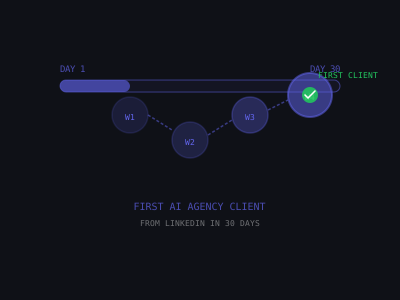
Getting your first AI agency client is the hardest part. Not because it is technically difficult, but because most new agency owners spend weeks perfecting their offer, building a website, and procrastinating on the actual work of finding clients: talking to people. LinkedIn is the fastest path to that first yes, and this guide gives you a day-by-day plan for the next 30 days.
If you follow this plan, you should have at least 2-5 qualified sales conversations booked by the end of week 3, and a strong chance of having your first client (or a very close second conversation) by day 30. The plan is designed for agency owners who are starting from zero, no existing clients, no large network, no established LinkedIn presence.
Before Day 1: The Three Non-Negotiables
Do not start outreach until these three things are in place. Sending messages before fixing these is like driving traffic to a broken landing page.
- A clear, specific niche. "I help businesses with AI" is too broad to generate referrals or qualify prospects efficiently. Pick one: "I help HVAC companies automate their lead follow-up with AI" or "I build AI chatbots for dental practices." The niche can evolve, but you need a starting point that is specific enough to resonate. Specificity makes your messaging sharper, your targeting easier, and your conversations more productive, because you can speak directly to problems the prospect actually has rather than speaking generally about possibilities.
- A LinkedIn profile that passes the 5-second test. When a prospect clicks your profile after getting a connection request, they need to immediately understand: what you do, who you help, and why that is valuable. Your headline should be "I help [niche] with [specific outcome] using AI" not your job title. Your About section should tell a brief story about why you do this work and include 1-2 sentences on what success looks like for clients you work with.
- An offer you can explain in one sentence. "I build a custom AI chatbot that handles your inbound leads 24/7, qualifies them automatically, and books appointments directly to your calendar, for a one-time setup fee and a monthly retainer." One sentence. Practice saying it out loud until it sounds natural. If you cannot explain your offer in one sentence, it is too complicated for a first conversation.
LinkedIn Profile Optimization Checklist
Before sending a single connection request, optimize these profile elements:
- Headline: "I help [niche] [achieve specific outcome] with AI automation" not "Founder at XYZ Agency"
- Banner image: A simple graphic showing your core offer or a client result. Canva has free templates.
- About section: 3-4 short paragraphs: who you help, what problem you solve, what results look like, and a CTA to connect.
- Featured section: Pin a case study, a Loom demo walkthrough, or a client testimonial. Even a mock case study works when starting out.
- Experience: Your current role should clearly describe your AI automation services and results, not read like a resume.
The "mock case study" point deserves emphasis. If you do not have a paying client yet, build a demo project for a hypothetical business in your niche, or offer to do a free audit or proof-of-concept for a local business in exchange for permission to document the results. Having even one concrete example to point to in your Featured section transforms your profile from theoretical to credible. Prospects evaluate competence through evidence, not claims.
LinkedIn Outreach Funnel: Realistic Numbers for First 30 Days
Week 1 (Days 1-7): Foundation and List Building
In week 1, you are not pitching anyone. You are building your prospect list, optimizing your profile, and sending warm-up connection requests without any explicit sales intent.
Daily tasks for week 1 (30-45 minutes per day):
- Day 1: Finalize your profile headline, banner, and About section. Add a clear call-to-action at the bottom of your About section.
- Day 2: Build a prospect list of 50 people in your target niche. Use Boolean search, LinkedIn groups, or engagement on niche content.
- Day 3: Send 10 connection requests from your list. Use specific, personalized notes (not blank requests). Target: decision-makers with 50-500 employee companies in your niche.
- Day 4: Add 20 more prospects to your list. Send 10 more connection requests.
- Day 5: Follow up on anyone who accepted from Day 3 with a brief, non-salesy opener. Like and comment on 5-10 posts from prospects on your list.
- Day 6-7: Continue building the list to 100 prospects. Send 10-15 connection requests. Engage with content in your niche.
End of week 1 target: 100 prospects in your pipeline, 30-40 connection requests sent, 8-15 accepted connections, 0 pitches made.
The "0 pitches made" target is deliberate. Week 1 is about building a foundation of connections and engagement that makes your outreach in week 2 feel natural rather than cold. The temptation to start pitching immediately is strong, resist it. Prospects who have seen your profile, noticed your content engagement, and accepted your connection request are in a fundamentally different mental state than those receiving a cold pitch from a stranger.
Week 2 (Days 8-14): Starting the Conversations
Week 2 is where you start sending first DMs to your accepted connections and moving people toward conversations. The goal is not to pitch, it is to find out if they have the problem you solve.
Daily tasks for week 2 (45-60 minutes per day):
- Day 8: Message all connections accepted in week 1 who you have not messaged yet. Use a problem-first opener: "Most [niche] owners I talk to say [specific problem] is their biggest challenge. Is that the case at [Company] or do you have that pretty dialed in?"
- Day 9-10: Send 10-15 new connection requests. Keep engaging with content from prospects. Follow up with anyone who has accepted but not been messaged.
- Day 11: Monitor responses from Day 8 messages. Reply to anyone who responded, keep the conversation going with a follow-up question or insight, not a pitch.
- Day 12-14: Continue sending connection requests and first messages. For any conversation that has gone 2-3 exchanges deep, introduce the soft ask: "I'd love to show you what we've built for [similar company], would you be open to a quick 20-minute call this week?"
End of week 2 target: 60-70 connection requests sent total, 20-30 accepted, 10-15 first messages sent, 3-8 conversations active, 1-3 sales calls booked.
The problem-first opener is critical. Compare "Hi, I run an AI automation agency and I'd love to show you what we do" with "Most dental practice owners I talk to say managing patient follow-ups is eating 10+ hours per week. Is that the case at [Practice Name]?" The first message is about you. The second message is about them. The second message gets replies because it demonstrates understanding and invites a natural response. For more DM scripting, see our LinkedIn DM scripts guide.
Week 3 (Days 15-21): Running Discovery Calls
By week 3, you should have at least 1-3 calls booked. This is where the LinkedIn work transitions to sales work. But you also need to keep the LinkedIn pipeline moving so you have a steady flow of conversations.
Daily tasks for week 3 (45-60 minutes per day):
- Continue sending 10-15 connection requests per day
- Follow up on unanswered messages from week 2 with a different angle
- Run your discovery calls, focus on understanding their problem, not presenting your solution
- After each call: send a thank-you message within 2 hours with a brief summary of what you discussed and the agreed next step
Discovery call script outline:
- Open: "Thanks for making time. I just have a few questions to understand where you're at, then I'll share what I've been doing that's relevant, and we can figure out if there's a fit."
- Questions: "Walk me through what your current [process] looks like." "What's the biggest bottleneck?" "How much is that costing you in time/money/leads right now?"
- Transition: "Based on what you've shared, this is basically what I've solved for companies similar to yours..."
- Close: "Does this feel like the right solution for where you are? What would you need to see to feel confident moving forward?"
The discovery call is where first-time agency owners most commonly fail, not because they lack technical skills, but because they over-present and under-listen. The ideal ratio is 70% listening, 30% talking. Your job on the call is to understand their situation deeply enough to propose a specific solution, not to demo every feature you can build. The prospect does not care about your technical capabilities, they care about whether you can solve their problem. Demonstrate understanding of their problem first, and the technical solution conversation follows naturally.
For a complete sales call framework, see our guide on closing AI automation clients.
End of week 3 target: 2-5 discovery calls completed, 1-2 follow-up conversations in progress, clear picture of what objections come up most.
Week 4 (Days 22-30): Close or Keep Moving
By week 4, you are either closing your first client, handling objections from warm conversations, or accelerating your outreach volume based on what you have learned. Most first clients for AI agency owners come from this window, or from week 5-6 follow-ups on conversations started here.
Common week 4 scenarios and what to do:
- Someone said "yes, let's move forward" on the call: Send them a proposal or contract within 24 hours. Speed kills uncertainty. The longer you wait to formalize, the more likely the prospect cools off or gets distracted by other priorities.
- Someone said "I'm interested, send me more info": Do not send a document, book a follow-up call. "I have a few questions I want to answer first before sending anything over, do you have 20 minutes Thursday?" The "send me info" request is often a polite stall. A follow-up call converts better than a PDF.
- Someone said "let me think about it": Follow up in 3-5 days with a relevant case study or specific insight: "Was thinking about our call, I put together a quick example of what this would look like for [Company]. Would it be helpful to walk through it on another short call?"
- No calls booked yet: Review your message opening rates and response rates. The most common cause of low response is messaging the wrong prospect, not using the wrong words. Narrow your niche further and re-test.
Common First-Client Objections and Close Rates After Handling
Realistic Numbers: What to Expect
First-time LinkedIn outreach to a new niche typically produces:
- Connection request acceptance rate: 25-40% (higher with good personalization)
- Message reply rate (from accepted connections): 10-20%
- Reply to call conversion: 30-50% of replies that engage with your question
- Call to close rate (first client): 15-30% on discovery calls when you are new
With these numbers, if you send 100 connection requests, 30-40 accept, 3-8 reply to your first message, 2-4 get on a call, and 1 becomes a client. That is a realistic first-month outcome. By month 2-3, your message quality improves, your niche sharpens, and conversion rates at every stage go up.
These numbers may seem low if you are used to seeing influencers claim 80% response rates and five clients in a week. Those claims are not representative of the typical first-month experience. The honest reality is that your first 30 days involve a lot of learning, which messages resonate, which niches respond, how to structure discovery calls, how to handle objections. That learning is the most valuable outcome of month one, even more than the first client.
Content That Accelerates LinkedIn Outreach
While running outreach, posting content on LinkedIn amplifies your results. Prospects who see your posts before receiving a connection request are more likely to accept and engage. You do not need to post daily, 2-3 posts per week is enough.
- Educational posts: Share specific AI automation tips relevant to your niche. "3 ways HVAC companies lose leads after hours (and how AI fixes each one)."
- Result posts: Share outcomes from your work (even from demo projects or free audits). Numbers and specifics matter.
- Process posts: Walk through how you built something. People trust practitioners who show their work.
- Engagement posts: Ask a question relevant to your niche. "HVAC owners: what's your biggest challenge with lead follow-up right now?" This starts conversations in the comments that lead to DMs.
The content-outreach synergy is powerful. When a prospect receives your connection request, the first thing they do is visit your profile. If your profile shows recent, relevant posts about problems they actually have, your credibility is established before you exchange a single message. If your profile shows no activity, they have only your headline and About section to evaluate, which is a much weaker credibility signal.
The Single Biggest Mistake New Agency Owners Make
The most common failure mode for new AI agency owners on LinkedIn: waiting until everything is perfect before starting outreach. The website needs to be done. The case studies need to be written. The service needs to be clearer. The proposal template needs to be finalized.
You do not need any of that for your first client. You need a conversation, a clear offer, and a client who has the problem you solve. The first client teaches you more about your offer, pricing, and delivery than six months of refining a deck.
Start the outreach. Refine everything else based on what real conversations tell you. The feedback loop from actual prospect conversations is the fastest path to a compelling offer, the right pricing, and a delivery process that works. Every day you spend perfecting materials instead of sending messages is a day wasted.
For the complete guide to getting your first AI automation client from any channel, see our post on how to get clients for your AI automation agency.
Want to learn how to build and sell AI automations? Kingstone AI Operators is our free community for AI automation agency builders. Join Kingstone AI Operators, free.
FAQ
Frequently Asked Questions
How do I get my first AI agency client from LinkedIn in 30 days?
Follow a structured 4-week plan: Week 1 optimize your profile and build a prospect list of 100 people. Week 2 start conversations with accepted connections using problem-first openers. Week 3 run discovery calls and refine your pitch. Week 4 close or accelerate based on feedback. Most first clients come from week 3-4 conversations or week 5-6 follow-ups.
How many LinkedIn connection requests should I send per day to get AI clients?
Send 10-15 personalized connection requests per day to decision-makers in your target niche. LinkedIn's soft limit is around 20-25 per day. With a 25-40% acceptance rate, this generates 3-6 new connections daily. Combined with follow-up messages, this volume produces 2-5 qualified conversations per month.
What should my LinkedIn profile say if I run an AI automation agency?
Your headline should be 'I help [niche] with [specific outcome] using AI', not your job title. Your About section should tell a brief story about why you do this work and include 1-2 sentences on what success looks like for clients. Include a clear call-to-action at the bottom. The profile must pass the 5-second test: visitors immediately understand what you do and who you help.
What is the best LinkedIn DM script for selling AI automation services?
Do not pitch in the first message. Use a problem-first opener: 'Most [niche] owners I talk to say [specific problem] is their biggest challenge. Is that the case at [Company] or do you have that pretty dialed in?' This starts a conversation rather than triggering a sales reflex. Pitch only after 2-3 message exchanges.
How long does it take to get an AI agency client from LinkedIn?
With consistent daily outreach of 10-15 connection requests, most agency owners book their first discovery call within 2-3 weeks and close their first client within 30-60 days. The median is around 45 days. Speed depends on niche specificity, message quality, and how quickly you follow up with engaged prospects.
What is a realistic conversion rate for LinkedIn outreach for AI agencies?
Connection request acceptance: 25-40%. Message reply rate from accepted connections: 10-20%. Reply to call conversion: 30-50% of engaged replies. Call to close rate for first-time agency owners: 15-30%. With 100 connection requests, expect roughly 1 client. By month 2-3, conversion rates improve at every stage as your messaging refines.
Do I need LinkedIn Sales Navigator to get AI automation clients?
No. Free LinkedIn search with Boolean operators can find plenty of prospects in most niches. Sales Navigator helps at scale (100+ requests/week) by providing better filtering and InMail credits, but it is not necessary for your first 5-10 clients. Invest in Sales Navigator after you have a proven outreach sequence.
Program · 90 days
Client Accelerator bundles the demo software with live coaching.
A one-time $1,499 purchase, or 4 interest-free payments of $374.75. Includes Ciela AI with 150 personalized demos each month throughout the program, the 90-Day AI Client System, two live group coaching calls every week, sales and outreach templates, 200+ n8n workflow templates, and private Build With Adhiraj resources.
See what is includedCiela AI is the demo platform for AI agencies and AI consultants. It turns any prospect's website into a live, personalized AI demo (chat, voice, or missed-call text-back) you can send before the first call.
Start Client AcceleratorCiela AI pricingAgent builds by nicheAll articles
Community · Training
Join Build With Adhiraj free.
Build With Adhiraj is the free community for people building and growing AI service businesses. Learn alongside other operators as you package, demonstrate, sell, and deliver practical AI systems.
Join Build With Adhiraj free