
How to Get Referrals From AI Automation Clients Systematically
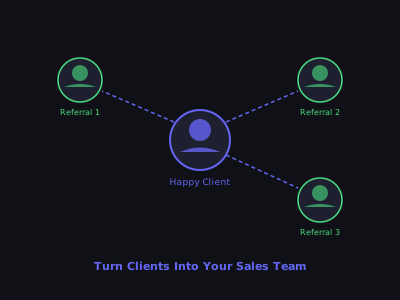
Referrals are the most efficient client acquisition channel available to an AI automation agency. A referred prospect already trusts you because someone they trust does. They close faster, negotiate less, and churn at half the rate of cold-sourced clients. The problem is that most agency owners treat referrals as something that happens to them rather than something they engineer. This guide covers the systematic approach to generating referrals consistently, when to ask, what to say, how to make it easy, and how to build a partner network that sends warm leads every month.
The Four Moments When Referral Asks Convert
Most agency owners wait for clients to spontaneously refer business. That is a passive approach that produces occasional referrals. The systematic approach identifies the four specific moments when clients are most emotionally primed to refer and builds explicit asks into your process at each one.
The first moment is immediately after a visible win. When a client sends you an excited message about a result, their first automated booking, a record lead month, a significant time saving, that is your window. Respond to the excitement, let it land, and then say: "I am really glad to hear this is working well. Do you know any other [niche] owners who might be dealing with similar challenges? I would love a quick intro if anyone comes to mind." This feels natural because it follows genuine enthusiasm, not a scheduled ask.
The second moment is the 30-day check-in call. After every project goes live, schedule a 30-minute check-in at day 30 to review early results. When results are visible and positive, close the call with the referral ask: "This has been a great first month, the results are already showing. Is there anyone in your network you think would benefit from something similar?" Clients who have just experienced value are in the ideal mindset to share it.
The third moment is the quarterly business review. Frame referrals as a natural topic: "Our best client relationships often come from introductions by clients who love the work. If anyone in your network ever mentions they are struggling with lead follow-up or automation, please do not hesitate to connect us, happy to do the same for you." The fourth moment is 60 days before renewal. A client renewing their contract is demonstrating trust and satisfaction. The renewal conversation is the ideal time to mention that their referrals would be meaningful.
Referral Ask Timing vs. Conversion Rate
The Referral Kit: Making It Easy to Introduce You
Clients who want to refer you often do not because they are not sure what to say. The referral kit removes that friction by giving them the exact words to use. Create a one-paragraph copy-paste introduction template for every client after their first successful result. The template should include your name, what you do in one sentence, the specific result you achieved for the referring client (with their permission), and a low-commitment next step like booking a free 30-minute audit.
Send it to the client with a note: "If you ever want to make an introduction, here is a quick template so you do not have to write it from scratch, just customize it however you like." The key is that the template includes specific results, not generic descriptions. "They helped me reduce my no-show rate from 35 percent to 12 percent in the first month" is a referral that gets meetings. "They do AI automation for businesses" does not.
Referral Incentives That Work
Service credits, offering one free automation build per successful referral, work best for clients who already love your work and are excited about what more automation could do for their business. A discount on their next renewal is another effective structure because it incentivizes the referral while simultaneously improving retention: the client now has a financial reason to renew on time and to refer before renewal. Cash referral fees of 5 to 10 percent of the first three months of a new client's contract work well for business-minded clients and referral partners who think in terms of financial transactions.
The most important principle is to offer the incentive after the referral converts, not before. "If you introduce me to anyone and they become a client, I will give you a free automation build worth $1,500" is a meaningful incentive that does not feel transactional. "I will pay you $200 for any name you give me" feels like you are paying for leads, which devalues the referral and the relationship.
Building a Referral Partner Network
Strategic referral partners are non-competing service providers who serve the same clients you serve. A web designer who builds sites for local service businesses is a perfect referral partner for an AI agency targeting local service businesses. A marketing consultant who runs campaigns for dental practices is a perfect referral partner for an agency targeting dental practices. They encounter your ideal clients daily, are trusted by those clients, and have no overlap with what you offer.
Identify five to ten potential partners in adjacent services: web developers, copywriters, marketing consultants, business coaches, accountants, and CRM specialists. Reach out with a mutual referral proposal: "I work with [niche] businesses on AI automation and you work with them on [their service]. Our clients are the same people but we never compete. I would love to explore a mutual referral relationship, would a 20-minute call make sense?" One active referral partner who serves the same niche as you can generate two to four qualified leads per month consistently.
Referral Revenue as % of Total Agency Revenue Over Time
Tracking Referrals in Your CRM
A referral system without tracking is a referral system that atrophies. Add a Referred By field to every new contact in your CRM and fill it in every time a lead comes from a referral. At the end of each month, review how many leads and how much revenue came from referrals. Track the referral rate per client, which clients are actively referring and which are not. Clients with zero referrals after six months of good results are an opportunity: they like your work but have not been asked systematically, or the referral process is too complex.
Set a goal of generating one referral conversation per week by month six. At a 40 percent conversion rate from referral conversation to new client, that is one new client every two to three weeks from referrals alone, a channel that requires no outreach budget and compounds over time as your client base grows. For the broader client acquisition strategy that referrals feed into, see the AI agency referral strategy guide and how to get clients for your AI automation agency.
Program · 90 days
Client Accelerator bundles the demo software with live coaching.
A one-time $1,499 purchase, or 4 interest-free payments of $374.75. Includes Ciela AI with 150 personalized demos each month throughout the program, the 90-Day AI Client System, two live group coaching calls every week, sales and outreach templates, 200+ n8n workflow templates, and private Build With Adhiraj resources.
See what is includedCiela AI is the demo platform for AI agencies and AI consultants. It turns any prospect's website into a live, personalized AI demo (chat, voice, or missed-call text-back) you can send before the first call.
Start Client AcceleratorCiela AI pricingAgent builds by nicheAll articles
Community · Training
Join Build With Adhiraj free.
Build With Adhiraj is the free community for people building and growing AI service businesses. Learn alongside other operators as you package, demonstrate, sell, and deliver practical AI systems.
Join Build With Adhiraj free