
How to Sell AI Automation to Business Owners Who Don't Understand Technology
The biggest challenge most AI automation agency owners face isn't building the automations, it's convincing the business owner to buy them. Most of your ideal clients run plumbing companies, dental practices, law firms, or gyms. They didn't go to business school. They definitely didn't study machine learning. When you start talking about AI workflows and webhook triggers, their eyes glaze over and they start wondering how fast they can end the call.
This guide is a complete playbook for selling AI automation to people who don't understand technology, and don't want to. You'll learn the exact language, analogies, and frameworks that turn skeptical small business owners into paying clients.
Why Most AI Agency Pitches Fail Immediately
When you lead with technology, you lose. Saying "I build AI-powered n8n workflows integrated with your CRM via webhooks" means absolutely nothing to a roofing contractor. What they hear is: expensive, complicated, probably a scam.
The fundamental mistake AI agency owners make is pitching the tool instead of the outcome. Business owners don't buy technology, they buy time, money, and peace of mind. Your job is to translate what you do into those three currencies.
The good news: once you learn to speak their language, selling AI automation becomes dramatically easier than selling most other services. The outcomes are concrete, measurable, and deeply valuable to any business that relies on leads, follow-up, or customer communication.
The Golden Rule: Outcomes Before Everything
Before any conversation about technology, you need to anchor on outcomes. The framework is simple: Problem → Cost of Problem → Your Solution → Result.
Here's what that looks like in practice for a dental practice:
- Problem: "You're losing patients every month who call after hours and don't get a response."
- Cost of Problem: "A single new patient is worth $1,200 to $3,000 in lifetime value. If you're missing 10 calls a month, that's potentially $12,000 to $30,000 in lost revenue."
- Your Solution: "I set up a system that automatically responds to every missed call within 60 seconds, qualifies the patient, and books them into your calendar, without your front desk doing anything."
- Result: "Most practices I work with recover 4–6 new patients per month in the first 60 days."
Notice there is zero technology language in that pitch. No mention of AI, automation, workflows, or any tool name. Just a clear problem, a dollar amount attached to it, and a result.
Analogies That Make AI Automation Click
Even after the pitch lands, prospects often ask "but what actually is this?" You need analogies ready. The best ones compare your work to things they already understand and trust.
The "24/7 Employee Who Never Sleeps" Analogy
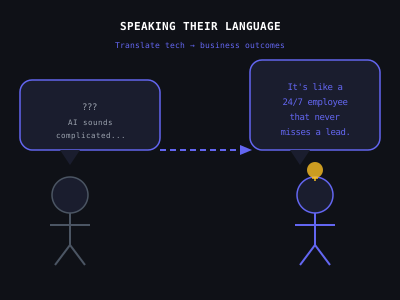
"Think of it like hiring an employee who works 24 hours a day, seven days a week, never calls in sick, never asks for a raise, and always follows your exact script. They respond to every inquiry, follow up with every lead, and book appointments, all automatically. That's essentially what I build for you."
This analogy works because business owners understand employees. They know what a $15/hour employee costs and what they can do. When you frame automation as a tireless, perfect employee who costs a fraction of that, the value becomes immediate.
The "Assembly Line" Analogy
"You know how a factory has an assembly line where parts move automatically from one station to the next without anyone touching them? I build the same thing for your business. A lead comes in, the system automatically responds, qualifies them, follows up, and books the appointment, without anyone on your team lifting a finger."
The "GPS for Your Business" Analogy
"Before GPS, you'd have to call someone every time you needed directions. Now you just get in the car and the GPS handles it. I do the same thing for your follow-up process. Right now you're manually calling leads back. I automate that so it happens instantly, every time, without you thinking about it."
Handling the Top 5 Objections From Non-Technical Buyers
Objection 1: "I've Tried Software Before and It Never Works"
This is a trust objection dressed up as a technology objection. The prospect has been burned before, probably by an over-promised CRM or a chatbot that confused every customer.
Response: "I completely understand, most software tools require your team to change how they work, and they usually don't stick. What I build is different: it runs in the background and your team doesn't need to learn anything new. In fact, most of my clients barely notice it's there until they start seeing more booked appointments showing up in their calendar."
Objection 2: "My Business Is Different, Automation Won't Work for Me"
Response: "That's actually something I hear from almost every client before we work together. And honestly, the more 'relationship-based' a business is, the more this tends to help, because the automation handles the boring, repetitive stuff so you and your team can focus on the actual relationship-building. Can I show you a quick example of how this works for someone in a similar industry?"
Objection 3: "This Sounds Too Complicated to Set Up"
Response: "You don't do any of the setup, that's what you're paying me for. My job is to handle everything technical. Your job is to answer maybe three questions about how your business works, and then I handle the rest. Most clients are fully up and running within two weeks without doing anything themselves."
Objection 4: "What If Something Breaks?"
Response: "Great question. I monitor everything on an ongoing basis. If anything stops working, I fix it, that's included in the monthly fee. You won't even know there was an issue most of the time. Think of it like having IT support on retainer."
Objection 5: "I Don't Need AI, My Team Handles This"
Response: "I'm sure they do a great job. Here's the question I always ask: what happens when a lead comes in at 9pm on a Sunday, and your team isn't there? Or when someone fills out your contact form while your team is on three other calls? The system I build captures every one of those people and responds immediately, it's not replacing your team, it's making sure no one falls through the cracks."
The Demo Approach That Closes Non-Technical Buyers
Words are fine, but showing is infinitely more powerful. The fastest way to close a non-technical business owner is to give them a live demonstration they can experience as a customer.
Before your discovery call, build a simple demo for their industry. Set up a missed-call text-back flow, or a lead response sequence. During the call, say: "Would you mind if I showed you exactly what your customers would experience? Pull out your phone, I'm going to send you a text right now."
Then trigger the demo. They receive an instant, personalized text response. They see the follow-up question. They experience the booking flow. You don't have to explain anything, they just lived through it.
This technique is so effective because it eliminates abstraction entirely. They're no longer trying to imagine what the automation does. They just experienced it as their own customer would.
For more on building effective demos, see our guide on how to create a demo that closes AI automation clients.
The Language Swap: What to Say Instead
Here are direct substitutions for technical language that will immediately improve your close rate:
- Instead of "AI workflow" → say "automated follow-up system"
- Instead of "webhook integration" → say "connects to your existing tools"
- Instead of "n8n/Make/Zapier automation" → say "the system I build for you"
- Instead of "language model" → say "smart response technology"
- Instead of "API connection" → say "connects to your calendar/CRM/email"
- Instead of "prompt engineering" → say "I train the system to sound exactly like you"
- Instead of "machine learning" → say "gets smarter the more your customers use it"
Discovery Questions That Uncover the Pain Fast
The best salespeople ask more than they talk. Here are seven questions to run in every discovery call that help non-technical buyers see their own problem clearly:
- "What happens when a lead comes in after hours?"
- "How quickly does your team follow up with new inquiries?"
- "How many leads do you think you lose each month because of slow follow-up?"
- "What's the average value of a new customer for you?"
- "If you could only fix one bottleneck in how you get new customers, what would it be?"
- "Is your team spending time on tasks that feel repetitive that should probably be automated?"
- "What does your follow-up process look like today, walk me through it step by step."
When a business owner talks through their own follow-up process out loud, they inevitably hear how broken it is. You don't need to pitch hard, you just need to ask the right questions and listen.
Following Up After the Discovery Call
Non-technical buyers often need time to process. They're not dragging their feet out of disrespect, they genuinely need to think about whether they trust you and whether this makes financial sense.
Your follow-up should never lead with more technology. Instead, lead with social proof: "I wanted to share a quick result from a client in your industry, they recovered 6 additional patients per month in their first 30 days."
The most powerful follow-up tool is a case study or testimonial from someone they can relate to. Not a generic AI case study, a specific story from a similar business in a similar situation. If you don't have one yet, offer a pilot engagement at reduced cost to create one.
For a complete guide to closing and follow-up, see our post on how to close AI automation clients.
Building Trust With the Non-Technical Buyer Long-Term
Once you close the client, your job is to make sure they feel in control even though they don't understand the technology. Here's how:
- Send simple weekly reports: Not dashboards full of metrics, one number that matters. "Your system sent 47 follow-ups this week and booked 3 appointments."
- Use plain language in all communication: Never say "the webhook failed." Say "we noticed the calendar connection had a hiccup, fixed it this morning."
- Show before-and-after comparisons: "Last month before the system: 12 leads. This month with the system: 12 leads responded to, 8 booked. Here's what changed."
- Frame issues as solved problems: Non-technical clients don't want to know about technical problems. They want to know you caught it and fixed it before they noticed.
Pricing Your Services for Non-Technical Buyers
Non-technical buyers are extremely sensitive to how you present pricing. They don't understand what goes into building an automation, so quoting "40 hours at $100/hour" feels arbitrary and scary. Instead, price based on the value of the outcome.
The most effective pricing framework for non-technical buyers is: setup fee + monthly retainer. The setup fee covers your build time and is easier to justify when anchored to the problem cost. If a client is losing $10,000/month in missed leads, a $2,500 setup fee feels like a bargain. The monthly retainer covers monitoring, optimization, and ongoing support, frame it as "your system running smoothly every month."
Avoid itemized invoices that list technical tasks like "webhook configuration" or "API integration." Non-technical clients will question every line item they don't understand. Instead, list deliverables in outcome language: "Automated lead response system," "24/7 appointment booking flow," and "Weekly performance reporting."
Another effective approach is tiered pricing. Offer a basic, standard, and premium package with clear outcome differences at each tier. This gives the prospect a sense of control and lets them self-select based on budget and ambition. Most will choose the middle tier, which you should design as your ideal engagement.
Using Social Proof to Close the Non-Technical Buyer
Non-technical buyers rely heavily on social proof because they can't evaluate the technical quality of your work. They need to see that someone like them trusted you and got results.
The most powerful social proof elements for this audience are:
- Industry-specific case studies: A dentist wants to hear about other dentists, not SaaS companies. Even if the automation is identical, the industry context matters enormously.
- Before-and-after numbers: "Before working with me, this HVAC company was responding to leads in 4 hours. Now they respond in 60 seconds. Their booking rate went from 15% to 42%."
- Video testimonials: A 60-second video of a business owner saying "I was skeptical but this actually works" is worth more than any pitch deck.
- Screenshots of results: Show actual text message conversations, calendar bookings, or lead flow screenshots with sensitive information redacted.
If you're just starting and don't have case studies yet, offer your first two or three clients a significantly reduced rate in exchange for permission to document results and record a testimonial. This initial investment in social proof will pay for itself dozens of times over.
The Proposal Template That Wins Non-Technical Clients
Your proposal should be one page, two at most. Non-technical buyers are overwhelmed by lengthy technical documents. Here's the structure that consistently wins:
- Header: Their business name, your name, and the date
- The Problem (2–3 sentences): Restate the specific problem they described on the discovery call, using their exact words
- The Solution (3–4 bullet points): What you'll build, described in outcome language
- The Expected Result (2–3 sentences): What they can expect in the first 30, 60, and 90 days, using numbers wherever possible
- Investment: Setup fee and monthly retainer, clearly stated
- What Happens Next: A simple three-step process, sign the agreement, answer a few questions about their business, and you handle the rest
- Social Proof: One or two sentences about results from a similar client
Send the proposal immediately after the discovery call while the conversation is fresh. Include a clear call to action: "If this looks good, just reply 'let's go' and I'll send over the agreement." Make it as easy as possible for them to say yes.
Niches Where This Approach Works Best
While this selling framework works for virtually any non-technical business, some niches are particularly receptive because they have high customer lifetime values, depend on lead follow-up, and are staffed by people who hate technology:
- Dental practices: Average patient lifetime value of $1,200–$3,000, high no-show rates, and front desk teams stretched thin
- HVAC and plumbing companies: Seasonal demand spikes, expensive missed calls, and owners who live on their phones
- Law firms: Every missed intake call is a potential $5,000–$50,000 case, and most firms have no after-hours response
- Real estate agents: Speed-to-lead is everything, the first agent to respond wins the listing appointment 78% of the time
- Med spas and aesthetics clinics: High-ticket services, impulse-driven inquiries, and appointment-based revenue
- Roofing and home services: Storm seasons create lead floods that overwhelm small teams, and each job is worth $5,000–$15,000
Pick one niche, master the language and pain points, build two or three case studies, and then expand. Trying to sell to every industry simultaneously makes your pitch generic, which is the opposite of what non-technical buyers need to hear.
The Mindset Shift That Changes Everything
The best AI agency owners don't think of themselves as tech consultants. They think of themselves as business growth partners who happen to use technology.
When you sell from that frame, you stop trying to educate prospects about AI and start solving their most painful business problems. The technology is your method, not your message. Your message is: "I help businesses like yours capture more leads, book more appointments, and make more money, without adding headcount."
Lead with that, and the non-technical business owner will lean forward instead of backing away.
Want to learn how to build and sell AI automations? Kingstone AI Operators is our free community for AI automation agency builders. Join Kingstone AI Operators, free.
FAQ
Frequently Asked Questions
How do I explain AI automation to a business owner who has never used technology?
Focus entirely on outcomes rather than technology. Instead of saying 'AI workflow,' say 'automated follow-up system.' Use analogies like comparing automation to a 24/7 employee who never sleeps, never calls in sick, and always follows the script. Frame everything around time saved, money recovered, and leads captured. Most business owners understand employees, assembly lines, and GPS, use those reference points to explain what you build.
What is the best way to pitch AI automation to small business owners who are skeptical?
Lead with the cost of their current problem, not your solution. Calculate how many leads they lose per month from slow follow-up, multiply by their average customer value, and present that number. Then explain that your system captures those lost leads automatically. Offer a live demo where they experience the automation as a customer, send them a text in real time so they can see exactly what their customers would experience. Skepticism dissolves when they feel the result firsthand.
What analogies work best when selling AI automation to non-technical people?
Three analogies consistently work: (1) The '24/7 employee', automation is like hiring a perfect employee who works around the clock for a fraction of the cost. (2) The 'assembly line', leads move automatically from one step to the next without anyone touching them. (3) The 'GPS', just like GPS replaced calling for directions, automation replaces manual follow-up. Choose the analogy that matches your prospect's industry and experience.
How do I overcome the objection 'my business is different, automation won't work for me'?
Acknowledge their concern, then redirect by explaining that relationship-based businesses actually benefit the most from automation because it handles repetitive tasks so the team can focus on real relationship building. Ask permission to show a quick example from a similar industry. If you don't have a case study in their exact niche, use one from an adjacent industry and highlight the universal patterns, lead follow-up, appointment booking, and customer communication work the same way in nearly every local business.
Should I mention AI or machine learning when selling to non-technical business owners?
Generally, no. The word 'AI' can trigger skepticism, fear, or confusion in non-technical buyers. Instead, use phrases like 'automated system,' 'smart follow-up,' or simply 'the system I build for you.' The exception is when AI is already a positive buzzword in their industry or when the prospect specifically asks about AI. Let the prospect's language guide yours, if they bring up AI positively, mirror that language back.
How do I build trust with business owners who have been burned by technology before?
Acknowledge their past experience directly and explain how your approach is different. Emphasize that your system runs in the background and requires zero learning from their team. Offer a short pilot period so they can see results before committing long-term. Send simple weekly reports with one key metric, not complex dashboards. Frame any issues as already-solved problems. The goal is to make them feel in control even though they don't understand the underlying technology.
What discovery questions should I ask non-technical prospects on a sales call?
Ask questions that help them discover their own pain: 'What happens when a lead comes in after hours?' 'How quickly does your team follow up with new inquiries?' 'How many leads do you think you lose each month from slow follow-up?' 'What's the average value of a new customer?' These questions force prospects to articulate their broken process out loud, which does the selling for you. Listen more than you talk and take notes on specific numbers they share.
How do I follow up with a non-technical prospect who didn't buy on the first call?
Never lead follow-ups with more technology explanations. Instead, send social proof, a specific result from a client in their industry, a short testimonial, or a before-and-after comparison. Keep messages short and focused on outcomes: 'Wanted to share a quick result, a dental practice I work with recovered 6 additional patients per month in their first 30 days.' If you don't have case studies yet, offer a reduced-cost pilot to create one together.
Program · 90 days
Client Accelerator bundles the demo software with live coaching.
A one-time $1,499 purchase, or 4 interest-free payments of $374.75. Includes Ciela AI with 150 personalized demos each month throughout the program, the 90-Day AI Client System, two live group coaching calls every week, sales and outreach templates, 200+ n8n workflow templates, and private Build With Adhiraj resources.
See what is includedCiela AI is the demo platform for AI agencies and AI consultants. It turns any prospect's website into a live, personalized AI demo (chat, voice, or missed-call text-back) you can send before the first call.
Start Client AcceleratorCiela AI pricingAgent builds by nicheAll articles
Community · Training
Join Build With Adhiraj free.
Build With Adhiraj is the free community for people building and growing AI service businesses. Learn alongside other operators as you package, demonstrate, sell, and deliver practical AI systems.
Join Build With Adhiraj free