
How to Stop Trading Time for Money in Your AI Automation Agency
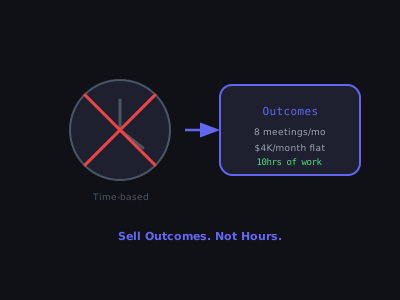
The irony of running an AI automation agency is that most owners spend their days doing everything manually. They're billing clients for automating their businesses while running their own business through spreadsheets, email threads, and 60-hour weeks. This guide is about applying the same leverage principles you sell to clients to your own agency, and breaking the time-for-money ceiling for good.
The Time-for-Money Trap in AI Agencies
At the core of the trap is hourly or project-based thinking. If you charge $150/hour and work 40 hours a week, your ceiling is $6,000/week or roughly $25K/month, before accounting for non-billable time, sales, admin, and overhead. The moment you get sick, take a vacation, or need to do sales, revenue drops.
The trap gets worse as you grow. More clients means more hours, more communication overhead, more edge cases. Without a deliberate shift in how you structure your business, growth in revenue means proportional growth in hours worked. That's not a business, it's a self-employment trap with extra steps.
Here's the diagnostic: if you stopped working for two weeks, what would happen to your revenue? If the answer is "it would drop significantly," you're still in the time-for-money trap regardless of what your invoices say. The goal is to build a business where revenue continues, and ideally grows, even when you're not actively delivering.
The trap is particularly insidious for AI agency owners because the work itself is intellectually engaging. You enjoy building automations, solving technical puzzles, and seeing systems come to life. That enjoyment masks the fact that you're doing $50/hour work when you should be doing $500/hour work, selling, strategizing, and building systems that scale without you.
Where AI Agency Owners Typically Spend Their Time
The Four Levers of Leverage
Lever 1: Productize Your Services
A productized service is a defined, repeatable offer with a fixed scope, fixed price, and documented delivery process. Instead of "custom AI automation consulting," you offer "the Lead Qualifier System: a 3-week implementation that connects your CRM to an AI scoring layer, delivered for $4,500."
Productized services create leverage because every delivery gets faster over time. Your 10th lead qualifier system takes half as long as your first. Your gross margin improves with every repetition. You can document and delegate the process. And you can quote instantly without a discovery call.
The psychological shift matters too. When you sell custom consulting, every conversation starts from zero, what do they need, what will it cost, how long will it take? When you sell a productized service, the conversation is about fit: "Here's what we build, here's what it costs, here's what you get. Is this the right fit for your business?" That single change reduces sales cycle length, eliminates scope creep, and lets you close deals faster.
How to Productize in Practice
Start with the automation you've built most often. Map out every step of the delivery process from the first client call to the final handoff. Standardize the tools, the configuration, and the testing process. Create a one-page offer document with a fixed price, a clear scope, a defined timeline, and specific deliverables. Now you have a product, not a service.
The best productized offers for AI automation agencies in 2026 include: missed-call-text-back systems ($1,500-$2,500 setup + $500-$1,000/month retainer), AI lead qualification chatbots ($2,000-$4,000 setup + $1,000-$2,000/month), automated cold email outreach systems ($3,000-$5,000 setup + $1,500-$3,000/month), and AI-powered appointment booking flows ($1,500-$3,000 setup + $750-$1,500/month).
A critical productization step that most agency owners skip is defining what is explicitly out of scope. Your offer document should clearly state what the package does not include. This prevents scope creep, which is the number one margin killer for agency owners. When a client asks for something outside the defined scope, you have a natural upsell conversation rather than an awkward negotiation about what was "supposed to be included."
Lever 2: Build Templates and Reusable Assets
Every hour you spend rebuilding something from scratch is an hour of negative leverage. The goal is to build once and deploy repeatedly. This means: template libraries for every automation type you build regularly, prompt templates for every AI use case you implement, onboarding checklists that take 15 minutes to run, and proposal templates that take 10 minutes to customize.
A typical AI automation agency owner who builds their template library seriously can reduce average project delivery time by 40-60% within six months. That's the equivalent of hiring a part-time person, at zero cost.
The Template Library You Need
At minimum, build templates for these recurring tasks:
- Automation templates: Pre-built n8n or Make.com workflows for your most common use cases. Clone and customize instead of building from scratch.
- Prompt templates: Tested AI prompts for lead qualification, customer support, email writing, and appointment booking. Refine these with every deployment.
- Client onboarding: A step-by-step checklist covering access requests, tool setup, kickoff call agenda, and first-week milestones.
- Proposal and contract templates: Pre-written documents that require only client-specific details to be filled in. Should take under 15 minutes to customize.
- Reporting templates: Monthly report format with placeholder sections for metrics, insights, and next steps. Fill in data, send.
The Compounding Effect of Templates
Templates do not just save time on individual projects, they compound. Every time you deploy a template, you find small improvements: a better prompt phrasing, a more reliable webhook configuration, a cleaner onboarding email sequence. You update the template, and every future deployment benefits from that improvement. Over 12 months, a template that started as a rough framework becomes a refined, battle-tested system that delivers consistent results in a fraction of the original time.
The agencies that reach $30K-$50K per month consistently report that their template library is their single most valuable business asset, more valuable than their client list, their brand, or their content. It is what allows them to deliver premium results at scale without proportionally scaling their team.
Lever 3: Delegate and Hire
The fastest path to breaking the time ceiling is hiring someone to do work you currently do. Start with your most time-consuming, least-skilled tasks. For most agency owners, that's client communication, basic workflow configuration, and reporting. A $1,500/month VA handling these tasks frees 15-20 hours per week, hours you can redirect to sales or high-value strategy work.
The key is documenting before delegating. You cannot hand off tasks that only exist in your head. Spend one week recording Loom videos of every repeatable task before you hire. This documentation becomes your training program and your quality standard.
What to Delegate First
Prioritize delegation by asking two questions: "Does this task require my specific expertise?" and "Could someone else do this at 80% of my quality with clear instructions?" If the answer is no and yes respectively, delegate it. The typical first delegation batch includes:
- Client onboarding email sequences and calendar scheduling
- Monthly performance report creation from templates
- Basic automation configuration from templates
- CRM updates and pipeline management
- Invoice creation and follow-up
- Social media content scheduling
The Delegation Resistance Problem
Most agency owners intellectually understand they should delegate but emotionally resist it. The common objections are: "No one can do it as well as I can," "It will take longer to explain than to just do it myself," and "I can't afford to hire yet." All three are valid in the moment and catastrophic in the long run.
The "no one can do it as well" objection confuses quality with necessity. Your client does not need a 98% quality report, they need an 85% quality report delivered on time every month. The difference between your perfectionist version and a good-enough delegated version is invisible to the client but costs you 5 hours per week.
The "faster to do it myself" objection is true exactly once. Yes, explaining the task takes longer than doing it this time. But you do this task every week. The 2 hours you spend training someone saves you 5 hours per week for the next 52 weeks, that is a 130x return on your training investment.
For a detailed hiring roadmap, see our guide on how to hire your first employee for an AI automation agency.
Lever 4: Shift to Outcome-Based Pricing
The highest form of leverage is being paid for outcomes rather than time. Instead of charging $2,000/month for "20 hours of automation work," charge $4,000/month for "a managed outreach system that books 8+ qualified meetings per month." If you can deliver that outcome in 10 hours, you've effectively doubled your hourly rate without raising prices at all.
Outcome-based pricing requires strong delivery systems and confidence in your results. But once you have case studies showing consistent outcomes, this pricing model is extremely defensible and extremely profitable.
How to Transition to Outcome Pricing
Don't switch all clients at once. Start with new clients and position the outcome-based offer as a premium option. Present it alongside a traditional retainer: "Option A is our standard growth retainer at $2,500/month with X deliverables. Option B is our performance program at $4,000/month where we guarantee Y outcome." Most serious clients choose Option B because it directly ties your fee to their business results.
The outcomes that work best for AI automation agencies are: meetings booked, leads qualified, response time improvements, hours saved, and cost per lead reductions. Pick outcomes you can reliably measure and influence directly.
One important nuance: outcome-based pricing works best when you control the entire system end-to-end. If your automation books meetings but the client's sales team fails to show up, that is not your failure, but it looks like one under a pure outcome model. Structure your agreements with clear definitions of what constitutes a "delivered outcome" and what factors are outside your control. For deeper guidance on structuring pricing for maximum revenue, check our AI agency pricing guide.
Effective Hourly Rate by Pricing Model
The Weekly Time Audit
Before you can improve your leverage, you need to know where your time is going. Spend one week tracking every work activity in 30-minute blocks. Categorize each block as:
- Zone A, Revenue-generating: Sales calls, proposals, closing. Only you can do this effectively.
- Zone B, High-leverage delivery: Strategy, system architecture, client relationships. Ideally you, or a senior hire.
- Zone C, Delegable delivery: Building repetitive workflows, writing reports, basic QA. Should be delegated.
- Zone D, Admin: Scheduling, invoicing, emails. Should be automated or delegated immediately.
Most agency owners discover they spend 50-60% of their time in Zones C and D. That's the opportunity. Move everything from Zone C and D off your plate within 90 days.
The time audit also reveals hidden time sinks that you do not realize are eating your week. Context switching, jumping between client Slack channels, checking email, responding to DMs, typically consumes 5-10 hours per week that feels productive but produces nothing. Batching communication into two 30-minute blocks per day rather than responding in real time can recover 3-5 hours per week with zero impact on client satisfaction.
The 90-Day Leverage Transformation Plan
Here is a concrete plan for moving from time-for-money to leveraged income over 90 days:
- Days 1-7: Complete your time audit. Identify your top 5 time sinks in Zones C and D.
- Days 8-21: Record Loom walkthroughs for every Zone C and D task. Build your first 3 automation templates.
- Days 22-35: Hire a VA or junior specialist. Begin onboarding using your documentation.
- Days 36-50: Delegate your first batch of tasks. Redirect freed time to sales and strategy.
- Days 51-65: Productize your most common offer. Create a one-page offer document with fixed pricing.
- Days 66-80: Pitch outcome-based pricing to one new prospect. Refine based on feedback.
- Days 81-90: Review results. Measure time savings, revenue impact, and margin improvements. Plan the next optimization cycle.
The 90-day timeline is not arbitrary, it is long enough to implement real changes and short enough to maintain urgency. Agencies that treat this as a gradual, indefinite process never complete the transformation. Set a hard deadline, block time on your calendar for each milestone, and treat this plan with the same rigor you would a client deliverable.
Measuring Your Leverage: The Key Metrics
Track these four metrics monthly to measure your progress away from time-for-money:
- Effective hourly rate: Total monthly revenue divided by total hours worked. This should increase every month as you implement leverage.
- Delivery hours per client: Track how many hours each client requires per month. This should decrease as you build templates and delegate.
- Revenue per team member: If you have a team, this measures how efficiently you're converting labor into revenue.
- Owner hours on delivery vs. strategy: The ratio should shift from 70/30 delivery-to-strategy to 30/70 within 6-12 months.
A fifth metric worth tracking is your "vacation test score" how many days could you disappear without revenue dropping? When you start, this number is probably zero. After implementing the four levers, it should be at least 14 days. Agencies that have truly broken the time-for-money trap can operate for 30+ days without the owner's daily involvement.
Common Pitfalls in the Leverage Transition
Even agency owners who understand the principles often stumble during implementation. Here are the most common mistakes and how to avoid them:
- Productizing too many offers at once: Start with one productized service. Master the delivery, refine the process, and prove the economics before adding a second. Agencies that launch three or four productized offers simultaneously end up with none that are truly refined.
- Hiring before documenting: If you hire a VA before you have clear SOPs, you will spend more time managing them than you save. Documentation first, hiring second, always.
- Underinvesting in the template library: Spending an extra 2 hours to templatize a workflow after delivering it to a client feels unproductive in the moment. Over 12 months, that 2-hour investment saves 50+ hours. Treat template creation as a mandatory final step of every project.
- Reverting under pressure: When a client emergency hits, the temptation is to drop everything and fix it yourself. Resist this. The whole point of your systems is to handle exactly these situations. Let your team and templates work, intervene only when the system genuinely cannot handle it.
Building the Agency That Runs Without You
The goal is not to be uninvolved, it's to have the option to step back without the business collapsing. You achieve this when: every delivery process is documented and delegable, client relationships can be maintained by a team member, leads come in through inbound channels you've built, and your monthly revenue is mostly retainer-based.
At that stage, your role shifts from operator to architect. You make decisions about positioning, pricing, and growth, not whether this webhook should fire before or after that filter.
The transition from operator to architect is the most psychologically difficult part of building a leveraged agency. You built this business because you enjoy the work. Letting go of the technical delivery means trusting someone else to maintain the quality standard you set. The way to bridge this gap is gradual: start by delegating the lowest-stakes tasks, verify quality, expand the delegation scope, verify again. Within 6 months, you will have enough confidence in your systems and team to step back from daily delivery entirely.
For more on building recurring revenue that doesn't require constant selling, read our guide on creating predictable recurring revenue with an AI automation agency. And if you want to understand the full hiring picture, see our post on how to hire your first employee.
Want to learn how to build and sell AI automations? Kingstone AI Operators is our free community for AI automation agency builders. Join Kingstone AI Operators, free.
FAQ
Frequently Asked Questions
How do I stop trading time for money in my AI automation agency?
Productize your services into fixed-scope, fixed-price offers that you can deliver faster with each repetition. Build template libraries for common automations, shift to outcome-based pricing, and hire to delegate repetitive delivery tasks. These four levers compound to break the time-for-money ceiling.
How do I productize my AI automation services?
Pick your most commonly delivered automation (like lead follow-up or missed call text-back), define a fixed scope and price, document the delivery process step by step, and offer it as a named package. Your 10th delivery of the same system takes half as long as your first, which improves margins with every repetition.
What is outcome-based pricing for AI automation agencies?
Instead of charging for hours worked, you charge for results delivered. For example, $4,000/month for a managed outreach system that books 8+ qualified meetings, rather than $2,000/month for 20 hours of work. If you deliver the outcome in 10 hours, you have effectively doubled your hourly rate.
When should I hire my first employee for my AI agency?
Hire when your monthly profit exceeds $5,000 after your own draw and you are spending more than 60% of your time on delivery. Start with a $1,500-$2,500/month part-time VA or junior specialist to handle repetitive tasks. Document every process with Loom videos before delegating.
How do I build systems that let my AI agency run without me?
Document every repeatable process with video walkthroughs and written SOPs. Build template libraries for automation builds, client onboarding, and reporting. Hire a VA for Zone C and D tasks. Shift to retainer revenue so monthly income does not depend on constant new sales.
What are the best ways to create leverage in an AI automation business?
The four leverage levers are: productize services for repeatable delivery, build templates and reusable assets, delegate low-skill tasks to VAs or junior hires, and shift to outcome-based pricing. A typical agency owner who implements all four can reduce delivery time by 40-60% within six months.
How do I scale my AI agency without working more hours?
The key is separating revenue from your personal time. Convert to retainer-based revenue, productize your core offer, build a template library, and hire a junior specialist to handle delivery. Agencies that do this effectively increase revenue by 50-100% while reducing owner hours from 60 to 30 per week.
Program · 90 days
Client Accelerator bundles the demo software with live coaching.
A one-time $1,499 purchase, or 4 interest-free payments of $374.75. Includes Ciela AI with 150 personalized demos each month throughout the program, the 90-Day AI Client System, two live group coaching calls every week, sales and outreach templates, 200+ n8n workflow templates, and private Build With Adhiraj resources.
See what is includedCiela AI is the demo platform for AI agencies and AI consultants. It turns any prospect's website into a live, personalized AI demo (chat, voice, or missed-call text-back) you can send before the first call.
Start Client AcceleratorCiela AI pricingAgent builds by nicheAll articles
Community · Training
Join Build With Adhiraj free.
Build With Adhiraj is the free community for people building and growing AI service businesses. Learn alongside other operators as you package, demonstrate, sell, and deliver practical AI systems.
Join Build With Adhiraj free