
How to Write LinkedIn Outreach Messages That Don't Feel Spammy (With Templates)
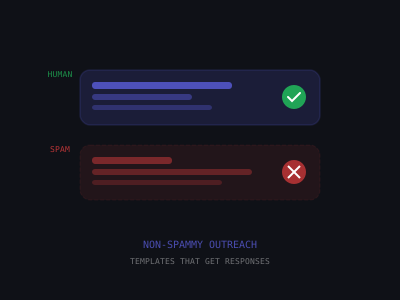
Most LinkedIn outreach feels spammy because it is spammy. Same opening lines, same hollow compliments, same "I help businesses like yours" template copied from a YouTube tutorial from three years ago. Recipients have seen these patterns thousands of times. They recognize them instantly, and they delete or ignore without a second thought.
The good news: writing LinkedIn outreach that doesn't feel spammy is a learnable skill, not a mystery. This guide breaks down exactly what makes messages feel human versus automated, with 10 real templates you can adapt for your own outreach.
Understanding why some messages get responses while others get reported is not just about the words you use, it is about the mindset behind them. Every principle in this guide flows from one core idea: treat every person you message as a human being with their own priorities, challenges, and inbox fatigue. When your messages reflect genuine awareness of the recipient's world, they stand out from the flood of self-interested pitches.
Why LinkedIn Outreach Feels Spammy (The Root Cause)
Most spammy LinkedIn messages share one root problem: they're written for the sender's convenience, not the recipient's interest. They start with what the sender wants (a call, a sale, a response), use language designed to sound impressive, and treat the recipient as a target rather than a person.
The result is messages that feel like they were written for anyone, because they were. The antidote is simple in theory and harder in practice: write specifically for this person, not for your ideal prospect archetype.
Here are the specific patterns that make LinkedIn messages read as spam:
- Opening with "I", "I wanted to reach out," "I help companies like yours," "I noticed your profile." Starting with yourself signals self-interest immediately.
- Vague compliments, "Your content is amazing," "I love what you're building," "Your company looks impressive." These could apply to anyone and signal you didn't actually look at their profile.
- Immediate pitch, Mentioning your service or product in the first message. Selling in message one is the equivalent of proposing on a first date.
- Outcome promises, "We could 3x your revenue," "I can help you generate 50 leads per month." These are red flags, not hooks.
- The "just 15 minutes" ask, "Would you have 15 minutes for a quick call?" in message one. Recipients know it's never 15 minutes and always a sales call.
- Paragraphs of context, Long first messages signal you wrote a template, not a personal note. Short messages feel more like real communication.
The Empathy Test
Before sending any outreach message, run it through the empathy test: read the message as if you are the recipient. You have just received 12 similar messages this week. You are busy. You are skeptical of anyone trying to sell you something on LinkedIn. Now read your message again. Does it feel like the 13th pitch, or does it feel like a genuine human reaching out about something relevant to your world?
If your honest answer is "this feels like another pitch," rewrite it. The bar for standing out on LinkedIn is not high, it is just rarely cleared because most senders are optimizing for volume rather than quality.
LinkedIn Message Response Rate by Approach
The Anti-Spam Framework: 4 Rules
Before writing any outreach message, run it through these four rules:
- Could this message have been sent to 100 people without changing a word? If yes, it's too generic. Add something specific to this person.
- Does the first sentence start with "I"? If yes, rewrite it to start with something about them, their name, their company, a specific observation.
- Does the message include any kind of ask or pitch? For messages 1 and 2, the only acceptable "ask" is a question that invites them to share something about themselves.
- Is it under 75 words? Short messages get read. Long messages get skimmed or ignored. Especially for cold outreach.
These four rules eliminate 90% of what makes LinkedIn messages feel like spam. If you want a personalized starting point that already follows them, our LinkedIn DM generator drafts a message around a specific detail you provide. Now let's get into the actual templates.
The Research Investment
Non-spammy outreach requires research. Plan to spend 60-90 seconds per prospect before writing your message. Look at their recent posts, their headline, their company page, and any recent news. Find one specific thing you can reference that proves you actually looked at their profile. This investment of time is what separates messages that get responses from messages that get deleted.
Some agency owners resist this because it limits volume. You cannot research 200 people per day at 90 seconds each, that would take over 5 hours just for research. But here is the math that matters: 20 well-researched messages with a 25% response rate generate 5 conversations. 200 generic messages with a 2% response rate generate 4 conversations, and burn your reputation in the process. Quality always wins. For a complete system on combining outreach with content to maximize your conversion, see our guide on multichannel outreach combining LinkedIn and email.
10 Non-Spammy LinkedIn Outreach Templates
Template 1: The Genuine Observation
Use case: First DM after connecting with someone in your target niche.
Hey [Name], noticed you're running [Company] in the [niche] space. I've been seeing a lot of companies in that area starting to use AI for [specific use case]. Is that something you're thinking about, or still more in the "maybe later" category?
Why it works: The question is genuinely curious, not leading. It gives them three options to respond: yes, no, or not yet, all of which open a conversation.
Template 2: The Content Reference Opener
Use case: After someone posts content relevant to a problem you solve.
[Name], your post on [specific topic] made me think of something. Have you ever tried [approach or tool]? I've seen it work well for companies at [Company]'s stage. Curious if you've explored it.
Why it works: Anchors on something real they wrote. The "made me think of something" framing positions you as thoughtful, not salesy.
Template 3: The Industry Insight Share
Use case: When you have a genuinely useful piece of information for their industry.
Hey [Name], I've been working with a few [niche] companies lately and noticed a trend: [one-line trend observation]. Not sure if you're seeing the same thing at [Company], have you noticed it?
Why it works: You're leading with value and curiosity, not a pitch. Asking if they've noticed the same thing invites a response without pressure.
Template 4: The Warm Compliment + Question
Use case: When their company has done something genuinely notable recently.
[Name], [specific thing they did, e.g., "the expansion you announced last month"] is impressive. I'm curious, is the growth you're seeing coming more from inbound or outbound right now?
Why it works: Specific compliment + genuine question = feels like a peer conversation, not a pitch. The question about their growth is one any curious professional might ask.
Template 5: The Shared Problem Opener
Use case: When you know their industry has a specific, painful challenge.
Hey [Name], most [niche] owners I talk to say [specific problem, e.g., "following up with leads fast enough"] is their biggest bottleneck. Is that the case at [Company], or do you have that part pretty dialed in?
Why it works: The "most [niche] owners I talk to say" framing establishes credibility without bragging. Asking if they have it dialed in is non-threatening and conversational.
Template 6: The Recent Change Trigger
Use case: When you see a job change, new hire announcement, or funding news on their profile.
[Name], saw [Company] recently [hired for X role / raised / launched product]. Big move. I help [type of company] get more out of [relevant area] during growth phases like that, any chance you'd be open to a quick chat?
Why it works: Change creates urgency and openness to new solutions. This is the one template where asking for a chat in message one is acceptable, because the context justifies it.
Template 7: The Direct But Respectful Approach
Use case: When you want to be upfront without being pushy.
[Name], I'll be honest: I work with [niche] companies on [specific service] and [Company] came up as a strong fit. I'd love to show you what we've done for similar businesses. If you're even slightly curious, worth a 20-minute call?
Why it works: Some prospects appreciate directness over pretense. The "I'll be honest" framing disarms defensiveness. "Even slightly curious" lowers the commitment threshold.
Template 8: The Follow-Up to Silence
Use case: After 5-7 days of no response to message 1.
[Name], just wanted to circle back on this. I know your inbox is probably packed, no hard feelings if now isn't the right time. If things change, I'm here. Either way, hoping the [niche] is treating you well this month.
Why it works: Acknowledges that not responding is okay. The lighthearted last line feels human. This often gets responses from people who meant to reply but forgot.
Template 9: The Pattern Interrupt
Use case: When reaching out to someone who probably gets a lot of pitches.
[Name], I'm not going to pretend I found your profile by accident or that I have a revolutionary insight just for you. I do think there's a real fit between what I do and where [Company] is headed. Would a straight 15-minute conversation about it be worth your time?
Why it works: Acknowledging the clichés of LinkedIn outreach makes you instantly stand out from the people using those clichés. Self-aware honesty builds trust faster than any script.
Template 10: The Value-First Lure
Use case: When you have something genuinely useful to offer upfront, a template, a relevant case study, a tool.
Hey [Name], I put together a [specific resource, e.g., "5-step AI follow-up system specifically for HVAC companies"]. It's free and I think it'd be useful for [Company]. Want me to send it over?
Why it works: The value is specific enough to be credible. The ask is "can I send you something free?" one of the easiest yeses to give. This opens the conversation without any obligation.
Adapting Templates Without Losing Authenticity
Templates are starting points, not scripts. The moment you send a template without personalizing it, it becomes spam. Here is how to adapt each template while keeping it genuine:
- Replace every bracket with something specific. If a template says [specific topic], you need to name the actual topic from their actual post. "Your post on lead qualification" works. "Your post on [topic]" is a template that forgot to become a message.
- Match their tone. If the prospect writes casually on LinkedIn (short sentences, lowercase, emojis), mirror that energy. If they write formally (long paragraphs, professional language), match that instead. Tone mismatch signals inauthenticity.
- Adjust for your relationship temperature. A template designed for cold outreach sounds strange if you have been engaging with someone's content for three weeks. Warm prospects deserve warmer, more direct messages.
The Message Sequence: How to Chain These Together
Most conversions happen over 3-5 touchpoints, not one message. Here's a proven sequence structure for LinkedIn outreach:
- Day 0, Connection accepted: Warm acknowledgment, no pitch. Template 3 or 4 works well here.
- Day 2-3, Message 1: Curious question or industry insight. Template 1, 2, or 5.
- Day 8-10, Message 2 (if no response): Different angle. Template 6, 7, or 10.
- Day 15-18, Message 3 (last attempt): Graceful follow-up. Template 8.
- Day 30+, Re-engage: Share relevant content or reference a new development. No pitch, just staying visible.
Why Spacing Matters
The timing between messages is as important as the content. Sending a follow-up the day after no response feels desperate. Waiting three weeks feels like you forgot about them. The sweet spot for follow-ups is 5-7 days, long enough that you are not crowding their inbox, short enough that the context of your previous message is still fresh.
Never send more than three unreturned messages to the same person. After three with no response, the message is clear, they are not interested right now. Add them to a "nurture" list and re-engage in 60-90 days with fresh context (a new case study, a piece of content relevant to their industry, or a reference to a recent development at their company).
Optimal LinkedIn Outreach Sequence Timing
For the complete DM sequences with timing and transition scripts, see our full guide on what to say in LinkedIn DMs to book sales calls.
The Connection Request Note: Your First Impression
The connection request note is the most under-optimized element of LinkedIn outreach. Most people either send blank connection requests or paste a mini-pitch into the 200-character limit. Both approaches waste the opportunity to make a strong first impression.
The connection request note should accomplish exactly one thing: give the recipient a reason to accept. It should reference something specific about them, establish a relevant connection between you, and be short enough to read in 3 seconds. Our LinkedIn connection request generator can help you craft a note that fits inside the character limit.
Strong examples: "Hey Sarah, saw your post about dental practice marketing. I work in that space too and would love to connect." Or: "James, we have 12 mutual connections in the HVAC industry. Thought it would make sense to connect." Or: "Hi Alex, noticed you just opened a second location. Congrats! Would love to follow your growth story."
Weak examples: "Hi, I help businesses automate their operations with AI. Let's connect!" Or: "I came across your profile and was impressed. Would love to add you to my network." Both of these could be sent to anyone, which means they were written for no one.
Handling Responses: Continuing the Non-Spammy Tone
Getting a response is only half the battle. Many agency owners successfully start a conversation with a non-spammy opening, then immediately revert to sales mode in their reply. The same principles that got you the response need to carry through the entire conversation.
When someone responds positively to your initial message, your next message should deepen the conversation, not pivot to a pitch. If they said "Yes, we are thinking about AI for lead follow-up," your reply should not be "Great, I offer exactly that service, here is my calendar link." Instead: "Interesting, what does your follow-up process look like right now? Are you handling it manually or do you have some automation already?"
The goal is to have a genuine 3-5 message conversation where you learn about their situation before suggesting a call. By the time you propose a call, they should feel like you already understand their business well enough to be worth 30 minutes of their time. That level of understanding cannot be faked, it comes from asking real questions and listening to the answers.
The "Before and After" Rewrite Test
Here's a quick way to audit any message you write before sending it. Ask yourself: if you got this message from a stranger on LinkedIn, would you respond? If the honest answer is no, rewrite it.
Before (spammy):
Hi [Name], I came across your profile and I'm impressed by what you've built at [Company]. I help businesses like yours increase their revenue through AI automation. I'd love to schedule a quick 15-minute call to share how we've helped similar companies achieve great results. Are you available this week?
After (human):
[Name], I've been talking to a few companies in the [niche] space and the common thread is [specific challenge]. Is that showing up for you at [Company] right now, or have you found a good solution for it?
The "after" version is shorter, starts with them, invites a natural response, and contains zero pitch language. For the full system of connecting, messaging, and booking calls on LinkedIn, see our guide on how to book 10+ meetings per month from LinkedIn without ads.
Measuring Outreach Quality Over Time
Track three metrics weekly to ensure your outreach remains non-spammy and effective:
- Response rate: The percentage of first messages that receive any reply. A healthy response rate for personalized LinkedIn outreach is 20-35%. Below 15% indicates your messages are too generic or too salesy.
- Positive response rate: The percentage of responses that are interested or curious (as opposed to "not interested" or "please remove me"). Agencies with strong outreach see 60-80% positive response rates among those who reply.
- Report rate: If more than 1 in 200 recipients reports your messages, your approach is too aggressive. LinkedIn tracks this and will restrict your account.
Review these metrics every Friday and adjust your approach based on what you see. If response rates drop, your messages may be getting stale, refresh your templates with new observations and angles. If positive response rates drop, you may be targeting the wrong prospects or leading with the wrong angle. Continuous iteration based on real data is what separates great outreach practitioners from people who send the same message forever and wonder why it stopped working.
Want to learn how to build and sell AI automations? Kingstone AI Operators is our free community for AI automation agency builders. Join Kingstone AI Operators, free.
FAQ
Frequently Asked Questions
How do you write LinkedIn outreach messages that get replies without being spammy?
Focus on three principles: start with the recipient's world (their industry, challenge, or content), keep the first message under 80 words, and end with a specific question rather than a pitch. Each message should reference something genuine about the person that proves you did not send the same text to 500 people. Questions invite conversation; statements invite deletion.
What makes a LinkedIn message feel like spam?
Messages feel spammy when they start with the sender's introduction instead of the recipient's situation, include generic flattery without specifics, list multiple services, ask for a meeting in the first message, use vague value claims like 'help companies grow 10x,' or could obviously be sent to anyone. The root cause is writing for sender convenience rather than recipient interest.
How short should a LinkedIn cold outreach message be?
First messages should be 40-80 words maximum. Under 40 words can feel abrupt for cold outreach; over 80 words reads as a pitch. Follow-up messages can be slightly shorter at 30-60 words. The goal is to be substantive enough to demonstrate relevance while short enough to read in 10-15 seconds on mobile.
What is the best LinkedIn message template that does not feel like spam?
The highest-performing non-spammy template follows this structure: 'Hey [Name], [specific observation about their business or content]. I work with [niche] companies on [specific problem]. Is that something showing up at [Company]?' This is about 40 words, starts with them, demonstrates niche expertise, and ends with a genuine question.
How many LinkedIn outreach messages per day is considered spammy?
Quality matters more than quantity. Sending 15-25 well-personalized messages per day is sustainable and non-spammy. Sending 100+ identical messages per day is spam regardless of the content. The practical test: if you cannot write something specific about each recipient, you are sending too many messages. Each message should take 60-90 seconds including research.
How do you avoid getting reported for spam on LinkedIn?
Keep messages under 80 words, always include genuine personalization, never pitch in the first message, space follow-ups 3-5 days apart, use questions instead of statements, avoid spam-trigger words like 'free' or 'guarantee,' and never send identical messages to more than 30-40 people. If recipients consistently report your messages, LinkedIn will restrict your account.
Program · 90 days
Client Accelerator bundles the demo software with live coaching.
A one-time $1,499 purchase, or 4 interest-free payments of $374.75. Includes Ciela AI with 150 personalized demos each month throughout the program, the 90-Day AI Client System, two live group coaching calls every week, sales and outreach templates, 200+ n8n workflow templates, and private Build With Adhiraj resources.
See what is includedCiela AI is the demo platform for AI agencies and AI consultants. It turns any prospect's website into a live, personalized AI demo (chat, voice, or missed-call text-back) you can send before the first call.
Start Client AcceleratorCiela AI pricingAgent builds by nicheAll articles
Community · Training
Join Build With Adhiraj free.
Build With Adhiraj is the free community for people building and growing AI service businesses. Learn alongside other operators as you package, demonstrate, sell, and deliver practical AI systems.
Join Build With Adhiraj free