
Why Your Cold Email Reply Rate Is Below 1% and How to Fix It
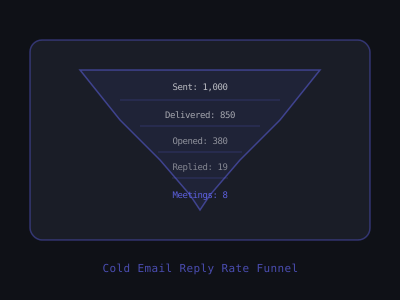
A sub-1% cold email reply rate is frustrating, but it's diagnostic information, not a judgment on your business. Every cold email campaign that underperforms does so for a specific, fixable reason. The problem is that most people try to fix reply rates by rewriting their copy, when the actual issue is deliverability, targeting, or the offer, not the words.
This guide works through every layer of the cold email funnel, from domain reputation to CTA design, to help you identify exactly where your campaign is breaking down and what to do about it. A well-configured campaign targeting the right people with the right message should realistically hit 3–8% reply rates. Some highly targeted campaigns with strong personalization hit 10–15%. If you're below 1%, something fundamental is broken.
Start with the Data: Where Are You Actually Losing People?
Before changing anything, diagnose where in the funnel you're losing prospects. The problem is fundamentally different at each stage:
- Low deliverability rate (<85% inbox): Your emails aren't reaching people. DNS/reputation problem.
- Low open rate (<20% for Gmail, accounting for MPP inflation): Your emails reach the inbox but aren't being opened. Subject line or sender name problem.
- Good open rate, low reply rate (<1%): Your emails are opened but the content doesn't earn a response. Messaging, offer, or CTA problem.
- Mostly negative replies: You're getting responses but they're "not interested" or "remove me." Targeting problem.
Run a GlockApps inbox placement test to determine your actual deliverability rate. If you're not regularly running inbox placement tests, you're flying blind on the most fundamental variable. MXToolbox and Mail-tester.com are free tools that catch most common authentication and spam scoring issues. Run them before you do anything else.
One important note on open rate data: Apple Mail Privacy Protection (MPP) pre-loads emails and triggers open pixels regardless of whether the recipient actually opened your email. This inflates open rates by 20–40% for lists with a lot of Apple Mail users. If your sending tool shows 60% open rates but 0.5% reply rates, MPP inflation is almost certainly distorting your open rate data. Use reply rate and positive reply rate as your primary KPIs, they can't be faked by tracking pixels.
Problem 1: Your Emails Are Going to Spam
If your open rate is below 20% (after accounting for Apple Mail Privacy Protection inflation), your emails are likely going to spam for a significant portion of your list. This is a deliverability problem, not a copy problem.
Most common causes:
- Incorrect or missing SPF/DKIM/DMARC records
- Domain less than 30 days old or under-warmed
- Sending domain or IP on a blacklist
- Sending from a shared tracking domain
- Content patterns that match known spam (Mail-tester.com score below 8)
Fix: Stop the campaign. Audit your setup using our cold email deliverability checklist. Fix authentication records, warm up the domain longer, and set up a custom tracking domain before relaunching.
On domain warm-up specifically: most cold email senders under-warm their domains by a wide margin. The standard advice is 3–4 weeks, but for domains sending at volume (>100/day), a full 6–8 week warm-up gets meaningfully better inbox placement. Tools like Instantly and Smartlead have built-in warm-up networks, use them, but also manually send and receive emails from your new domain through your regular email provider to build genuine engagement signals.
One overlooked fix: your tracking domain. When you use a cold email tool's default shared tracking domain for open and click tracking, your tracking domain is shared across hundreds or thousands of other senders. If any of them are spammers, your emails inherit reputation baggage from that shared domain. Always set up a custom tracking subdomain (e.g., track.yourdomain.com) that is unique to your sending.
Problem 2: Bad Subject Lines, The Email Never Gets Opened
If your deliverability is good (80%+ inbox placement) but open rates are still low, subject lines are the problem. The subject line is the only thing standing between "deleted without reading" and "opened."
Subject line patterns that consistently underperform in cold email:
- "[Your company name] + [their company name]" immediately screams partnership pitch
- "Quick question about [Company]" overused to the point of being ignored
- Excessive curiosity bait: "This changed everything for us..."
- Benefit-first subject lines: "Increase your sales by 30%"
- Feature-focused: "AI-powered CRM for [industry]"
Subject lines that work in 2026 are short (3–5 words), conversational, and feel like a colleague wrote them:
- "[their company]'s follow-up process"
- "idea for [specific initiative]"
- "Re: [their recent LinkedIn post topic]"
- "[their city] dentist question" (hyper-local/specific)
- "[shared connection name]" (if applicable)
A/B test your subject lines across a minimum of 200 sends per variant before drawing conclusions. Most cold email tools support subject line split testing natively. If you need more candidates to test, a subject line generator can give you several conversational angles to put head to head.
A practical subject line testing process: write 5–10 candidate subject lines before you launch a campaign. Send your first 1,000 emails split across the top 3–4 candidates. After 500 sends per variant, identify the winner (highest open rate among verified Gmail opens, not MPP-inflated), then roll out the rest of the campaign using only the winning subject line. This testing habit alone can double open rates over time.
The sender name also matters more than most people realize. "John from Acme" consistently outperforms "John Smith" or "Acme AI" for cold outreach. It signals a real person without hiding who they work for. Some senders test first-name only (e.g., "Michael") for specific industries and find it increases curiosity opens, though it can also increase spam complaints if your list is cold.
Problem 3: Your Opening Line Loses Them in 2 Seconds
The email preview in the inbox shows the subject line and the first 1–2 lines of the email body. If your opening line is about you or your company, most people close it without reading further. The first line must be about them.
Opening lines that fail:
- "My name is [Name] and I'm the founder of [Company]..."
- "I'm reaching out because I think we could help you..."
- "[Company] is an AI automation agency that specializes in..."
- "I hope this email finds you well." (this one especially)
Opening lines that earn the read:
- A specific reference to something they posted, published, or announced
- A pattern interrupt: "Most [their role] I talk to are wrestling with [specific problem]."
- A relevant data point: "HVAC companies in [their market] are typically missing 30–40% of inbound calls during peak season."
- Direct relevance signal: "Noticed [company] recently opened your third location, congrats on the growth."
The best personalization hooks come from publicly available information: LinkedIn activity, recent press mentions, Google reviews, job postings, or Glassdoor data. A dentist posting on LinkedIn about struggling to fill last-minute cancellations is telling you their exact pain point, reference it directly. A roofing company with 47 Google reviews and the most recent one about a missed callback is showing you the problem to lead with.
For scale personalization without manually researching every prospect, tools like Clay let you pull LinkedIn posts, recent news, and company data at scale and pipe it into custom first-line variables. A semi-automated first line like "Saw your post on the challenge of training new technicians, that seems to be the theme for [industry] right now" takes 5 seconds to populate but reads like genuine research. This approach typically lifts reply rates by 30–60% compared to generic openers.
Problem 4: The Email Is Too Long
Cold emails above 150 words have measurably lower reply rates than shorter emails. Every additional sentence is another opportunity for the prospect to disengage before reaching your CTA.
Rule: If your email can't be read in under 30 seconds, it's too long. Aim for 60–100 words for Email 1 in a sequence. That's three to five short sentences.
The pressure to write longer emails usually comes from wanting to explain everything upfront, benefits, process, pricing, case studies. Resist it. The goal of Email 1 is to earn a reply, not to close a deal.
A useful editing test: paste your email into a word counter and cut it in half. If the core message survives the cut, the original was too long. If the email breaks when halved, you've found your true minimum. Most people are shocked by how much their emails improve when forced to hit 75 words.
Specific things to cut from cold emails:
- Any sentence that starts with "We" or "Our" in the first three lines
- Social proof in Email 1 (save it for the follow-up)
- Multiple CTAs ("You can reply, or book a call, or check out our site...")
- Hedge phrases: "I'm not sure if this is relevant, but..."
- Unnecessary transitions and filler: "As I mentioned..." "Just following up to say..."
Problem 5: Wrong Audience, You're Targeting the Wrong People
Even perfect copy gets no replies if you're sending to people who have no reason to care about your offer. Targeting problems are often masked as copy problems because they both produce low reply rates.
Signs of a targeting problem:
- High spam complaint rate (people are annoyed, not just uninterested)
- Mostly negative replies ("We don't need this" / "not relevant")
- Replies that reveal a fundamental misunderstanding of their situation
- You can't articulate a specific pain point this segment has
Fix: Get more specific with your ICP. Instead of "B2B SaaS companies," target "B2B SaaS companies between 20–100 employees in their first 24 months post-Series A, using Hubspot, with an outbound SDR team." The more specific your targeting, the more relevant your messaging can be, and the higher your reply rate will be.
A practical targeting audit: look at your last 10 positive replies and identify what those prospects had in common that your non-responders didn't. Company size, tech stack, job title, hiring activity, revenue stage, geography, pattern-match the winners and rebuild your list criteria around them. This process has transformed 0.4% reply rate campaigns into 4%+ campaigns without changing a single word of copy.
For local service businesses specifically, targeting by recent behavioral signals works better than demographics alone. A plumber who just ran a "now hiring" ad is growing and likely has process problems you can solve. A dentist with recent one-star reviews mentioning missed callbacks is telling you they need follow-up automation. Apollo, Clay, and even Google Maps scraping can surface these signals at scale.
Problem 6: Weak Offer, No Compelling Reason to Reply
Your email can be perfectly targeted and well-written but still get no replies if the offer, the thing you're asking them to do, isn't compelling. "Let's get on a call and I'll show you a demo" is a low-value offer for the prospect. Their time costs them something. Your demo benefits you.
Offers that increase reply rates:
- Free audit or review: "I can map out exactly what's causing the delay in your lead follow-up, 20 minutes and I can show you the issue."
- Relevant content: "I built a workflow template specifically for [their industry] that you can deploy in a day, want me to send it over?"
- Specific result preview: "I can show you exactly how [similar company] cut their no-show rate by 40%, relevant if this is on your radar."
- Low-stakes question: "Is automating your [specific process] on your list for this quarter?" a yes/no answer is the lowest-commitment possible reply
The most underused offer in B2B cold email is the "send you something valuable" offer. Instead of asking for a meeting, offer to send a relevant template, audit, checklist, or case study. The prospect's activation energy to reply "yes, send it" is almost zero, no calendar coordination, no commitment, no risk. Once they reply and you deliver value, you have an ongoing conversation with a warm lead, not a cold one. This approach consistently outperforms direct meeting requests by 3–5x in the first email of a sequence.
Offer framing also matters. "Free audit" sounds like a sales call in disguise. "I'll pull your website's lead flow and show you the three places you're losing qualified leads before they become appointments" is a specific, tangible version of the same thing, and it gets meaningfully more replies because the prospect can visualize the output.
Problem 7: Poor CTA, Asking for Too Much Too Fast
Asking for a 30-minute Zoom call in your first cold email is the most common CTA mistake. The prospect has never heard of you, doesn't yet trust you, and has no reason to give you 30 minutes of their week.
CTA hierarchy (use the lowest-commitment appropriate CTA for each email in the sequence):
- Email 1: Yes/no question ("Is this on your radar for Q2?")
- Email 2: Permission ask ("Want me to send the template?")
- Email 3: Soft meeting ("Worth 15 minutes to see if it applies?")
- Email 4: Direct calendar link (first time offering)
Reserve calendar links for prospects who have already replied or shown clear interest. Offering the calendar to a cold prospect who hasn't engaged yet consistently reduces reply rates.
One CTA mistake that's easy to miss: embedding multiple options. "You can reply here, book a call, or check out our case study" gives the prospect three decisions to make instead of one. Decision fatigue is real even for small choices. A single, clear CTA at the end of a cold email consistently outperforms a menu of options. Pick one action and make it easy to take.
Problem 8: Your Follow-Up Sequence Is Broken
Most replies from cold email campaigns don't come from Email 1, they come from follow-ups. Industry data consistently shows that 60–70% of positive replies come from the second, third, or fourth touch. If your sequence ends after one email, you're leaving most of your potential replies on the table.
A solid cold email sequence structure, which you can draft quickly with a follow-up sequence generator and then refine, looks like this:
- Email 1 (Day 0): Core value proposition with a yes/no CTA. Short, 60–80 words.
- Email 2 (Day 3): Add a data point or case study. New angle, not just "just following up."
- Email 3 (Day 7): Offer something tangible, template, checklist, audit. Lower the bar to reply.
- Email 4 (Day 14): The "breakup" email. Short, direct, no hard feelings. "No worries if now isn't the right time, should I reach back out in Q3?"
The follow-up that gets the most replies is the one that adds new value rather than re-asking the same question. "Just checking in" follow-ups are noise. A follow-up that says "I put together a quick breakdown of how three [their industry] companies solved this problem, happy to share if helpful" gives the prospect a fresh reason to engage.
Spacing matters too. A follow-up the day after your first email signals desperation. Three days is the minimum for professional sequences. Seven to ten days between later touches gives prospects who were genuinely busy a natural window to engage.
Problem 9: You're Sending at the Wrong Time
Send timing has a measurable impact on open and reply rates, though it's often overstated relative to targeting and messaging. The honest reality: the right time to send is whenever your list is most likely to check email with enough attention to engage.
What the data actually shows for B2B cold email:
- Tuesday, Wednesday, and Thursday outperform Monday and Friday by 10–20% on reply rate
- 8–10 AM local time (recipient's timezone) and 1–3 PM outperform midday and evening
- Avoid sending on the first business day after a long weekend, inboxes are flooded
- For local service business owners (contractors, dentists, etc.), midday during the work week often works better than early morning
Most modern cold email tools let you set time-zone-aware sending windows. Configure your campaigns to land in recipient inboxes between 8 AM and 4 PM in their local time zone, even if your list spans multiple time zones. The difference between "hits inbox at 8 AM when they start their day" versus "hits inbox at 11 PM and gets buried under overnight emails" is significant.
Problem 10: Sending Volume Is Too High on New Domains
One of the fastest ways to tank deliverability is sending too many emails too quickly from a new or partially warmed domain. Gmail and Outlook use sending velocity as a spam signal, a two-month-old domain sending 500 emails per day has a fundamentally different risk profile than an established domain with years of clean sending history.
Safe sending limits by domain age and warm-up stage:
- Week 1–2 of warm-up: 10–20 emails per day, all warm-up network sends
- Week 3–4: 20–50 per day, mixing warm-up sends with real outreach to your most targeted list
- Month 2: 50–100 per day total, monitoring deliverability weekly
- Month 3+: 100–150 per day maximum for a single domain/inbox
If you need to send at higher volume, the answer is more domains and inboxes, not pushing a single domain past safe limits. A campaign sending 500 emails per day should be spread across 4–5 domains (e.g., getciela.com, tryCiela.com, cielahq.com) with 100–150 sends each. This is standard practice for any serious cold email operation and is built into tools like Instantly and Smartlead natively.
The Fix Framework: Where to Start
If you're getting less than 1% reply rate, work through this order of operations:
- Step 1: Run a GlockApps inbox placement test. If below 80% Primary, fix deliverability first, everything else is secondary.
- Step 2: Check your domain warm-up status and authentication records using our domain warm-up guide.
- Step 3: A/B test 3 different subject lines on 200 sends each. Identify the winner before changing body copy.
- Step 4: Rewrite Email 1 to be under 100 words, with a specific personalization hook and a yes/no CTA.
- Step 5: Tighten your ICP, send to a smaller, more specific segment with a more directly relevant message.
- Step 6: Audit your follow-up sequence. Make sure you have at least 3–4 touches with value-add content at each step, not just "bumping" threads.
- Step 7: Check your sending volume against your domain age and reduce if over limit.
Most campaigns that are genuinely below 1% reply rate have a deliverability problem masking the copy quality. Fix infrastructure first, then optimize messaging. Running the full cold email deliverability checklist before changing anything else is almost always the highest-leverage first step.
Benchmarks: What "Good" Actually Looks Like
Before you assess whether your campaign is underperforming, know what realistic targets look like for cold email in 2026. These benchmarks assume proper deliverability setup, a verified list, and a relevant ICP:
- Inbox placement rate: 85–95% Primary (test with GlockApps)
- Open rate (Gmail only, excluding MPP): 30–50% for well-targeted campaigns
- Reply rate: 2–5% for generic campaigns, 5–10% for highly personalized campaigns
- Positive reply rate: 30–50% of total replies should be interested or neutral (not negative)
- Meeting booked rate: 0.5–2% of total emails sent for a solid campaign
If your reply rate is between 1% and 2%, you're not broken, you're in the low-normal range and likely have a targeting or messaging issue that incremental improvements can fix. If you're under 0.5%, the problem is almost certainly infrastructure (deliverability) or a fundamental mismatch between your offer and your audience.
Want to learn how to build and sell AI automations? Kingstone AI Operators is our free community for AI automation agency builders. Join Kingstone AI Operators, free.
Program · 90 days
Client Accelerator bundles the demo software with live coaching.
A one-time $1,499 purchase, or 4 interest-free payments of $374.75. Includes Ciela AI with 150 personalized demos each month throughout the program, the 90-Day AI Client System, two live group coaching calls every week, sales and outreach templates, 200+ n8n workflow templates, and private Build With Adhiraj resources.
See what is includedCiela AI is the demo platform for AI agencies and AI consultants. It turns any prospect's website into a live, personalized AI demo (chat, voice, or missed-call text-back) you can send before the first call.
Start Client AcceleratorCiela AI pricingAgent builds by nicheAll articles
Community · Training
Join Build With Adhiraj free.
Build With Adhiraj is the free community for people building and growing AI service businesses. Learn alongside other operators as you package, demonstrate, sell, and deliver practical AI systems.
Join Build With Adhiraj free