
How to Use AI to Pre-Qualify Leads Before You Get on a Sales Call
Unqualified discovery calls are one of the most expensive hidden costs in running an AI agency. A 45-minute call with someone who has no budget, no decision-making authority, or no clear problem is 45 minutes you could have spent on a qualified prospect. At scale, this cost compounds. An AI-powered lead qualification system eliminates 50 to 70 percent of unproductive sales calls by filtering and scoring prospects before they reach your calendar, leaving only the leads who match your ideal client criteria.
This guide shows you how to build that filter end to end: the framework to score against, the exact intake questions and AI scoring prompt to use, how to wire it together in n8n, and what to do with the leads who do not make the cut. Done well, pre-qualification does not shrink your pipeline. It concentrates your calendar time on the prospects most likely to become paying clients, which is why it lifts close rates even when the raw lead quality is unchanged.
What Pre-Qualification Actually Solves
Pre-qualification is not gatekeeping. It is alignment. When you qualify a lead before a call, both parties arrive better prepared, the prospect has articulated their problem in concrete terms, and you know enough about their situation to make the call genuinely useful rather than exploratory from scratch. The data shows that pre-qualified discovery calls close at two to three times the rate of unqualified calls, even when the underlying prospect quality is similar. Articulating a problem before a call creates a commitment to solving it.
Impact of AI Pre-Qualification on Sales Metrics
The BANT Qualification Framework
The classic BANT framework, Budget, Authority, Need, Timeline, remains the most reliable pre-qualification structure for B2B services. For AI automation specifically, translate each dimension into questions a prospect can answer in under three minutes. Budget: "What are you currently spending on [the problem area], either in direct costs or staff time?" Authority: "Are you the person who would make the final decision on this, or would others need to be involved?" Need: "What specific problem are you trying to solve, and how long has it been an issue?" Timeline: "When are you looking to have something like this in place?"
Add two AI-agency-specific questions: "How many leads do you receive per month, and what is your average deal value?" This produces the ROI calculation you will need for the call. And: "What tools are you currently using for [CRM, lead capture, communications]?" This tells you immediately whether the integrations you build are compatible with their existing stack.
Building the AI Qualification Flow in n8n
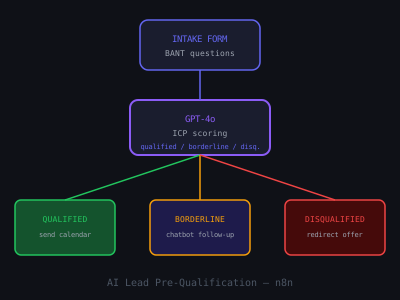
The qualification flow has three components. First, the intake form, add six to eight qualification questions to your booking page or as a pre-booking requirement. Use Typeform or a native Calendly intake form. The form is not optional: make completing it a prerequisite for booking access to your calendar. This filters out tire-kickers who will not complete a three-minute form. Second, the AI scoring workflow, when a form is submitted, the data triggers an n8n workflow that sends the responses to GPT-4o with a scoring prompt. The prompt asks GPT to score the lead on each BANT dimension from 1 to 5 and calculate a total score out of 20. Leads scoring 14 or above get routed to your calendar. Leads scoring below 14 get routed to a nurture sequence. Third, the routing decision, qualified leads receive a confirmation with the booking link. Lower-scoring leads receive a response that offers a free resource, asks for more context, or offers a group call instead of a 1:1. None are rejected outright, they are triaged appropriately.
The AI Scoring Prompt
The scoring prompt to pass to GPT-4o after form submission: "Evaluate this lead for an AI automation agency that serves small and mid-sized service businesses. Score each BANT dimension from 1 to 5 based on the responses below. Budget (5=clear budget or clear cost problem, 1=vague or no budget signal). Authority (5=sole decision-maker, 1=not the decision-maker). Need (5=specific urgent problem, 1=vague curiosity). Timeline (3 months or sooner = 5, 12 months or more = 1). Fit (score 5 if they have high lead volume and high deal value, 1 if lead volume or deal value is very low). Calculate total out of 25. Provide one sentence of rationale. Responses: [form data]." Output the score and rationale as JSON for clean downstream processing in the n8n workflow.
What to Do With Lower-Scoring Leads
Do not discard leads who score below the threshold. Lower-scoring leads fall into two categories: not ready yet (they have the problem but not the budget or timeline urgency) and not the right fit (wrong company size, decision-making authority, or problem type). For not-ready leads, add them to a quarterly check-in sequence, a brief email every 60 days that shares one relevant case study or insight. Timing-based no decisions often convert six to twelve months later when the timing changes. For not-right-fit leads, consider whether a referral to a more appropriate provider would be useful. Referrals build goodwill even with prospects you cannot serve. For the broader system that makes qualification work, see how to create an AI CRM workflow and 5-minute lead response automation.
Pre-Qualification Intake Form Questions
1. What is your main business type and industry?
2. How many leads do you receive per month?
3. What is your average deal or project value?
4. What is the biggest lead or sales problem you are trying to solve?
5. Are you the decision-maker for tools and services like this?
6. When are you hoping to have a solution in place?
Buying Signals That Predict a Good-Fit Client
A score is only as good as the signals feeding it. Beyond the BANT basics, the inputs that most reliably separate a real buyer from a browser for AI automation work are concrete and easy to ask for. Weight these heavily in your scoring prompt:
- A quantified problem: the prospect can name a number (missed calls per week, hours lost to admin, leads that go cold) rather than a vague wish to "use more AI."
- An existing budget line: they already pay a person or a tool to do the job today, so the money exists and only needs redirecting.
- A trigger event: recent hiring, a new location, a bad stretch of no-shows, or a tool they just churned from. Timing beats interest almost every time.
- Tool compatibility: they use a CRM, calendar, or phone system you can integrate with, so delivery is not a research project.
- Decision clarity: one owner or one small team decides, not a committee that will stall for two quarters.
These behavioral signals are the backbone of any serious AI lead qualification setup, and they map cleanly onto the questions you can put on the discovery call itself.
Common Lead Qualification Mistakes to Avoid
Most qualification systems fail in predictable ways. The first is making the form so long that good prospects abandon it; six to eight sharp questions is the ceiling. The second is treating the score as a verdict instead of a router, rejecting anyone below the line rather than sending them somewhere useful. The third, and most damaging, is qualifying for interest instead of fit: an enthusiastic prospect with no budget and no authority will happily take your call and waste it. Score for the boring signals (budget, timing, decision power) and not for how excited someone sounds in a form field.
One more trap: never let qualification become a black box you stop checking. Review a sample of scored leads every couple of weeks against how the calls actually went, and adjust the prompt weights. A scoring model that is never audited slowly drifts out of line with your real close data. Once a lead does clear the bar, the handoff matters just as much, so pair this with a tight discovery call question set and a repeatable structure for running the call itself.
Let a Live Demo Do Part of the Qualifying
The strongest qualifier is not a form question at all; it is watching what a prospect does with a working example. When you send a live, personalized demo of an AI agent built on the prospect's own business, the ones who open it, try it, and reply are self-selecting into your qualified pile. Engagement with a real demo is a harder signal than any self-reported answer, because it is behavior instead of a claim.
This is exactly what Ciela AI is built for. It provisions a branded, prospect-specific demo (a chat assistant, a voice agent, or a missed-call responder) preloaded with their business and dropped inside your outreach. The prospects who engage arrive at the call already sold on the outcome, so your discovery time goes to closing rather than convincing.
Stop burning discovery calls on prospects who were never going to buy. Score the boring signals, route everyone somewhere useful, and let the demo pre-qualify for you. See a personalized demo and watch who leans in.
FAQ
Frequently Asked Questions
How does AI pre-qualify leads before a sales call?
You put a short intake form in front of your calendar, then an automation sends each submission to a language model with a scoring prompt. The model rates the lead on budget, authority, need, timeline, and fit, returns a total score, and routes high scores straight to your calendar while lower scores go to a nurture sequence. It all happens in seconds, before a human spends any time.
What questions should an AI lead qualification form ask?
Keep it to six to eight sharp questions: business type and industry, monthly lead volume, average deal value, the specific problem they want solved, whether they are the decision-maker, and their timeline. Two of those, lead volume and deal value, also hand you the ROI math you will use on the call itself.
Does pre-qualifying leads reduce how many calls I book?
It reduces the number of bad calls, not good ones. A three-minute form filters out tire-kickers who were never going to buy, so your calendar fills with better-fit prospects. Pre-qualified discovery calls typically close at two to three times the rate of unqualified ones, so fewer calls usually means more revenue, not less.
What is a good lead score threshold for booking a call?
A common pattern is to score each dimension one to five and require a total in the top third to earn a booking link. The exact cutoff matters less than reviewing it against real outcomes: sample your scored leads every couple of weeks, compare the scores to how the calls went, and adjust the prompt weights so the model tracks your actual close data.
Can AI qualify leads without a human involved?
For the scoring and routing, yes. AI can read the form, score it, send the right follow-up, and book qualified prospects with no human touch. The human still owns the judgment calls: the call itself, edge cases the model flags, and the decision to refine the criteria over time.
What should I do with leads that do not qualify?
Never reject them outright. Route not-ready leads (real problem, wrong timing) into a light 60-day check-in sequence, and offer not-a-fit leads a resource or a referral. Timing-based no answers convert surprisingly often six to twelve months later, and referrals build goodwill even with prospects you cannot serve today.
Program · 90 days
Client Accelerator bundles the demo software with live coaching.
A one-time $1,499 purchase, or 4 interest-free payments of $374.75. Includes Ciela AI with 150 personalized demos each month throughout the program, the 90-Day AI Client System, two live group coaching calls every week, sales and outreach templates, 200+ n8n workflow templates, and private Build With Adhiraj resources.
See what is includedCiela AI is the demo platform for AI agencies and AI consultants. It turns any prospect's website into a live, personalized AI demo (chat, voice, or missed-call text-back) you can send before the first call.
Start Client AcceleratorCiela AI pricingAgent builds by nicheAll articles
Community · Training
Join Build With Adhiraj free.
Build With Adhiraj is the free community for people building and growing AI service businesses. Learn alongside other operators as you package, demonstrate, sell, and deliver practical AI systems.
Join Build With Adhiraj free