
How to Upsell Existing AI Automation Clients on Additional Services
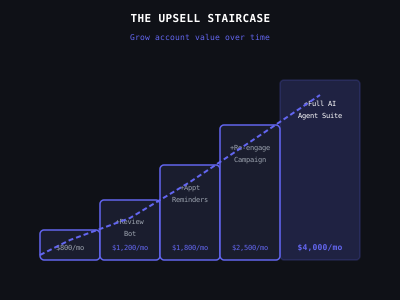
Acquiring a new client costs five to ten times more than expanding an existing one. Yet most AI automation agency owners spend 80% of their time on new business while completely ignoring the goldmine sitting in their current client roster. This guide is about fixing that.
Upselling existing AI automation clients isn't about being pushy, it's about identifying the next logical problem to solve, making a clear case for the ROI, and proposing it at exactly the right moment. When done well, your clients don't experience it as a sales pitch. They experience it as you understanding their business and proactively looking out for them.
The difference between agencies that plateau at $10K-$15K/month and those that break through to $30K-$50K/month almost always comes down to one thing: how well they grow the accounts they already have. Outbound acquisition has a ceiling. Upselling compounds. Every dollar of MRR you add through upsells is a dollar you never have to prospect, pitch, or onboard for again. For a complementary approach with specific conversation frameworks, see our guide on upselling clients on additional AI automations without being pushy. And if you need to build the initial lead follow-up system that starts the upsell path, check out our guide to automated lead follow-up.
Why Your Existing Clients Are Your Fastest Path to More Revenue
When you sign a new AI automation client, you've spent time on outreach, discovery calls, proposal writing, and onboarding. That time investment is sunk cost. Your existing clients already trust you, already understand the value of what you do, and have already seen results from your work. The sales cycle for an upsell is a fraction of the time and effort of finding a new client.
The math is compelling: if you have 10 clients paying $1,500/month and you successfully upsell half of them to $2,500/month, you've added $5,000 in monthly recurring revenue without finding a single new prospect.
More importantly, clients who buy additional services tend to stay longer. Each new automation creates another dependency on your work, another result they're experiencing, another reason to keep the relationship going. Data across SaaS and service businesses consistently shows that multi-product customers churn at roughly half the rate of single-product customers. In practical terms, a client running three automations with you will stick around twice as long as a client running one.
There is also a compounding credibility effect. Each successful automation you deliver raises the client's confidence in your recommendations. Their internal resistance to spending more drops because you have a track record of delivering measurable outcomes. By the time you pitch your third or fourth automation to a client, the conversation shifts from "can you really do this?" to "what should we build next?"
AI Automation Upsell Path, Typical Monthly Revenue Per Client
Percentage of maximum account value captured, each add-on compounds revenue and reduces churn
The Three Types of AI Automation Upsells
Not all upsells are created equal. Understanding the three types helps you sequence your offers correctly and match the right pitch to the right client at the right stage of the relationship.
Type 1: Expansion Upsells (More of the Same)
You've built a lead follow-up automation for their main service. Now they want it for a second service line, a second location, or a different audience segment. The work is similar but distinct, and it often commands a new setup fee plus expanded monthly retainer.
Expansion upsells are your lowest-effort, highest-certainty wins. The client already knows the automation works because they are seeing results. You already have the technical blueprint. A dental practice running missed-call text-back for their general dentistry line will often want the same system for their cosmetic dentistry line within 60 days. A roofing company with lead follow-up for residential repairs will want it mirrored for their commercial division. Watch for these signals: the client mentions a second location opening, a new service launch, or a seasonal campaign they want to run differently. Each of those is an expansion upsell in disguise.
Pricing for expansion upsells should be slightly discounted from the original, typically 60-80% of the initial setup fee since you're duplicating rather than inventing. The monthly retainer can often remain the same or close to it because the ongoing maintenance scope is identical.
Type 2: Complementary Upsells (Adjacent Problems)
You solved one problem, and the natural next problem is now visible. You built a missed-call text-back system, and now they need an appointment reminder workflow. You built a lead qualification bot, and now they need a CRM data enrichment workflow. These adjacent automations are easy pitches because the client already sees how the first one works.
The key to complementary upsells is mapping out the client's entire customer journey and identifying where the gaps are. Think of it as a chain: lead capture → lead follow-up → appointment booking → appointment reminders → service delivery → review request → referral generation → dormant lead reactivation. Most clients come to you with one or two links in that chain automated. Your job is to show them which link is the weakest and how much revenue it is costing them.
For example, if your client's lead follow-up automation is booking 40 appointments per month but 12 of those are no-shows, the appointment reminder upsell practically sells itself. You already have the data. You can say: "You are losing roughly 12 appointments a month to no-shows. At your average job value of $800, that is $9,600 in potential revenue walking away. An automated reminder system with AI-powered rescheduling recovers 50-70% of those. That's $4,800 to $6,700 back in your pocket every month for a $300/month add-on."
Type 3: Vertical Upsells (More Sophisticated Solutions)
The client started with a basic automation and now wants a more comprehensive AI system. The missed-call text-back becomes a full conversational AI agent. The simple follow-up sequence becomes a multi-channel outreach system with AI personalization. These are your highest-value upsells and often require a new proposal.
Vertical upsells typically happen 90-180 days into the relationship when the client has built enough trust and seen enough ROI to justify a larger investment. A med spa that started with a $1,500/month lead follow-up system might be ready for a $4,000/month AI voice agent that handles inbound calls, books appointments, answers product questions, and follows up with leads across SMS, email, and voicemail drops. The scope jump is significant, but the client's confidence in you is also significantly higher than it was on day one.
Position vertical upsells as "phase two" engagements. During your initial onboarding, plant the seed: "Phase one is getting your lead follow-up dialed in. Once that's producing consistent results, phase two is where we build the full AI-powered front office, handling calls, booking, reminders, and reviews all in one system." This frames the upsell as part of the original plan rather than an afterthought.
When to Pitch: The 4 Best Upsell Moments
Timing is everything with upsells. Pitch too early and you feel opportunistic. Pitch too late and you've left revenue on the table for months. Here are the four ideal moments to introduce an upsell conversation:
Moment 1: The 30-Day Win
About 30 days after deploying an automation, you should have meaningful results to report. This is the perfect moment for an upsell conversation because the client is experiencing peak satisfaction, they just saw real results, their trust in you is at its highest, and they're primed to hear what else is possible.
Script: "Based on the results from the first month, I've been thinking about what would make the biggest impact for you next. I had an idea I wanted to run by you, do you have 15 minutes this week?"
The 30-day win is particularly effective because the data is fresh and specific. You are not speaking in hypotheticals. You can say: "Your missed-call text-back system sent 347 messages last month and booked 23 appointments that would have been lost. That's roughly $18,400 in recovered revenue based on your average ticket. The next biggest leak I see is that 31% of your booked appointments are no-shows. I have a system that can cut that number in half. Want me to walk you through it?"
Moment 2: The Monthly Review Call
If you have monthly check-in calls (which you should), always end them with a forward-looking question: "Based on everything we've covered today, is there another area of the business where you feel like you're losing leads or wasting time?" Let them surface the problem. Then you have something concrete to build a proposal around.
Structure your monthly review calls with the last five minutes dedicated to expansion discussion. Walk through the current metrics, celebrate the wins, address any issues, and then transition: "Everything is trending well. I've been keeping a list of potential next steps for your account. Can I share the one I think would have the biggest impact right now?" By keeping a running list, you always have something specific to propose rather than scrambling to think of something on the spot.
Moment 3: The Problem Report
When a client mentions a pain point, a new hire who isn't working out, a busy season they're dreading, a process that's breaking down, that's an upsell opportunity. Don't rush to pitch. Listen carefully, ask clarifying questions, and say: "I think I might be able to help with that. Let me think about it and put together a quick proposal."
The problem report is often the most organic upsell path because the client raised the issue themselves. They feel heard, not sold to. The critical step is restraint, do not pitch on the same call. Instead, take 24-48 hours to put together a focused one-page proposal. This signals that you took their problem seriously and thought carefully about the solution rather than reflexively trying to sell them something.
Moment 4: The Renewal Conversation
When a client's contract comes up for renewal, that's a natural moment to propose an expanded engagement. Frame it as an upgrade: "I've been thinking about what would take your results to the next level this year. I put together a proposal for what I'd recommend building next, want to take a look?"
Renewal conversations are also the right time to introduce bundled pricing. If your client is currently paying $1,500/month for lead follow-up and you want to add appointment reminders ($300/month) and review generation ($250/month), offer a bundled rate of $1,900/month instead of $2,050/month. The 7% discount is a small concession that makes the expansion feel like a deal rather than a cost increase. It also locks the client into a broader engagement that is harder to walk away from.
The ROI-First Upsell Framework
Every upsell conversation should start with ROI, not features. Here's the framework:
- Identify the problem: What's breaking down, being missed, or costing them money right now?
- Quantify the cost: What's the dollar value of that problem? (Lost leads x average customer value, or time spent x hourly cost)
- Propose the solution: "I can build [specific automation] that solves this."
- State the expected ROI: "Based on what I've seen with similar clients, this should recover [X] leads per month worth [Y dollars]."
- State the investment: "The setup fee is $[X] and monthly maintenance is $[Y]."
When the ROI clearly exceeds the investment, the sale becomes almost automatic. Most upsell pitches fail not because the client doesn't want to buy, but because the agency owner never articulated the financial case.
A useful rule of thumb is the 3x rule: the projected monthly ROI of the upsell should be at least three times the monthly cost. If you are proposing a $500/month add-on, you need to show at least $1,500/month in recovered revenue or saved costs. Anything below 3x and the client will hesitate because the margin of error feels too thin. At 5x or above, the decision becomes almost instant because even if your projections are half wrong, the client still comes out ahead.
Always use the client's own numbers in your calculations, not industry averages. Pull their actual lead volume, their actual no-show rate, their actual average ticket value from the automations you are already running. When you say "based on your data from last month" instead of "based on what we typically see," the credibility of your pitch increases dramatically.
5 High-Value Upsells for AI Automation Clients
Here are five upsells that consistently generate strong client interest and healthy revenue:
1. AI-Powered Appointment Reminders + No-Show Recovery
If you've built a booking automation, the natural next step is reducing no-shows. Add automated reminder sequences at 48 hours, 24 hours, and 2 hours before appointments, plus an AI-driven re-booking flow for clients who cancel. For service businesses, reducing no-show rates by even 20% can add thousands per month to their bottom line.
The implementation is straightforward: pull upcoming appointments from the client's calendar or CRM, trigger SMS reminders at each interval, and if the customer replies with a cancellation or doesn't confirm, route them to an AI-powered rescheduling flow. The rescheduling component is what separates this from a basic reminder and justifies a higher price point. Instead of just reminding, the system actively recovers lost appointments by offering alternative times. Pricing this at $250-$400/month is standard, with a $500-$800 setup fee.
2. Review Generation Automation
After a positive client interaction, automatically send a review request via SMS or email with a direct link to their Google or Yelp profile. Most local businesses know they need more reviews but never follow up consistently. This automation runs itself and delivers measurable impact within weeks.
The best review generation systems include a sentiment gate: send an initial message asking "How was your experience?" and only route positive respondents to the public review link. Negative respondents get routed to a private feedback form that goes directly to the business owner. This protects the client's online reputation while still capturing valuable feedback. Build in a two-touch sequence, an initial request plus a follow-up nudge 48 hours later for non-respondents. This alone can double the response rate. Most businesses see 15-30 new reviews per month from this system, which has a material impact on local search rankings and conversion rates. Price it at $200-$350/month.
3. Re-Engagement Campaign for Dead Leads
Every business has a pile of old leads who never converted. Build an AI-personalized re-engagement sequence that revives their CRM's "dead" leads. These are often high-intent prospects who just got lost, and recovering even a few per month pays for the automation many times over.
Pull all leads from the CRM that have not been contacted in 60-180 days. Segment them by original service interest and last interaction. Then deploy a multi-touch sequence, typically three to five messages over two weeks, that references their original inquiry and offers a relevant incentive to re-engage. The AI personalization layer is what makes this work at scale: each message references the specific service the lead originally asked about, the timeframe of their inquiry, and any notes from the original conversation. A plumbing company with 600 dead leads in their CRM might see 15-25 re-engaged conversations and 5-8 booked jobs from a single campaign. At an average job value of $400-$1,200, that is a significant return. Charge $500-$1,000 per campaign run or $300-$500/month for ongoing reactivation.
4. Social Proof and Referral Automation
Build a workflow that identifies happy customers (based on positive responses or completed purchases) and automatically asks for referrals with a simple referral link or incentive. Referral programs are notoriously underfunded in small businesses because they require manual management, automation solves that.
The trigger for referral requests should be a positive outcome event: a five-star review left, a completed appointment with positive feedback, or a repeat purchase. The timing matters, ask within 24 hours of the positive experience while satisfaction is highest. The message should be simple and specific: "Thanks for the kind words! Know anyone else who could use [specific service]? Here's a link to share, they will get [incentive] and so will you." Track referral conversions and report them back to the client monthly. This visibility is what makes the system feel valuable beyond the automation itself. Price at $200-$400/month depending on the complexity of the referral tracking.
5. AI Reporting Dashboard
As you add more automations, the client has more data but less visibility. Build them a simple weekly or monthly report that pulls key metrics from all their automations and sends a plain-English summary. This upsell has high perceived value and relatively low build time once you have a template.
The report should answer three questions: what happened (total leads, appointments, reviews, messages sent), what worked (conversion rates, best-performing channels, top lead sources), and what to do next (one recommended action based on the data). Send it as an automated email every Monday morning or on the first of each month. Keep it to one page or less, executives skim, they don't read dashboards. The real value of the reporting upsell is not the report itself but the retention effect. Clients who see a weekly summary of results are constantly reminded of the value you provide. They are far less likely to churn. Price this at $150-$300/month, and note that it costs you virtually nothing to deliver once the template is built.
How to Present the Upsell Proposal
Your upsell proposal doesn't need to be a formal document. In most cases, a conversational Loom video walking through the problem and proposed solution works better than a PDF deck. It feels personal, it's easy to consume, and it gives you a chance to think out loud about the ROI in a way that resonates.
Keep your proposal short: problem → cost → solution → expected result → investment → next steps. The whole thing should take under three minutes to review. Long proposals create friction and delay decisions.
Here is a concrete structure for your Loom proposal that works consistently: Start with 30 seconds on the specific data point you spotted (e.g., "Your no-show rate last month was 28%, which means roughly 14 lost appointments"). Spend 60 seconds on the solution and how it works in plain language. Then 30 seconds on the expected outcome with a specific number ("This should recover 7-10 of those appointments per month"). Finish with 30 seconds on pricing and next steps ("The setup is $750, monthly is $300, and I can have this live within a week. Want me to move forward?"). That is a two-and-a-half-minute video that contains everything the client needs to make a decision.
For more on pricing your upsells correctly, see our guide on what to charge for AI automation services.
Handling the "Let Me Think About It" Response
Unlike new client sales where "let me think about it" can mean the prospect is uncertain about you, from an existing client it almost always means they need clearer financial justification or they're concerned about implementation burden.
Follow up with a specific ROI calculation: "I ran the numbers and based on your current lead volume, if this automation recovers even 3 additional customers per month at your average value of $1,800, that's $5,400/month in new revenue against a $500 monthly investment. Does that make the decision easier?"
If the objection is about implementation burden rather than cost, address it directly: "This will take about 3-5 days to build and won't require any changes to your current workflows. I will handle the entire setup and just need 15 minutes of your time for a quick test before we go live." The less effort the client perceives on their end, the faster they will say yes.
Another powerful follow-up technique is the risk reversal. For upsells where you have high confidence in the outcome, offer a 30-day performance guarantee: "If we don't reduce your no-show rate by at least 30% in the first month, I will waive the first month's fee." You should only do this when you have strong data from other clients to back up your projections. But when you can offer it, the guarantee eliminates the last remaining objection and accelerates the decision to same-day in many cases.
Best Upsell Moments, Client Receptivity Score
Relative client receptivity, timing upsells around results milestones dramatically improves close rates
Avoiding the Most Common Upsell Mistakes
Even experienced agency owners make predictable errors when upselling. Knowing what to avoid is just as important as knowing what to do.
Mistake 1: Pitching before proving. If your first automation has not produced clear, quantifiable results, any upsell conversation will feel premature. The client is still evaluating whether the initial investment was worth it. Trying to add more at this stage erodes trust. Wait until you have at least 30 days of measurable data.
Mistake 2: Leading with features instead of outcomes. Clients do not care about webhook triggers, API integrations, or AI model configurations. They care about revenue recovered, time saved, and problems eliminated. Every sentence in your upsell pitch should tie back to a business outcome the client cares about.
Mistake 3: Offering too many options at once. Presenting three or four upsell options simultaneously creates decision paralysis. Pick the single highest-impact automation and pitch that one. If the client asks what else is available, then you can share a roadmap. But always lead with one clear recommendation.
Mistake 4: Ignoring client signals. If a client is slow to respond, frequently misses calls, or has expressed budget concerns, forcing an upsell conversation will damage the relationship. Read the room. Some clients need more time, and pushing too hard on the wrong client will cost you the entire account.
Building a Systematic Upsell Process
The best AI agency owners don't leave upsells to chance. They build a systematic process:
- Monthly review call with every client (required for retainer clients)
- Upsell idea backlog per client, a running list of potential next automations
- Scheduled upsell pitch at the 30-day win and at every 90-day mark
- Trigger-based pitches whenever a client mentions a pain point
With 10 clients and a systematic approach, you should be closing at least one upsell per month. Over a year, that compounds significantly.
To operationalize this, create a simple tracker, a spreadsheet or CRM tag system, with three columns per client: current automations running, upsell opportunities identified, and next proposed pitch date. Review this tracker weekly. When a pitch date arrives, pull the client's latest performance data, draft a one-page proposal or two-minute Loom, and send it within 24 hours. The discipline of maintaining this tracker is what separates agencies that grow from upsells and agencies that leave money on the table indefinitely.
Set a monthly target for upsell revenue. If you have 10 clients, a reasonable starting target is one upsell per month averaging $300-$500 in new MRR. That is $3,600-$6,000 in additional annual recurring revenue from each month's upsell, and each one compounds. After 12 months of consistent upselling, you will have added $25,000-$45,000 in annual recurring revenue without signing a single new client.
For the bigger picture on building monthly recurring revenue, check out our guide on building MRR in your AI automation agency.
Want to learn how to build and sell AI automations? Kingstone AI Operators is our free community for AI automation agency builders. Join Kingstone AI Operators, free.
FAQ
Frequently Asked Questions
How do I upsell existing AI automation clients on more services?
Present data-driven upsell opportunities during results review calls at the 30-60 day mark. Show the ROI from their current automation, then identify the next biggest gap in their process. Frame expansions as natural next steps: 'Your lead follow-up is working great, the next opportunity is reducing your 15% no-show rate with automated reminders, which could recover another $2,000/month.'
What is the best upsell path for AI automation clients?
Start with their highest-pain automation (usually lead follow-up or missed-call text-back), then expand to appointment reminders, then review generation, then customer reactivation campaigns, then voice AI. Each addition builds on the previous one and increases the client's total value from automation. Most clients expand from $1,500/month to $3,000-$4,000/month within 6 months.
How do I avoid seeming pushy when upselling AI automation clients?
Always lead with data from their current results, never with a sales pitch. Ask permission: 'I noticed something in your data that could be an opportunity, want me to walk you through it?' Frame the upsell as solving a problem they already have, not adding a product they don't need. If they say no, respect it and revisit in 90 days with fresh data.
How much can I increase revenue per client through upselling AI automations?
Systematic upselling increases average client value by 40-80% within 6 months. A client paying $1,500/month for lead follow-up can expand to $3,500-$4,500/month with appointment reminders, review generation, reactivation campaigns, and reporting. The upsell cost to you is near zero since you already have the client relationship and platform access.
When should I NOT upsell an AI automation client?
Never upsell before the initial deliverable is proven and generating measurable ROI. Never upsell a client who is dissatisfied with their current service, fix the existing issues first. Avoid upselling clients who are already at their budget ceiling or who have expressed that they want to keep things simple. The relationship is always worth more than one additional sale.
How do I package upsell automations for easy client decision-making?
Create pre-built add-on packages with clear pricing and expected outcomes: 'Appointment Reminder Pack, $300/month, reduces no-shows by 50-70%' or 'Review Booster, $250/month, generates 15-25 new Google reviews per month.' Bundled discounts of 10-15% for adding multiple automations incentivize larger expansions. Productized packages are easier to sell and faster to deliver than custom scoping each add-on.
Program · 90 days
Client Accelerator bundles the demo software with live coaching.
A one-time $1,499 purchase, or 4 interest-free payments of $374.75. Includes Ciela AI with 150 personalized demos each month throughout the program, the 90-Day AI Client System, two live group coaching calls every week, sales and outreach templates, 200+ n8n workflow templates, and private Build With Adhiraj resources.
See what is includedCiela AI is the demo platform for AI agencies and AI consultants. It turns any prospect's website into a live, personalized AI demo (chat, voice, or missed-call text-back) you can send before the first call.
Start Client AcceleratorCiela AI pricingAgent builds by nicheAll articles
Community · Training
Join Build With Adhiraj free.
Build With Adhiraj is the free community for people building and growing AI service businesses. Learn alongside other operators as you package, demonstrate, sell, and deliver practical AI systems.
Join Build With Adhiraj free