
AI Automation for Plumbers: The Exact Workflows That Book More Jobs
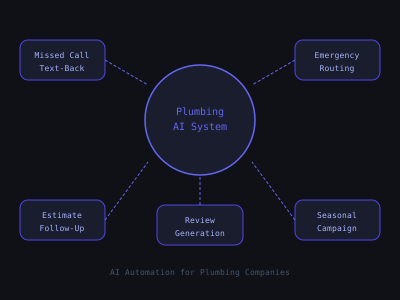
Plumbing is one of the highest-urgency service businesses in existence. When a pipe bursts at 11pm or a water heater fails on a Saturday morning, a homeowner needs a plumber immediately — and they will call every number they can find until someone picks up or texts back. The first plumber to respond and book the job wins.
For AI automation agency owners, plumbing is a goldmine. The average emergency plumbing call generates $300–$800. A water heater replacement runs $1,200–$3,500. A plumbing company doing $1.5M annually that captures just 10% more of its missed calls could add $150,000-plus in revenue. Your service fee is noise compared to that number.
Why Plumbing Companies Miss So Many Leads
Owner and technicians are on job sites and cannot answer the phone while under a sink or in a crawl space. They miss calls and do not call back for two to four hours. High urgency means low patience: a homeowner with a burst pipe calls three numbers in ten minutes. The first one to respond gets the job. Estimate follow-up is also inconsistent — a plumber quotes a non-emergency job, leaves, and forgets to follow up. The homeowner gets three quotes and picks the only contractor who followed up twice. Add in the lack of any review generation system (plumbers with 30 reviews lose jobs to competitors with 300) and you have four distinct, fixable problems.
A solo plumber who misses 10 calls per week at an average job value of $400 is leaving $4,000 per week on the table — not from lack of demand, but from lack of response systems. This is the conversation that opens doors with every plumbing business owner you approach.
The Five Automations That Move the Needle for Plumbers
The missed call text-back is the foundation of every plumbing automation package. Every missed call triggers an SMS within 30 seconds: "Hi, this is [Company]. Sorry we missed your call — we are currently on a job. What is your address and what type of plumbing issue are you dealing with? We will get back to you ASAP." When the homeowner responds, an AI continues the conversation to gather the issue type, address and property type, urgency level, and preferred service time. For emergency issues, the AI flags the conversation to the owner immediately. For non-emergency scheduling, it books directly into the calendar. Setup uses a webhook from their phone system (RingCentral, Grasshopper, or Twilio) connected to a GPT-4o AI layer and a booking integration via Calendly or ServiceTitan. Pricing: $197–$297 per month.
Emergency job priority response is the next highest-value automation. When a homeowner reports a burst pipe, active leak, or no hot water, the AI immediately confirms the issue is an emergency, sends emergency pricing disclosure (required for compliance in many states), gives an ETA based on current job queue, confirms the booking, and alerts the on-call technician with job details via SMS. Emergency plumbing carries premium pricing — often 1.5 to 2 times the standard rate. A single additional emergency call per day at $500 average is $182,500 per year in incremental revenue. Pricing: $297–$497 per month.
Estimate follow-up automation addresses the consistency problem that costs most plumbers 25–45% of their non-emergency quotes. After a plumber provides an estimate, a four-touch automated sequence runs: Day 1 email with the detailed estimate PDF, Day 3 SMS check-in, Day 7 message with scheduling availability and urgency framing, and Day 14 final follow-up asking if any clarification is needed. Most plumbers quote and forget. This sequence alone improves close rate on non-emergency estimates significantly. Pricing: $297–$497 per month.
Seasonal campaign automation builds automated outreach campaigns to the plumber's existing customer list: winter freeze prep campaigns, spring post-winter damage checks, fall water heater inspection specials, and annual service reminders for lapsed customers. Seasonal campaigns to an existing customer list typically generate 15–40 service calls per campaign. At $200–$400 per call, that is $3,000–$16,000 per campaign run from the existing database. Pricing: $297–$497 per month.
Google review automation sends a personalized SMS after every completed job: "Hi [Name], thanks for trusting [Company] with your plumbing today! Did we take care of you? A quick Google review means the world to small businesses like ours." Add a sentiment filter — route negative responses to the owner for service recovery before they go to Google. A plumber completing 15 jobs per week who gets even 15% to leave reviews generates over 100 new reviews per year, compounding their local SEO and reducing cost-per-lead indefinitely. Pricing: $197–$297 per month.
Plumbing Automation ROI — Revenue Impact by Workflow
How to Pitch Plumbers
Plumbing business owners are practical people who respond to direct, specific, numbers-based pitches. Skip the jargon. The opener: "How many calls do you think you miss in a typical week when you are on a job?" They will give you a number, usually five to twenty. Then: "Let us say it is ten. If even three of those were emergency calls worth $400 each, that is $1,200 per week you are leaving on the table because you were busy. I set up a system that texts every missed call back within 30 seconds and books the job for you automatically. It costs $297 per month."
That is the pitch. Direct. Specific. Numbers-based. Plumbers respond to it because it is framed around their actual problem and expressed in terms they care about: jobs booked and revenue earned. A customized ROI calculation using the plumber's actual call volume and average job value closes at much higher rates than a generic one. Use numbers they give you on the discovery call.
Pricing and Integration
Structure your packages around the most common needs: Starter at $497 per month covers missed call text-back plus estimate follow-up plus review automation, addressing the biggest revenue leaks. Growth at $797 per month adds emergency job routing and seasonal campaigns for full operational coverage. Full Service at $1,197 per month includes all five automations plus monthly performance reporting and campaign management, best for plumbing companies doing $1M or more annually or those with multiple technicians. Add a setup fee of $500–$1,000 as a one-time investment.
The most common integrations for plumbing automation include ServiceTitan (dominant field service software for larger plumbing companies, with a solid API for job scheduling and customer data), Housecall Pro (popular with small-to-mid size operations, easy to integrate via Zapier), and Jobber (common with owner-operated businesses, good API and webhook support). For SMS delivery, Twilio is standard. GoHighLevel works well as the CRM and SMS layer regardless of what scheduling software they use.
Plumbing Automation Package Pricing — Market Benchmarks
Finding and Closing Plumbing Prospects
Google Maps is the fastest prospecting source. Search "plumber [city]" and sort by review count. Target companies with 20–75 reviews — established enough to have volume but clearly not capturing all their reviews. Plumbers on Angi, HomeAdvisor, and Thumbtack are actively spending money on leads and are clearly aware of their lead problem. They are receptive to a better solution. Plumbing supply houses are another channel: contractors hang out at supply houses, and a relationship with the staff there can generate warm referrals.
When selling, avoid the three mistakes that kill deals with plumbing business owners. First, do not lead with technology — a plumber does not care about n8n, OpenAI, or webhooks. Frame every conversation around jobs booked and revenue earned. Second, do not over-automate too soon: start with missed call text-back, let the first week of recovered leads sell the upsell. Third, when you demo the system, use the plumber's actual business name, phone number, and service area. A personalized demo closes at three to five times the rate of a generic one. For more on selling automation to trades businesses, see our guide on selling AI automation to local service businesses and our breakdown of the most profitable AI automation niches in 2026.
Program · 90 days
Client Accelerator bundles the demo software with live coaching.
A one-time $1,499 purchase, or 4 interest-free payments of $374.75. Includes Ciela AI with 150 personalized demos each month throughout the program, the 90-Day AI Client System, two live group coaching calls every week, sales and outreach templates, 200+ n8n workflow templates, and private Build With Adhiraj resources.
See what is includedCiela AI is the demo platform for AI agencies and AI consultants. It turns any prospect's website into a live, personalized AI demo (chat, voice, or missed-call text-back) you can send before the first call.
Start Client AcceleratorCiela AI pricingAgent builds by nicheAll articles
Community · Training
Join Build With Adhiraj free.
Build With Adhiraj is the free community for people building and growing AI service businesses. Learn alongside other operators as you package, demonstrate, sell, and deliver practical AI systems.
Join Build With Adhiraj free