
The AI Automations Dentists Will Actually Pay For in 2026
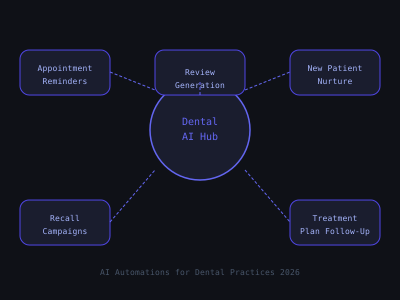
Dental practices are sitting on a goldmine of automation opportunities — and most of them know it. Ask any dental practice manager what their biggest operational headaches are and you'll hear the same answers: no-shows, patients who fall off their recall schedule, slow new patient conversion, and not enough Google reviews despite hundreds of satisfied patients walking out every week.
For AI automation agency owners, dentistry is one of the most attractive niches available. The average general dentistry practice generates $800,000–$1.5M in annual revenue. A single no-show costs $150–$400 depending on the procedure. A lapsed patient who doesn't come back for their 6-month cleaning represents $300–$600 in lost hygiene revenue alone — and potentially thousands if they eventually need restorative work.
This guide covers the specific AI automations dental practices will pay for in 2026, what to charge, how to build each one, and the exact words to use when you sell them. Dental is one of the most profitable niches for AI automation agencies.
The Dental Practice Automation Landscape in 2026
Dental offices already use software like Dentrix, Eaglesoft, Open Dental, and Curve Dental. Most of these platforms have basic reminder features built in — but “basic” is the key word. They send a single reminder, don't handle two-way responses, and have zero intelligence around patient behavior or personalization.
That's your opening. You're not selling them a replacement for their existing software. You're selling them a layer on top of it that actually works.
The practices most ready to buy are those with:
- No-show rates above 10%
- Fewer than 100 Google reviews
- A recall list with 200+ patients overdue for their cleaning
- New patient leads that aren't being followed up within 24 hours
When you walk in and ask a practice manager “how many patients are on your overdue recall list right now?” — if they pause and say “we're not really sure” or “maybe a few hundred” — that's a buying signal. The problem exists, they just haven't quantified it. Your job is to put a dollar figure on it before you pitch the solution.
Dental Practice Revenue Leaks, Where Automation Has the Most Impact
The 5 Highest-ROI Dental Automations
1. Multi-Touch Appointment Reminder System ($397–$597/month)
The standard single-reminder approach misses patients who ignore the first message. Build a 3-touch sequence:
- 5 days before: Email with appointment details, “do you need to reschedule?” option, and insurance reminder
- 48 hours before: SMS with one-click confirm link
- Morning of: SMS with a brief reminder and office address/parking info
For unconfirmed appointments after 48 hours, trigger an AI outreach: “Hi [Name], we haven't heard back about your appointment on [date]. Would you like to keep it or reschedule?” This catches the patients who meant to cancel but forgot — giving the practice time to fill the slot.
The slot-filling piece is where most agencies stop short. A truly high-value reminder system does two things simultaneously: it nudges confirmed patients and it maintains a cancellation waitlist. When a patient cancels, the system immediately texts the next 3–5 patients on the waitlist: “An opening just came up on [date] at [time]. Want to grab it?” Practices that implement this recover 60–70% of same-week cancellations rather than letting slots go empty.
Build this in n8n: Use a webhook trigger from the practice management system (or a Zapier step if no direct API exists), route into a Google Sheets “waitlist” tab, and fire SMS via Twilio when a cancellation event comes in. The entire flow takes about 3 hours to build and test.
ROI: A practice with 200 appointments/week at 12% no-show rate loses 24 appointments/week worth ~$150 each = $3,600/week. Reducing no-shows by even 40% recovers $1,440/week = $5,760/month. Your $497 fee is less than 10% of the recovered revenue.
2. Recall and Reactivation Campaigns ($597–$897/month)
The hygiene recall list is the lifeblood of a dental practice. Patients who are 3, 6, or 12+ months overdue for their cleaning need a structured reactivation campaign, not a single postcard.
Build a tiered reactivation sequence:
- 3 months overdue: Friendly SMS: “Hi [Name], it's time for your 6-month cleaning at [Practice]! We have openings this week — want to grab a slot?”
- 6 months overdue: More direct email + SMS: “We haven't seen you in 6 months and want to make sure your smile is healthy. Here's a direct link to book your cleaning.”
- 12+ months overdue: Win-back offer: “It's been a while and we miss you! Book your cleaning this month and we'll waive the hygiene exam fee.”
A practice with 500 overdue patients typically reactivates 60–100 with a well-run campaign. At $200/cleaning, that's $12,000–$20,000 from one campaign.
The AI voice call layer is what separates good from great. At the 7-day mark for non-responders, trigger an AI voice call (Vapi works well here) with a short script: “Hi, this is [Practice Name] calling for [Patient Name]. We noticed it's been a while since your last cleaning and we wanted to reach out personally. Would you like me to help you schedule a time that works for you?” Voice calls consistently outperform SMS for the hardest-to-reach segment — the 12+ month lapsed patients who've learned to tune out texts.
One-time campaign offer: Before pitching the monthly retainer, consider offering a one-time reactivation campaign at $1,500–$2,500. Pull all patients 6+ months overdue, run a 14-day campaign, and report back with booked appointments. If you reactivate 20 patients generating $4,000+ in hygiene revenue, the monthly retainer conversation is trivial.
3. New Patient Lead Nurture Bot ($497–$697/month)
Most dental practices get leads from their website, Google Ads, or referrals — and then follow up hours or days later. The data on this is damning: leads contacted within 5 minutes of inquiry are 21x more likely to convert than those contacted after 30 minutes. Most dental front desks don't have the capacity to achieve that response time consistently.
Build an AI that responds to every new patient inquiry within 60 seconds, gathers basic information, and books them directly:
- Trigger: new form submission, missed call, or live chat inquiry
- AI responds: “Hi [Name]! Are you looking for a new dentist or do you have a specific concern we can help with?”
- Collects: insurance (or self-pay), preferred day/time, chief concern
- Books: directly into Dentrix/Eaglesoft via API or sends Calendly link
- Sends: confirmation + new patient paperwork link
The paperwork automation alone is a massive win. Most practices still hand new patients physical forms at the office. Sending digital forms in advance reduces check-in time by 15 minutes and dramatically improves the first-visit experience — which matters because first-visit experience is the single biggest predictor of long-term patient retention.
Insurance pre-verification add-on: The most sophisticated version of this bot also triggers an insurance eligibility check 48 hours before the appointment. If the patient's insurance has lapsed or changed, the front desk gets a flag and can call to sort it out before the patient arrives. This prevents the awkward “your insurance doesn't cover this” conversation at the chair — one of the top patient frustrations cited in dental satisfaction surveys.
Missed call text-back: Layer this in at no extra build cost. Any missed call to the practice automatically triggers a text: “Hi, we missed your call at [Practice]. We'd love to help — are you an existing patient or looking for a new dentist?” For a practice missing 10–20 calls per week, this alone can recover 3–5 new patient bookings monthly.
4. Google Review Generation ($197–$297/month)
Post-visit review requests via SMS are the most cost-effective way to build a dental practice's online reputation. The timing matters: send the review request 2–3 hours after the appointment while the positive experience is fresh.
Add a sentiment check: if the patient responds positively, send the Google review link. If they express dissatisfaction, route to the office manager for service recovery. This filter protects the practice from negative reviews while maximizing positive ones.
A busy practice seeing 400 patients/week that gets even 5% to leave a review generates 20 new Google reviews/week. That's 80+ reviews/month, compounding their local SEO presence every single month you're retained.
Why this is your best foot-in-the-door offer: Review generation requires minimal integration — you just need appointment completion data and patient phone numbers. No deep API work, no complex HIPAA analysis, no practice management system credentials. You can deploy this in a single afternoon for a new client. Once they see 30 new reviews in the first month, they're psychologically committed to the relationship.
The compounding SEO story: When you report back to the practice owner, show them their review count month-over-month and where they rank for “dentist near [city].” Google local pack rankings are heavily influenced by review velocity (how quickly new reviews accumulate) and recency. A practice that goes from 45 reviews to 125 reviews in 3 months doesn't just look better — they rank higher and show up more often. Frame your retainer as an SEO investment, not a software fee.
5. Treatment Plan Follow-Up Automation ($397–$597/month)
One of the highest-value but most overlooked automations: following up on unaccepted treatment plans. A patient gets told they need a crown, says “let me think about it,” and never comes back. The average dental practice has $50,000–$200,000 in unaccepted treatment plans sitting in their system.
Build a 3-touch follow-up sequence that goes out to patients with open treatment plans:
- Week 1: “Hi [Name], Dr. [X] mentioned you were considering [treatment]. Do you have any questions we can answer?”
- Week 3: Email with educational content about the recommended treatment and consequences of delay
- Week 6: “We have limited availability this month. Would you like to schedule your [treatment]?”
Even a 10% conversion rate on $100,000 in unaccepted treatment is $10,000. Position this as “recovering revenue that's already in their system.”
The objection-handling angle: Treatment plan hesitation usually comes down to three things — cost, fear, or procrastination. Your Week 3 educational email should address all three. For cost: “Did you know many treatments become more expensive when delayed? A small cavity today can become a root canal in 12 months.” For fear: include a short video from the dentist explaining the procedure in plain language. For procrastination: create genuine urgency with limited scheduling windows. These emails can be templated and personalized by treatment type — implant follow-ups look different from filling follow-ups.
Build this integration carefully: You need treatment plan status flags from Dentrix or Eaglesoft. Both have APIs (Dentrix G7+ has REST API access; Eaglesoft uses a SQL database you can query with the right credentials). If direct API access isn't feasible, build a simple intake where the front desk exports overdue treatment plans monthly to a Google Sheet, which triggers the automation sequences. Imperfect but functional, and you can upgrade to API integration later.
Pricing Your Dental Automation Package
- Starter ($597/month): Appointment reminders + review generation. Immediate ROI, easy approval from practice owner.
- Growth ($1,197/month): Starter + recall campaigns + new patient bot. Full patient lifecycle coverage.
- Full Practice ($1,997/month): All five automations + monthly reporting + campaign management. Position as their complete patient communication system.
Setup fees: $750–$2,000 depending on the integrations required. Dentrix and Eaglesoft integrations are more complex and justify higher setup fees.
How to present pricing without getting price-shopped: Never lead with the price tier. Lead with the ROI calculation. Walk them through their numbers first: “Based on what you told me — 180 appointments/week, about 14% no-show rate — you're losing roughly $6,500/month in missed appointments. Our reminder system typically recovers 40–50% of that. That's $2,600–$3,250/month recovered for $597/month. Want to talk about implementation?” When the ROI is 4–5x clearly stated, the pricing conversation is almost irrelevant.
The Dental Practice Patient Lifecycle: Where Your Automations Fit
Understanding the patient lifecycle helps you explain the value of each automation in context. Most practice owners think about patient flow in terms of chairs filled — your job is to show them the full picture.
- Acquisition: New patient lead bot (inquiry → booked), missed call text-back, referral follow-up
- Activation: Pre-appointment reminders, new patient paperwork automation, pre-visit insurance verification
- Retention: Post-visit review requests, recall campaign (5.5 months), birthday/holiday touchpoints
- Revenue Recovery: Treatment plan follow-up, lapsed patient win-back (12+ months overdue), unaccepted estimate nurture
When you map your five automations to this lifecycle during a sales conversation, it becomes clear you're not selling five separate tools — you're selling a complete patient communication infrastructure. That framing justifies the $1,997/month Full Practice price far better than listing features.
How to Find and Approach Dental Prospects
- Google Maps audit: Look for practices with fewer than 75 reviews in a metro area. That's your opening: “I noticed you have 43 reviews. Similar practices in your area have 200+. I can show you exactly how they got there.”
- Practice management software communities: Dentrix, Eaglesoft, and Open Dental all have Facebook groups and forums where practice managers ask questions. Answer genuinely, build relationships, and mention your service contextually.
- Dental supply reps: They have relationships with dozens of practices. Offer a referral commission of $200–$500 per closed client.
- Dental study clubs: Most metro areas have CE (continuing education) study clubs where dentists gather monthly. Sponsoring the coffee at one of these meetings costs $50–100 and puts you in a room with 15–30 practice owners. Bring a one-page ROI calculator specific to their niche.
The Discovery Call Framework for Dental Prospects
When you get a dental practice on the phone, your goal in the first 10 minutes is to quantify their problem before you pitch anything. Use this sequence:
- “How many patient appointments do you schedule per week on average?”
- “What's your no-show rate? Even a rough estimate.”
- “How many patients are currently on your overdue recall list?”
- “When a new patient fills out your contact form, how quickly does someone typically follow up?”
- “How many Google reviews do you have right now?”
Take notes on every number. After they answer, do the math out loud: “So with 180 appointments/week and a 12% no-show rate, that's about 21 missed slots per week. At an average ticket of $175, that's roughly $3,675/week in missed revenue — about $180,000 per year. Does that track with what you're seeing?” Most practice owners have never had anyone quantify this for them. It's a powerful moment.
For the full approach to local business selling, read our guide on how to sell AI automation to local businesses.
Dental Automation Package, Monthly Revenue Recovery Potential
What to Deliver in Month 1 vs. Month 3
Setting clear delivery expectations protects you from early churn and positions you as a professional operator. Here's a realistic timeline:
- Week 1–2: Onboarding call, access to practice management software (or data export agreement), HIPAA BAA signed with all vendors, review generation live
- Week 2–3: Appointment reminder system built and tested with a small batch of upcoming appointments
- Week 3–4: Full reminder system live, first recall campaign segment running, reporting dashboard set up
- Month 2: New patient bot live, treatment plan follow-up sequences running, first recall campaign ROI report delivered
- Month 3: All five automations optimized based on month 1–2 data, expansion conversation initiated
Deliver a 1-page monthly report showing: appointments saved, recall patients booked, new reviews generated, new patients converted. Keep it visual. Most dentists don't want to read a 10-page report — they want a single number that tells them your fee is worth it.
HIPAA Considerations for Dental Automation
Always address HIPAA upfront. Dental practices handle Protected Health Information (PHI), which means your tools need appropriate safeguards:
- Get a Business Associate Agreement (BAA) signed before handling any patient data — this is non-negotiable and should be part of your agency contract
- Use HIPAA-compliant communication tools (Twilio offers a BAA, as does HighLevel on their HIPAA tier)
- Store only minimum necessary information — you don't need clinical notes to run a recall campaign, just name, contact info, and last appointment date
- Include data processing terms in your agency contract specifying how patient data is used, stored, and deleted
- Never store PHI in your automation tools longer than necessary — use the practice management system as the source of truth and pull fresh data for each campaign
Most practices will ask about this. Having a clear, confident answer to HIPAA compliance builds enormous trust and removes a major objection. The practices that push back hardest on HIPAA are often the ones most in need of better processes — use it as an opportunity to demonstrate professionalism. If you are just getting started and need to learn the agency model end-to-end, see our complete guide to starting an AI automation agency in 2026.
Practical tip: Build a one-page “HIPAA Compliance Summary” document that lists every tool in your stack, whether it offers a BAA, and how patient data flows through your system. Share it proactively during the sales process. No competitor is doing this — it immediately differentiates you.
Get the Free Template
The complete Vapi + n8n voice agent template is available for free inside our community. Import the workflow, connect your Vapi account, and deploy this for a client the same day.
Join Kingstone AI Operators, free, to access all templates.
Want to learn how to build and sell AI automations? Kingstone AI Operators is our free community for AI automation agency builders. Join Kingstone AI Operators, free.
FAQ
Frequently Asked Questions
What are the highest ROI AI automations for dental practices in 2026?
The five highest-ROI dental automations are: multi-touch appointment reminders ($397-$597/month, reduces no-shows by 40% recovering $5,760+/month), recall and reactivation campaigns ($597-$897/month, reactivates 60-100 patients from 500 overdue for $12,000-$20,000), new patient lead nurture bot ($497-$697/month, responds within 60 seconds to every inquiry), Google review generation ($197-$297/month, generates 80+ reviews per month), and treatment plan follow-up ($397-$597/month, recovers 10% of $100,000+ in unaccepted treatments).
How much should I charge for dental AI automation packages?
Three-tier pricing works best: Starter at $597/month covers appointment reminders plus review generation, immediate ROI, easy practice owner approval. Growth at $1,197/month adds recall campaigns plus new patient bot for full patient lifecycle coverage. Full Practice at $1,997/month includes all five automations plus monthly reporting and campaign management. Setup fees range from $750-$2,000 depending on integration complexity. Dentrix and Eaglesoft integrations justify higher setup fees.
How do I find and approach dental practices to sell AI automation?
Three proven channels: 1) Google Maps audit, search for practices with fewer than 75 reviews and pitch review automation as the opening. 2) Practice management software communities, Dentrix, Eaglesoft, and Open Dental Facebook groups where practice managers ask questions. Answer genuinely and mention your service contextually. 3) Dental supply reps, they have relationships with dozens of practices. Offer $200-$500 referral commission per closed client.
Is dental AI automation HIPAA compliant?
It can be when properly configured. Requirements: get a Business Associate Agreement (BAA) signed with every platform vendor before handling patient data, use HIPAA-compliant communication tools (Twilio offers a BAA, GoHighLevel has a HIPAA tier), store only minimum necessary patient information, and include data processing terms in your agency contract. Having a clear, confident answer to HIPAA compliance builds trust and removes the biggest objection dentists raise.
How much revenue can dental recall campaigns recover?
A dental practice with 500 overdue patients typically reactivates 60-100 with a well-run automated recall campaign, generating $12,000-$20,000 at $200 per cleaning. The automated approach achieves 20-35% recall rates versus 8-12% with manual processes. The system pulls patients who are 5.5 months since their last cleaning, sends personalized SMS and email, follows up with non-responders, and makes AI voice calls at 7 days. Most practices see results within the first 2-4 weeks.
What is the best way to start selling AI automation to dentists?
Start with Google review generation as your easiest entry point, it requires minimal integration, delivers visible results quickly (practices see 20+ new reviews within the first month), and costs the practice only $197-$297/month. Once they see their review count climbing, upselling appointment reminders and recall campaigns becomes straightforward. Alternatively, run a one-time reactivation campaign at $1,500-$2,500 to demonstrate immediate ROI before pitching the monthly retainer.
Program · 90 days
Client Accelerator bundles the demo software with live coaching.
A one-time $1,499 purchase, or 4 interest-free payments of $374.75. Includes Ciela AI with 150 personalized demos each month throughout the program, the 90-Day AI Client System, two live group coaching calls every week, sales and outreach templates, 200+ n8n workflow templates, and private Build With Adhiraj resources.
See what is includedCiela AI is the demo platform for AI agencies and AI consultants. It turns any prospect's website into a live, personalized AI demo (chat, voice, or missed-call text-back) you can send before the first call.
Start Client AcceleratorCiela AI pricingAgent builds by nicheAll articles
Community · Training
Join Build With Adhiraj free.
Build With Adhiraj is the free community for people building and growing AI service businesses. Learn alongside other operators as you package, demonstrate, sell, and deliver practical AI systems.
Join Build With Adhiraj free