
The Best Day and Time to Send Cold Emails for B2B Outreach (Data-Backed)
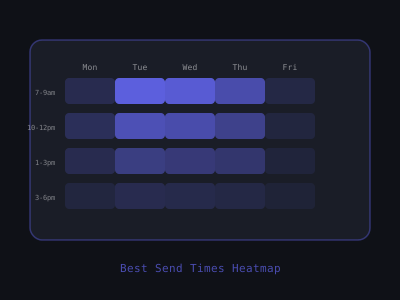
Send time is a lever most cold email operators underestimate. The same email, with identical copy and deliverability, can have a 35–45% open rate if sent at 8am Tuesday or a 15–20% open rate if sent at 4pm Friday. The difference is not the email, it's when it arrived in the inbox relative to the prospect's attention window.
Think about your own inbox behavior. When you open email at 8:00am, you scan the first 8–12 messages, respond to a few, archive some, and move on. Anything below that fold gets a quick subject-line glance at best. By 10:00am, emails that arrived overnight are functionally invisible. Cold email operates under the same physics as every other email, if it does not land in the prospect's active attention window, the copy does not matter because it will never be read.
This guide covers the data on optimal cold email send times across B2B industries, broken down by day, time window, prospect role, and timezone considerations, plus how to configure timezone-aware sending in Instantly and Smartlead. If your emails are landing in spam regardless of timing, see our guide on how to avoid spam filters in cold email.
The Data: What the Research Actually Shows
Multiple large-scale studies on B2B email timing have been published by HubSpot, Mailchimp, Yesware, and Saleshandy, aggregating data from tens of millions of emails. While individual results vary by industry and audience, the consensus data points to consistent patterns.
One thing to keep in mind: most of these studies combine marketing email and cold outreach into a single dataset. Cold email behaves differently from opt-in marketing email because the recipient has no prior relationship with the sender. That means the penalty for bad timing is steeper, a newsletter subscriber might open your email three hours late, but a cold prospect who does not recognize you will simply skip past it. The windows below are adjusted for cold-specific behavior, not blended averages.
Best days to send cold emails (ranked):
- Tuesday: Consistently highest open and reply rates across most studies. Monday inbox overload has cleared, but the week's urgency hasn't yet peaked.
- Wednesday: Slightly behind Tuesday. Mid-week attention window is solid.
- Thursday: Good performance, slightly declining vs. Tuesday/Wednesday. Works well for follow-ups.
- Monday: Significantly underperforms. Inboxes are full from weekend accumulation and Monday morning planning.
- Friday: Lowest open and reply rates. Prospects are mentally checked out or rushing to close the week.
- Saturday/Sunday: Avoid for B2B. Even if technically delivered, weekend emails get buried under Monday morning email clearing.
A practical implication of this ranking: if you are running a 4-step sequence, schedule Email 1 on Tuesday, Email 2 on Thursday, Email 3 the following Tuesday, and Email 4 the following Thursday. This keeps every touch inside the Tuesday–Thursday performance zone and avoids the Monday/Friday dead zones entirely. If you only have budget for three active send days per week, Tuesday/Wednesday/Thursday is the correct selection every time.
Cold Email Performance by Day of Week (Relative Open Rates)
Best Time Windows for Cold Email
Time of day has more variance than day of week, and it interacts strongly with the prospect's role and industry. However, consistent top performers across most B2B segments are:
7:00 AM – 9:00 AM (Prospect Local Time): The Early Morning Window
The highest-performing time window for most B2B cold email. Your email arrives when the prospect first opens their inbox in the morning, before the day fills with meetings and tasks that push email to the back. It's at the top of the inbox when they're fresh and have the most attention available.
The reason this window dominates is inbox position. Most email clients display messages in reverse chronological order. An email that arrives at 7:45am sits at position 1–5 when the prospect opens their inbox at 8:00am. An email that arrived at 11:00pm the previous night sits at position 30–50, below a wall of newsletters, internal messages, and other cold emails. Position 1–5 gets opened. Position 30–50 gets archived without reading.
Within this window, there is a tactical consideration: sending at exactly 7:00am or 8:00am on the dot can look automated. Most scheduling tools batch sends on round numbers, so inboxes see a cluster of cold emails all timestamped at 8:00:00am. Offset your send time by 7–13 minutes (e.g., 7:07am, 8:11am) to appear more like a manually sent message. This is a minor optimization, but at scale it adds up.
This window is especially effective for:
- C-suite executives (CEOs, CMOs, CFOs), they often check email before their calendar fills
- Founders and business owners, early morning is often their strategic thinking time
- Sales and business development roles, early risers with high email responsiveness
10:00 AM – 11:00 AM: The Mid-Morning Window
The second best window, particularly for mid-level managers. The morning meeting rush has subsided, and there's a natural email-check window before lunch. Studies show reply rates are 20–30% higher in this window vs. afternoon sends for manager and director-level roles.
This window works because of a specific behavior pattern: after the first round of morning meetings (typically 9:00–10:00am), professionals return to their desk and do a second inbox scan. They are looking for action items from those meetings, but they also process new emails that arrived during the meeting block. If your cold email landed at 9:45am while they were in a standup, it sits at the top of the inbox when they return at 10:05am. Tactically, sending at 9:30–9:45am to land in the mid-morning review window is a strong secondary strategy if you cannot send in the 7–9am range.
1:00 PM – 2:00 PM: The Post-Lunch Window
A smaller but real peak window. The post-lunch email check is a consistent behavior pattern across B2B buyers. Works well as a secondary window if your primary send time is 7–9am. Note: lower performance for senior executives who often have back-to-back afternoon meetings.
The post-lunch window is most useful for two scenarios. First, if you are running multi-timezone campaigns and need to stagger sends across a wide window, the 1:00pm slot for Eastern time prospects can run simultaneously with a 10:00am slot for Pacific time prospects. Second, if you are targeting operations managers, office managers, or administrative roles, the post-lunch window often outperforms the early morning window for these roles because their mornings are consumed by operational tasks and they catch up on email after lunch.
Times to Avoid:
- Before 7am: Looks automated/scheduled. Gets buried if the recipient is a late riser.
- 12:00 PM – 1:00 PM: Lunch hour, lowest engagement window of the business day.
- After 4:00 PM: Buried in end-of-day email sweep. Likely to be deferred to tomorrow, then forgotten.
- After 6:00 PM: Personal time intrusion. Can generate negative sentiment toward the sender.
One nuance worth flagging: the 4:00–6:00pm window is not just low-performing, it can actively hurt your sender reputation. Prospects who receive cold emails during wind-down hours are more likely to mark them as spam rather than simply ignoring them. A spam complaint has a compounding negative effect on your domain reputation that persists long after that single email. The risk-reward math on late-afternoon sends is clearly negative.
How Send Time Varies by Industry
Industry-specific timing adjustments can add 10–20% to your reply rate on top of the general best practices. The key insight is that different industries have different daily rhythms, and cold email timing should mirror when the prospect is actually at their desk, in front of their inbox, and in a receptive mindset.
Home Services (HVAC, Plumbing, Electrical, Roofing)
Home services business owners are often in the field during the day. Their primary email window is early morning (6:30–8:00am) before jobs start, and evening (after 6pm when they're back). For this segment, an early 7:00am send can outperform any other window by a significant margin.
Consider a 7:00am send for this segment specifically, and don't be afraid of an early evening follow-up (6:00–7:00pm) for home services operators who check email at end of day.
There is an important structural reason the evening window works for home services and almost nobody else: these business owners physically cannot check email during the workday. They are on job sites, driving between appointments, or managing crews. Their inbox accumulates all day, and they process it in a single batch between 6:00–8:00pm. An email sent at 6:15pm is at the top of that batch. This is the one B2B segment where evening sends are not just acceptable but strategically advantageous.
SaaS and Tech Companies
Tech buyers are distributed across timezones and often flexible in their schedules. The 8:00–9:30am local time window performs best. Tuesday–Wednesday optimal days hold strongly for this segment. Evening sends underperform, tech professionals actively separate work and personal time.
A specific consideration for SaaS outreach: if you are targeting engineering leaders (VP of Engineering, CTO, Head of Platform), shift your send time 30 minutes earlier than you would for a marketing or sales leader at the same company. Engineering leaders tend to start earlier and have their first meetings later, creating a wider morning email window. For product managers and marketing directors at tech companies, the 9:00–10:00am window slightly outperforms the 8:00–9:00am window because their mornings start with standups and they check email afterward.
Healthcare and Medical Practices
Practice managers and healthcare administrators review email in windows between patient appointments. The best windows are early morning (7:00–8:30am) before clinic opens, or early afternoon (1:00–2:00pm) during a break period. Avoid 9am–12pm during peak appointment hours.
Healthcare is one of the most timing-sensitive verticals for cold email. The difference between sending at 7:15am (before clinic opens) and 9:15am (peak patient flow) can be the difference between a 6% reply rate and a 0.5% reply rate. If you are building campaigns for dental practices, medical spas, chiropractic offices, or physician groups, treat the 9:00am–12:30pm window as a hard blackout period. Your email will arrive during the highest- stress part of their day and will be ignored or flagged as spam.
Real Estate
Real estate professionals have erratic schedules. The 8:00–10:00am Tuesday–Thursday window performs well. Weekend sends (Saturday morning) actually perform better for real estate than most other B2B segments, agents are active on weekends and often reviewing leads Saturday morning.
For real estate specifically, Saturday 8:00–9:30am is a genuine high-performance window. Agents are preparing for open houses and showings, reviewing their pipeline, and actively looking for new opportunities. Their inbox volume on Saturday morning is a fraction of what it is on a Tuesday, which means your email gets significantly more attention per impression. If you are selling to real estate brokerages, agents, or teams, run a dedicated Saturday morning campaign alongside your Tuesday–Thursday cadence.
Financial Services
Financial services professionals are early risers with structured days. The 7:30–9:00am window on Tuesday or Wednesday is peak. Avoid Fridays entirely, financial services professionals often close the week on Thursday.
An additional timing note for financial services: the last week of each month and the last week of each quarter are low-engagement periods. Portfolio managers, advisors, and analysts are consumed with reporting, rebalancing, and compliance tasks during these windows. If you are running campaigns targeting financial services, pause or reduce volume during the last five business days of each quarter. The reply rate difference between mid-quarter and end-of-quarter can be 40–60% for this vertical.
Timezone-Aware Sending: Why It Matters and How to Set It Up
Sending at "8am" from your sending tool's server timezone is not the same as 8am for your prospect. If your server is in UTC and your prospect is in California (UTC-8), a configured 8am send actually arrives at midnight Pacific, the worst possible time.
This is the single most common timing mistake in cold email campaigns, and it is also the easiest to fix. Every major sending platform now supports timezone-aware delivery, but a surprising number of operators never enable it. The result is that their carefully optimized 8:00am send time only works for prospects in one timezone, while prospects in other timezones receive the email at random, suboptimal times.
Both Instantly and Smartlead support timezone-aware sending. Here's how to configure it:
In Instantly:
- Navigate to Campaign Settings > Schedule
- Set "Send in prospect's timezone" to ON
- Configure the send window: 7:00 AM – 5:00 PM
- Select days: Mon–Thu (uncheck Fri, Sat, Sun)
- Instantly uses the prospect's location data to determine timezone (enriched from IP or company location)
In Smartlead:
- Campaign Settings > Time Zone Settings
- Select "Follow prospect timezone"
- Set send window and active days
- Fallback timezone (for prospects without detected timezone), set to the primary timezone of your target market
If timezone data isn't available for your leads, segment by country/region and create separate campaigns for each major timezone. A US campaign (ET/CT/MT/PT) segmented into East and West Coast sends covers 90% of US prospects within an acceptable range.
Here is the practical segmentation approach: create two US campaigns. Campaign A targets prospects in ET and CT states (New York, Florida, Texas, Illinois, Georgia, etc.) with a send window of 7:00–9:00am ET. Campaign B targets MT and PT states (California, Washington, Colorado, Arizona, etc.) with a send window of 7:00–9:00am PT. The CT prospects in Campaign A receive emails at 6:00–8:00am local time, which is still within the acceptable window. The MT prospects in Campaign B receive at 8:00–10:00am local, also acceptable. This two-campaign split covers the entire US without needing per-prospect timezone enrichment.
For international campaigns, the segmentation becomes more important. UK and Western Europe prospects should be on their own campaign with a GMT/CET send window. Australian prospects need a separate campaign entirely, their business day overlaps with US evening hours, so a single global campaign will always send at bad times for one hemisphere or the other.
Optimal Send Window by Industry
How Send Time Interacts with Prospect Role
The optimal send time varies by the seniority and function of your target:
- C-suite (CEO, CFO, CMO): 6:30–8:30am. Executives typically have a standing early-morning email review window. They rarely check email mid-afternoon.
- VP and Director level: 8:00–10:00am and 1:00–2:00pm. Mid-level leaders have more meeting-heavy days, making the post-lunch window valuable.
- Manager and IC level: 9:00–11:00am. Later morning works better, this group tends to have later start times and more structured morning routines.
- Business owners (SMB): 6:30–8:00am or 7:00–9:00pm. SMB owners are often two-window email checkers: early morning and late evening. The evening window is underused by most cold emailers.
The role-based timing differences are large enough that they should influence how you structure campaigns. If you are running the same offer to both CEOs and marketing managers at mid-market companies, do not put them on the same campaign with the same send time. Create separate campaigns, one targeting C-suite with a 7:00am send, one targeting managers with a 9:30am send. The copy can be identical. The timing difference alone will produce meaningfully different reply rates.
For SMB business owners specifically, the evening window (7:00–9:00pm) deserves special attention. Most cold emailers avoid evening sends because the conventional wisdom says B2B email is a business-hours activity. But SMB owners do not operate on corporate schedules. A plumber, a dentist, a gym owner, or a restaurant operator is working during business hours and handling administrative tasks, including email, in the evening. Sending at 7:30pm Tuesday puts your email at the top of their inbox during their evening review session, with zero competition from other cold emailers who all sent at 8:00am.
Sequential Timing: When to Send Follow-Ups
Send time strategy applies to follow-ups as well as first touches. Data shows that follow-ups sent at the same time of day as the original email (in the prospect's timezone) outperform follow-ups at random times.
The hypothesis: if someone opens Email 1 at 8:15am on Tuesday, they were checking email at that time. Your follow-up arriving at the same time on Thursday has the highest probability of being seen in the same active review window.
Configure follow-ups in your sequence to send at the same time window as the initial email. In Instantly and Smartlead, this is controllable in the sequence step scheduling settings.
Beyond matching the time of day, follow-up spacing matters. The standard cadence that performs well across most B2B segments is: Email 1 on Day 1, Email 2 on Day 3, Email 3 on Day 7, and Email 4 on Day 14. You can draft this whole cadence with our free follow-up sequence generator. This creates a natural decay in frequency that avoids triggering annoyance while maintaining enough touches to catch prospects who missed earlier messages. Compressing the sequence (e.g., following up every day) increases spam complaints. Stretching it too far (e.g., 10+ days between touches) loses momentum and allows the prospect to forget the initial context entirely.
One advanced tactic: if your sending tool tracks open data, use it to inform follow-up timing. If a prospect opened Email 1 but did not reply, they saw your message and chose not to respond, yet. Your follow-up should arrive in the same time window but with a different angle or value proposition. If they did not open Email 1 at all, consider shifting the follow-up to a different time window. They may simply have missed it because of timing, and a different slot might land in their active review period.
Testing Your Send Times: The Right Methodology
Don't run send time tests with sample sizes below 200 per variant, you'll make decisions based on noise. A proper A/B test for send time requires:
- Minimum 200 sends per time variant
- Same email copy across variants (only variable is send time)
- Same list segment across variants (no list-quality differences)
- Measured over the same week (day of week and external events affect opens)
- Measured on reply rate, not just open rate
Here is how to structure the test concretely. Take a lead list of 600 prospects in the same industry and role. Randomly split it into three equal groups of 200. Send Group A at 7:30am Tuesday, Group B at 9:30am Tuesday, and Group C at 1:30pm Tuesday. Use identical subject lines and email copy. After 7 days, compare reply rates across the three groups. The group with the highest reply rate tells you which time window works best for that specific audience segment. Then run the winning time against a new variant the following week to continue optimizing.
A critical mistake to avoid: do not compare open rates across time variants and declare a winner. Open rate tracking in cold email is unreliable due to pixel blocking, privacy settings, and email client caching. A variant might show a 45% open rate and a 1% reply rate while another shows a 30% open rate and a 4% reply rate. The second variant is clearly better, but you would make the wrong call if you optimized for opens. Reply rate is the only metric that matters for send time optimization.
Most teams find that 7–9am Tuesday/Wednesday is the starting benchmark that's hard to beat, with industry- specific tweaks for home services, healthcare, and SMB audiences.
Putting It All Together: A Send Time Playbook
Here is a step-by-step process for setting up optimized send timing on a new cold email campaign:
- Step 1: Identify your prospect's industry and role. Check the industry and role sections above for the recommended time window.
- Step 2: Enable timezone-aware sending in your platform (Instantly, Smartlead, or equivalent). If timezone data is unavailable, segment by geography.
- Step 3: Set your send window to the recommended range. Offset by 7–13 minutes from round numbers (e.g., 7:07am instead of 7:00am).
- Step 4: Configure active days as Tuesday, Wednesday, Thursday. Add Monday only if you need volume and cannot increase daily send limits on Tue–Thu.
- Step 5: Set follow-up steps to match the same time window as Email 1. Space follow-ups at Day 1, Day 3, Day 7, Day 14.
- Step 6: After 200+ sends, review reply rates by time slot. Adjust the window based on actual performance data from your specific audience.
The compounding effect of correct send timing is significant. A 30% improvement in open rate (from timing alone) means 30% more prospects reading your copy, which translates directly into more replies, more booked calls, and more closed deals. Over a campaign sending 1,000 emails per week, that timing optimization could mean the difference between 15 booked meetings per month and 22 booked meetings per month, with zero change to copy, offer, or list quality.
For the full cold email system, from DNS setup and warm-up through campaign execution, start with our email domain warm-up guide and deliverability checklist. You can also model a ramp schedule with our free email warmup simulator.
Want to learn how to build and sell AI automations? Kingstone AI Operators is our free community for AI automation agency builders. Join Kingstone AI Operators, free.
FAQ
Frequently Asked Questions
What is the best day to send cold emails for B2B outreach?
Tuesday is consistently the best day for cold email across most B2B industries, followed by Wednesday and Thursday. Monday underperforms due to inbox overload from the weekend. Friday has the lowest engagement, prospects are mentally checked out. Saturday and Sunday should be avoided for B2B entirely, with one exception: real estate agents respond well to Saturday morning emails.
What is the best time of day to send cold emails?
7:00 AM to 9:00 AM in the prospect's local timezone is the highest-performing window for most B2B cold email. Your email arrives when the prospect first opens their inbox in the morning. The secondary window is 10:00 AM to 11:00 AM (mid-morning after the meeting rush), and a smaller peak exists at 1:00 PM to 2:00 PM (post-lunch email check). Avoid sending before 7am, during the 12-1pm lunch hour, or after 4pm.
Does the best cold email send time vary by industry?
Yes, significantly. Home services business owners (HVAC, plumbing, roofing) check email earliest at 6:30-8:00am before field jobs start. SaaS and tech buyers perform best at 8:00-9:30am. Healthcare administrators have windows at 7:00-8:30am before clinic opens and 1:00-2:00pm between appointments. Financial services professionals are early risers responding best at 7:30-9:00am on Tuesday or Wednesday.
How do I set up timezone-aware sending in Instantly or Smartlead?
In Instantly: go to Campaign Settings > Schedule, enable 'Send in prospect's timezone,' set the send window to 7:00 AM - 5:00 PM, and select Mon-Thu as active days. In Smartlead: go to Campaign Settings > Time Zone Settings, select 'Follow prospect timezone,' set your send window, and configure a fallback timezone for prospects without detected timezone data. Both tools use the prospect's location data to determine their timezone.
What is the best time to send cold emails to CEOs and C-suite executives?
C-suite executives (CEO, CFO, CMO) respond best to cold emails sent between 6:30-8:30am in their local timezone. Executives typically have a standing early-morning email review window before their calendar fills with meetings. They rarely check email mid-afternoon. For VP and Director level, 8:00-10:00am and 1:00-2:00pm both work. For SMB business owners, try 6:30-8:00am or 7:00-9:00pm, they often check email in two windows.
Should cold email follow-ups be sent at the same time as the first email?
Yes. Data shows that follow-ups sent at the same time of day as the original email outperform follow-ups sent at random times. If a prospect opened Email 1 at 8:15am on Tuesday, they were actively checking email at that time. Sending your follow-up at the same time on Thursday maximizes the probability of landing in their active review window. Configure this in your sequence step scheduling settings in Instantly or Smartlead.
How do I A/B test cold email send times correctly?
Run a minimum of 200 sends per time variant to avoid making decisions based on noise. Keep the same email copy across variants (only change send time), use the same list segment across variants, measure over the same week to control for day-of-week effects, and measure on reply rate not just open rate. Most teams find that 7-9am Tuesday/Wednesday is the benchmark that is hard to beat, with industry-specific tweaks for home services and healthcare.
Program · 90 days
Client Accelerator bundles the demo software with live coaching.
A one-time $1,499 purchase, or 4 interest-free payments of $374.75. Includes Ciela AI with 150 personalized demos each month throughout the program, the 90-Day AI Client System, two live group coaching calls every week, sales and outreach templates, 200+ n8n workflow templates, and private Build With Adhiraj resources.
See what is includedCiela AI is the demo platform for AI agencies and AI consultants. It turns any prospect's website into a live, personalized AI demo (chat, voice, or missed-call text-back) you can send before the first call.
Start Client AcceleratorCiela AI pricingAgent builds by nicheAll articles
Community · Training
Join Build With Adhiraj free.
Build With Adhiraj is the free community for people building and growing AI service businesses. Learn alongside other operators as you package, demonstrate, sell, and deliver practical AI systems.
Join Build With Adhiraj free